
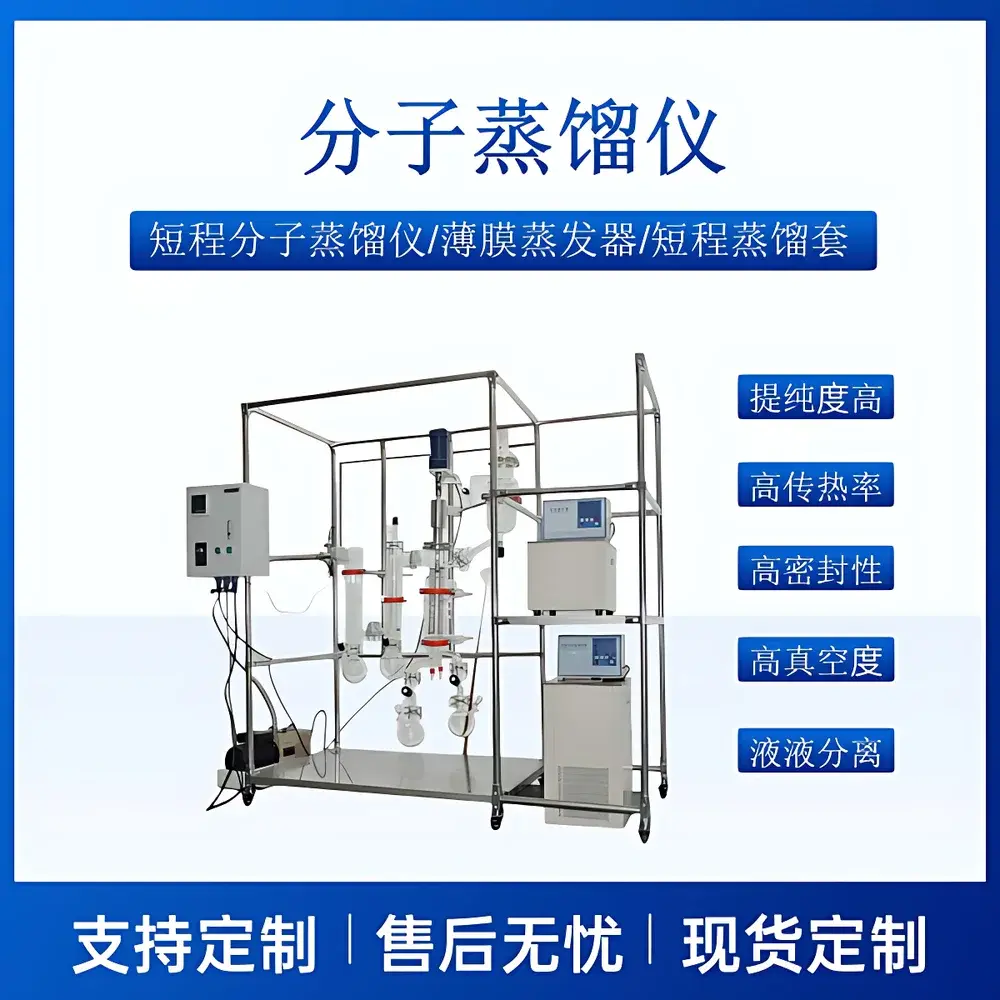
Anyan AYAN-B100 Laboratory-Scale Short-Path Molecular Distillation System
| Brand | Anyan Instruments |
|---|---|
| Origin | Zhejiang, China |
| Model | AYAN-B100 |
| Feed Rate | 0.5–5.0 L/h |
| Effective Evaporation Area | 0.1 m² |
| Evaporator Internal Diameter | 100 mm |
| Condensation Area | 0.25 m² |
| Collection Vessels | 2 (light & heavy fractions) |
| Ultimate Vacuum | <0.1 Pa |
| Heating Temperature Range | Ambient to 200 °C |
| Motor Power | 120 W |
| Max Rotational Speed | ≤450 rpm |
| Film Thickness | <0.5 mm |
Overview
The Anyan AYAN-B100 is a benchtop short-path molecular distillation system engineered for high-efficiency separation of thermally labile, high-boiling, and oxidation-sensitive compounds under ultra-high vacuum conditions. Operating on the principle of molecular free-path evaporation—where mean free path of vapor molecules exceeds the distance between evaporator surface and condenser—the AYAN-B100 enables separation based on differences in molecular weight and vapor pressure rather than boiling point alone. This makes it particularly suited for applications where conventional distillation would induce thermal degradation, polymerization, or decomposition. The system integrates a vertically oriented, rotating wiper-film evaporator with an internal concentric condenser, ensuring minimal residence time (<30 seconds), uniform thin-film formation (<0.5 mm), and high mass-transfer efficiency. Designed for compliance with fundamental requirements of GLP-aligned laboratory workflows, the AYAN-B100 supports traceable, repeatable purification across R&D, pilot-scale process development, and quality control environments.
Key Features
- Ultra-high vacuum capability (<0.1 Pa) achieved via integrated high-vacuum pumping interface—compatible with turbomolecular or diffusion pump systems—to suppress oxidative side reactions and enable low-temperature operation.
- PTFE-coated SS316L wiper blades ensure chemical resistance against aggressive solvents, acids, and oxidizing agents; blade geometry optimized for consistent film renewal and shear-controlled viscosity management.
- Double-jacketed evaporator cylinder with precise temperature control (ambient to 200 °C, ±1 °C accuracy) and independent condenser cooling circuit (typically −10 °C to −40 °C via external chiller).
- Modular dual-collection configuration: two independently controllable receiving flasks (light and heavy fractions) with fluorocarbon O-rings (FKM) for vacuum integrity; optional upgrade to PTFE-sealed ports for HF or strong alkali compatibility.
- Pre-heating feed tank with adjustable setpoint (up to 120 °C) minimizes thermal shock and improves feed viscosity stability prior to film formation.
- Integrated safety interlocks: dry-run protection, overtemperature cutoff, motor phase verification, and vacuum-loss shutdown protocol compliant with IEC 61000-6-2 EMC standards.
Sample Compatibility & Compliance
The AYAN-B100 accommodates a broad spectrum of liquid-phase feedstocks—including crude extracts, solvent residues, polymer oligomers, fatty acid esters, sterols, vitamins (e.g., vitamin A/E acetates), and fragrance intermediates—without requiring pre-treatment or carrier solvents. Its all-wetted surfaces (SS316L + PTFE + borosilicate glass) meet USP Class VI biocompatibility criteria and are compatible with ASTM D2622 (XRF sulfur analysis) sample prep protocols. While not certified for GMP manufacturing use out-of-the-box, the system’s design supports audit-ready documentation: mechanical seal leak rates <1×10⁻⁹ mbar·L/s, vacuum decay testing per ISO 2859-1 sampling plans, and full traceability of calibration records for temperature and pressure sensors (NIST-traceable transducers available as option). It satisfies foundational prerequisites for method validation under USP , ICH Q2(R2), and ISO/IEC 17025 clause 7.7.
Software & Data Management
The AYAN-B100 operates via a dedicated local HMI panel with real-time monitoring of vacuum level, jacket temperature, condenser temperature, rotational speed, and feed flow (when paired with optional Coriolis mass flow sensor). All operational parameters are logged at user-defined intervals (1–60 s) to internal SD card storage (≥16 GB) in CSV format, supporting post-run analysis in MATLAB, Python Pandas, or LabSolutions software. Optional RS485/Modbus RTU or Ethernet/IP connectivity enables integration into centralized SCADA or LIMS platforms. Audit trail functionality—recording operator ID, timestamp, parameter changes, and alarm events—is implemented in accordance with FDA 21 CFR Part 11 Annex 11 principles, including electronic signature support and immutable log archiving.
Applications
- Fine Chemicals: Purification of aromatic oils (e.g., rose oxide, citral), removal of residual monomers from polyetheramine prepolymers, and isolation of chiral intermediates from racemic mixtures.
- Pharmaceuticals: Solvent-free concentration of liposomal suspensions, recovery of heat-labile APIs (e.g., retinoids, prostaglandins), and deacidification of fish oil ethyl esters prior to enzymatic transesterification.
- Food & Nutraceuticals: Deodorization of omega-3 concentrates, fractionation of mixed triglycerides (e.g., MCT/LCT separation), and removal of 3-MCPD esters from refined vegetable oils per EU Regulation (EU) 2018/609.
- Materials Science: Purification of silicone fluid precursors, separation of oligomeric siloxanes, and cleanup of catalyst residues from metallocene-catalyzed polyolefin syntheses.
FAQ
What vacuum level is required for optimal molecular distillation performance?
A base pressure ≤0.1 Pa is recommended to ensure mean free path exceeds 10 cm—critical for unimpeded molecular travel from evaporator to condenser. System configuration (pump type, trap placement, and tubing conductance) must be validated using calibrated capacitance manometers.
Can the AYAN-B100 handle viscous feeds such as crude lanolin or polymer melts?
Yes—provided viscosity remains ≤5000 cP at operating temperature. Pre-heating the feed tank and selecting appropriate wiper blade pitch (standard: 30° helix) enhances film stability. For >10,000 cP feeds, optional high-torque motor (200 W) and heated feed line are advised.
Is the system compatible with corrosive halogenated solvents like chloroform or carbon tetrachloride?
All standard wetted materials (SS316L, PTFE, borosilicate 3.3) resist these solvents; however, prolonged exposure to UV-irradiated CCl₄ may degrade FKM gaskets. We recommend PTFE encapsulated O-rings for extended service life.
How is residue carryover minimized between runs?
The vertical orientation, combined with gravity-assisted drainage and optional in-situ hot nitrogen purge (≤150 °C), reduces hold-up volume to <5 mL. Validation data per ASTM E1847 shows <0.02% cross-contamination for sequential runs of tocopherol and squalene.
Does Anyan provide IQ/OQ documentation packages?
Yes—factory-verified Installation Qualification (IQ) and Operational Qualification (OQ) protocols are available upon request, aligned with ISO 9001:2015 and ASTM E2500-07 guidelines. Performance qualification (PQ) support requires customer-defined acceptance criteria and reference standards.



