
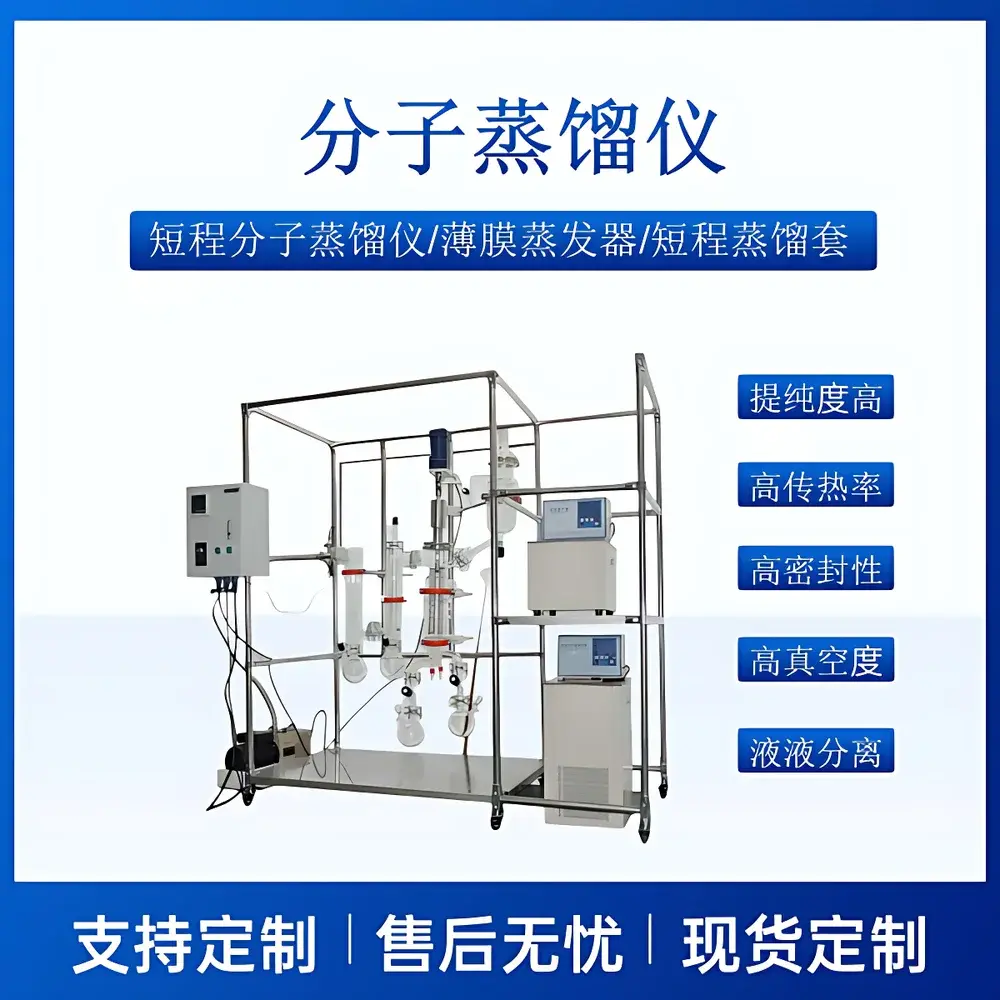
Anyan AYAN-B200 Thin-Film Molecular Distillation System
| Brand | Anyan Instruments |
|---|---|
| Origin | Zhejiang, China |
| Model | AYAN-B200 |
| Feed Flow Rate | 1.5–10 L/h |
| Effective Evaporation Area | 0.35 m² |
| Evaporator Internal Diameter | 200 mm |
| Condensation Area | 0.55 m² |
| Vacuum Level | < 0.1 Pa |
| Heating Temperature Range | Ambient to 200 °C |
| Wiper Material | PTFE + SS316L |
| Sealing | Fluoroelastomer (FKM) Gaskets (optional PTFE) |
| Motor Power | 120 W |
| Max Rotational Speed | ≤450 rpm |
Overview
The Anyan AYAN-B200 Thin-Film Molecular Distillation System is a precision vacuum-based purification instrument engineered for high-efficiency separation of thermally labile, high-boiling, and oxidation-sensitive compounds. Operating under ultra-high vacuum (< 0.1 Pa), it utilizes short-path molecular distillation principles—where mean free path of vapor molecules exceeds the distance between evaporator surface and condenser—enabling selective volatilization based on molecular weight and vapor pressure differentials rather than boiling point alone. Unlike conventional distillation or MVR (Mechanical Vapor Recompression) evaporation systems—which rely on latent heat recovery in bulk-phase boiling—the AYAN-B200 employs a mechanically driven wiper system to generate a uniform, sub-0.5 mm thin liquid film on a heated cylindrical evaporator surface. This ensures minimal thermal exposure (residence time typically < 30 seconds), near-ambient to 200 °C controllable heating, and absence of nucleate boiling or foaming. It is not an MVR device; the reference to MVR in source material reflects a conceptual misalignment—this unit is a dedicated molecular still, not a recompression evaporator. Its design prioritizes reproducibility in laboratory-scale isolation of delicate actives across fine chemical synthesis, natural product extraction, and pharmaceutical intermediate refinement.
Key Features
- Ultra-high vacuum capability (< 0.1 Pa) maintained via integrated dual-stage vacuum pump and leak-tight fluoropolymer-sealed joints, minimizing oxidative degradation of sensitive molecules.
- PTFE- and SS316L-coated rotating wiper assembly ensures chemical inertness and long-term corrosion resistance against aggressive solvents (e.g., chlorinated hydrocarbons, strong acids/bases).
- Precisely controlled heating mantle with PID regulation (±1 °C accuracy) over 0–200 °C range, enabling gentle thermal activation without localized overheating.
- Optimized short-path geometry: 0.35 m² evaporation area paired with 0.55 m² internal condenser surface maximizes condensation efficiency and minimizes back-migration of heavy fractions.
- Modular feed system with optional pre-heating jacket (temperature adjustable up to 100 °C) ensures consistent film formation and reduces thermal shock upon entry.
- Integrated cold trap and external condensation unit prevent volatile contaminants from reaching the vacuum pump and enhance solvent recovery yield.
- Compliant with GLP documentation requirements: all critical parameters (vacuum, temperature, rotation speed, feed rate) are monitorable and loggable via analog/digital interfaces.
Sample Compatibility & Compliance
The AYAN-B200 accommodates viscous, non-Newtonian, and particulate-laden feedstocks—including crude plant extracts, polymer melts, fatty acid esters, and pharmaceutical reaction mixtures—provided viscosity remains below 50,000 cP at processing temperature. Its PTFE/SS316L wetted path meets USP Class VI biocompatibility criteria for extractables/leachables. The system supports ASTM D2872 (standard test method for distillation of petroleum products) and ISO 11348 (water quality—determination of inhibition of light emission of Vibrio fischeri) sample preparation workflows. For regulated environments, optional audit-trail-enabled data logging complies with FDA 21 CFR Part 11 requirements when paired with validated third-party software. All elastomeric seals conform to FDA 21 CFR 177.2600 for repeated-use food-contact applications.
Software & Data Management
While the base AYAN-B200 operates via analog controls (manual vacuum valve, dial-based temperature setpoint, mechanical speed regulator), it features standardized 0–10 V / 4–20 mA signal outputs for integration into LabVIEW, DeltaV, or custom SCADA platforms. Optional digital control module (sold separately) provides real-time parameter display, programmable ramp-hold profiles, event-triggered data capture (sample timestamp, vacuum drift, temperature deviation > ±2 °C), and CSV export for traceability. All logged data include operator ID, session ID, and instrument serial number—supporting ALCOA+ (Attributable, Legible, Contemporaneous, Original, Accurate, Complete, Consistent, Enduring, Available) principles required under GMP/GLP audits.
Applications
- Fine Chemicals: Purification of fragrance aldehydes (e.g., lilial, helional), monoglyceride emulsifiers, and epoxy soybean oil stabilizers.
- Pharmaceuticals: Isolation of vitamin E acetate from tocopherol mixtures, removal of residual catalysts from API intermediates, and deacidification of omega-3 concentrates prior to encapsulation.
- Food & Nutraceuticals: Deodorization of fish oil ethyl esters, fractionation of mixed triglycerides (e.g., MLM-type structured lipids), and removal of 3-MCPD esters from refined palm olein.
- Materials Science: Solvent recovery from graphene oxide dispersions, purification of silicone oligomers, and dewaxing of bio-based lubricants.
- Environmental Analysis: Concentration of persistent organic pollutants (POPs) from sediment extracts prior to GC-MS analysis per EPA Method 1613.
FAQ
Is the AYAN-B200 compatible with corrosive solvents such as chloroform or trifluoroacetic acid?
Yes—wetted components use PTFE-coated SS316L wipers and FKM gaskets; for extended exposure to halogenated solvents, we recommend upgrading to perfluoroelastomer (FFKM) seals and verifying compatibility with our chemical resistance chart.
Can this system be validated for GMP manufacturing use?
The base unit supports IQ/OQ protocols; full PQ validation requires integration with qualified data acquisition software, calibrated traceable sensors, and documented change control procedures per Annex 15.
What vacuum pump specifications are recommended for achieving < 0.1 Pa?
A two-stage oil-sealed rotary vane pump (ultimate vacuum ≤ 5×10⁻² Pa) coupled with a secondary turbomolecular pump (pumping speed ≥ 300 L/s for N₂) is required. Pump oil must be low-vapor-pressure perfluoropolyether (PFPE) type.
Does the system include provisions for fractional collection of multiple distillates?
Yes—modular collector flanges accept up to three independently cooled receiving flasks; optional motorized fraction collector (AYAN-FC200) enables timed or temperature-triggered switching.
How is film thickness controlled during operation?
Film thickness is governed by feed rate, rotor speed, liquid viscosity, and wiper geometry—not manually adjusted. Optimal film formation (typically 0.1–0.4 mm) is achieved empirically via feed rate calibration and verified by visual inspection through borosilicate sight glasses.



