
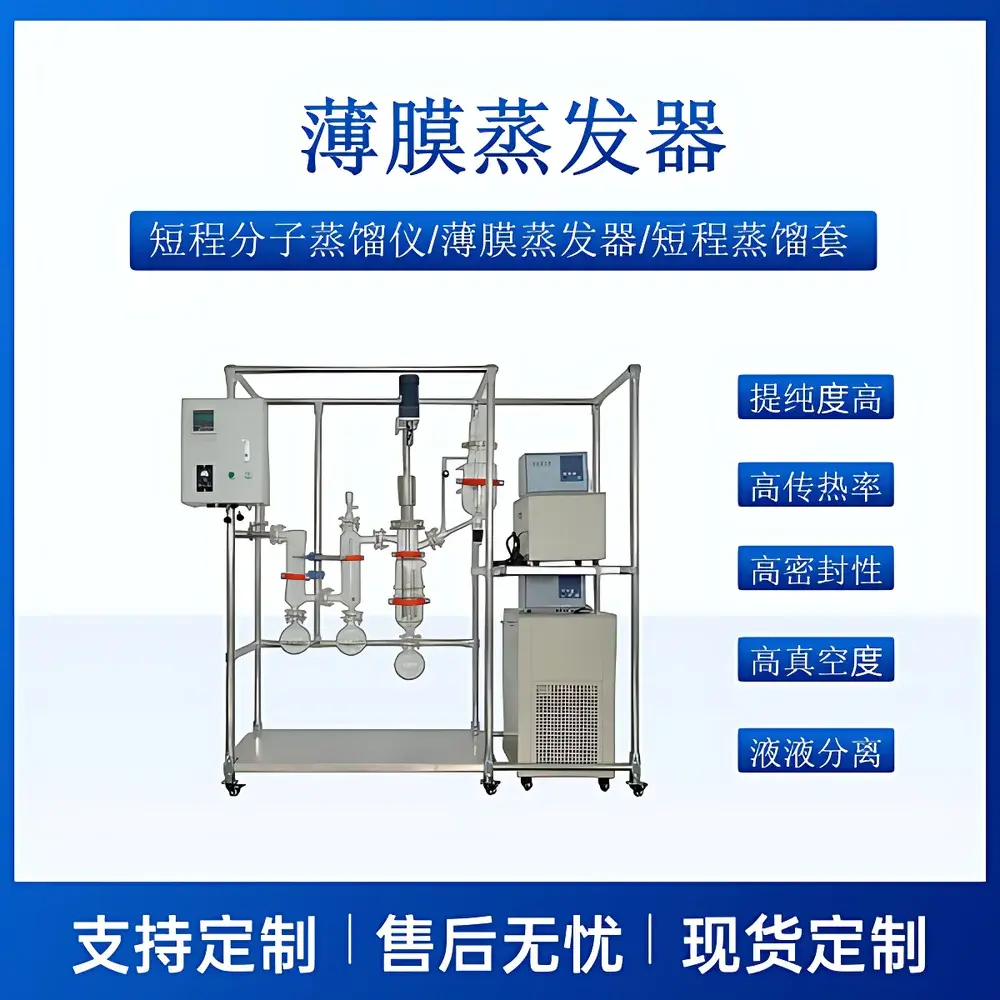
Anyan AYAN-B80 Wiped-Film Molecular Distillation System
| Brand | Anyan Instruments |
|---|---|
| Origin | Zhejiang, China |
| Model | AYAN-B80 |
| Feed Rate | 0.5–4.0 L/h |
| Effective Evaporation Area | 0.1 m² |
| Evaporator Internal Diameter | 80 mm |
| Condensation Area | 0.15 m² |
| Light Fraction Collection Flask | 1 L |
| Vacuum Level (Empty) | <10 Pa |
| Heating Temperature Range | Ambient to 200 °C |
| Max Rotational Speed | ≤450 rpm |
| Motor Power | 120 W |
| Construction Materials | SS316L + PTFE Wiper Blades |
| Sealing | Fluoroelastomer (FKM) Gaskets (optional PTFE upgrade) |
Overview
The Anyan AYAN-B80 Wiped-Film Molecular Distillation System is a precision-engineered laboratory-scale molecular distillation apparatus designed for high-efficiency separation of thermally sensitive, high-boiling-point, and oxidation-prone compounds under ultra-high vacuum conditions. Operating on the fundamental principle of molecular mean free path differential—where lighter molecules travel farther than heavier ones before collision—the AYAN-B80 enables selective condensation of volatile components on a cooled surface positioned within the mean free path distance. This non-equilibrium, short-residence-time process avoids bulk boiling, eliminating foaming, thermal degradation, and decomposition commonly associated with conventional distillation. The system is optimized for applications requiring purity levels unattainable via fractional or vacuum distillation, including isolation of natural actives, polymer intermediates, and high-value lipids. Its wiped-film geometry ensures uniform liquid distribution, sub-0.5 mm film thickness, and rapid heat transfer—critical for maintaining compound integrity during processing.
Key Features
- Ultra-high vacuum capability: Achieves 1.
- PTFE- and SS316L-coated wiper assembly: Chemically resistant to aggressive solvents, fatty acids, and oxidizing agents; maintains mechanical stability at elevated temperatures up to 200 °C.
- Precision temperature control: Independent heating jacket with PID regulation (ambient to 200 °C) and integrated cooling circuit for condenser surface (typically −10 to 5 °C).
- Modular design: Standardized ISO-KF vacuum flanges (DN25/DN40) allow seamless integration with external vacuum pumps, cold traps, and analytical interfaces.
- Short residence time: Typical material dwell time <30 seconds—minimizing thermal stress on labile compounds such as vitamins A/E, unsaturated fatty acids, and sterols.
- Leak-tight sealing: Dual-seal configuration using fluorocarbon (FKM) elastomer gaskets; optional perfluoroelastomer (FFKM) or molded PTFE seals available for HF/HCl/strong oxidizer compatibility.
- Scalable architecture: Part of a validated series (AYAN-B80 to AYAN-B220); B80 serves as a robust platform for method development prior to pilot-scale translation.
Sample Compatibility & Compliance
The AYAN-B80 accommodates viscous liquids (up to 5,000 cP), suspensions, and heat-sensitive feedstocks without pre-dilution. It is routinely deployed in purification of fish oil concentrates (EPA/DHA enrichment), lanolin derivatives, fragrance isolates, pharmaceutical intermediates (e.g., amino acid esters, glycosides), and synthetic lubricant precursors. All wetted parts comply with USP Class VI biocompatibility requirements for extractables testing. While not certified to ISO 9001 or CE for industrial deployment, the system’s construction adheres to ASTM E2654-18 guidelines for laboratory vacuum equipment safety and performance verification. Vacuum integrity meets ASTM D2879-17 criteria for low-pressure distillation validation. For regulated environments (e.g., GLP-compliant labs), optional data logging modules support 21 CFR Part 11–compliant audit trails when paired with validated third-party software.
Software & Data Management
The AYAN-B80 operates via an embedded microcontroller with local LCD interface for real-time monitoring of vacuum level (capacitance manometer), heater temperature, rotational speed, and condenser coolant temperature. Optional RS485/Modbus RTU output enables integration into LabVIEW, MATLAB, or SCADA systems for automated parameter logging. Raw sensor data is timestamped and exportable as CSV for post-processing. No proprietary cloud platform is included; all firmware updates are delivered via USB flash drive to ensure air-gapped security in classified or regulated laboratories. System diagnostics include vacuum leak rate calculation, motor current profiling, and thermal gradient mapping across the evaporator wall—supporting preventive maintenance scheduling per ISO/IEC 17025:2017 Clause 6.4.10.
Applications
- Natural product isolation: Vitamin A/E recovery from fish liver oil; tocopherol purification from soybean distillates; astaxanthin concentration from Haematococcus biomass.
- Pharmaceutical synthesis: Removal of residual solvents (e.g., DMF, THF) from API intermediates; chiral separation of racemic alcohols via derivatization-coupled distillation.
- Food & nutraceuticals: Deacidification of edible oils; concentration of omega-3 ethyl esters; fractionation of mixed triglyceride streams.
- Polymer chemistry: Purification of monomers (e.g., caprolactam), oligomers, and silicone fluid precursors without catalyst contamination.
- Environmental analysis: Pre-concentration of persistent organic pollutants (POPs) from sediment extracts prior to GC-MS analysis.
FAQ
What vacuum pump is recommended for optimal performance?
A two-stage oil-sealed rotary vane pump (ultimate vacuum ≤0.1 Pa) combined with a liquid nitrogen cold trap is advised. For solvent-laden feeds, a dry scroll pump with hydrocarbon-resistant diaphragm may be substituted to avoid oil backstreaming.
Can the AYAN-B80 handle solid-containing feeds?
Yes—provided solids content remains below 5 wt% and particle size is <50 µm. Optional inline filtration (5–10 µm stainless steel sintered filter) is available upstream of the feed valve.
Is the system compatible with reactive gases (e.g., N₂, Ar) purging?
Yes. A dedicated gas inlet port (SS316, 1/4″ NPT) allows inert atmosphere blanketing during startup/shutdown to prevent oxidation of oxygen-sensitive fractions.
How is calibration traceability maintained?
Temperature sensors are factory-calibrated against NIST-traceable standards (±0.5 °C accuracy). Vacuum transducers include certificate of calibration valid for 12 months; users may perform field verification using a secondary capacitance manometer.
What maintenance intervals are specified for the wiper assembly?
PTFE wipers require replacement after 500 operational hours or upon visible wear (edge rounding >0.1 mm); SS316L shaft bearings are rated for 10,000 hours under continuous 300 rpm operation.



