
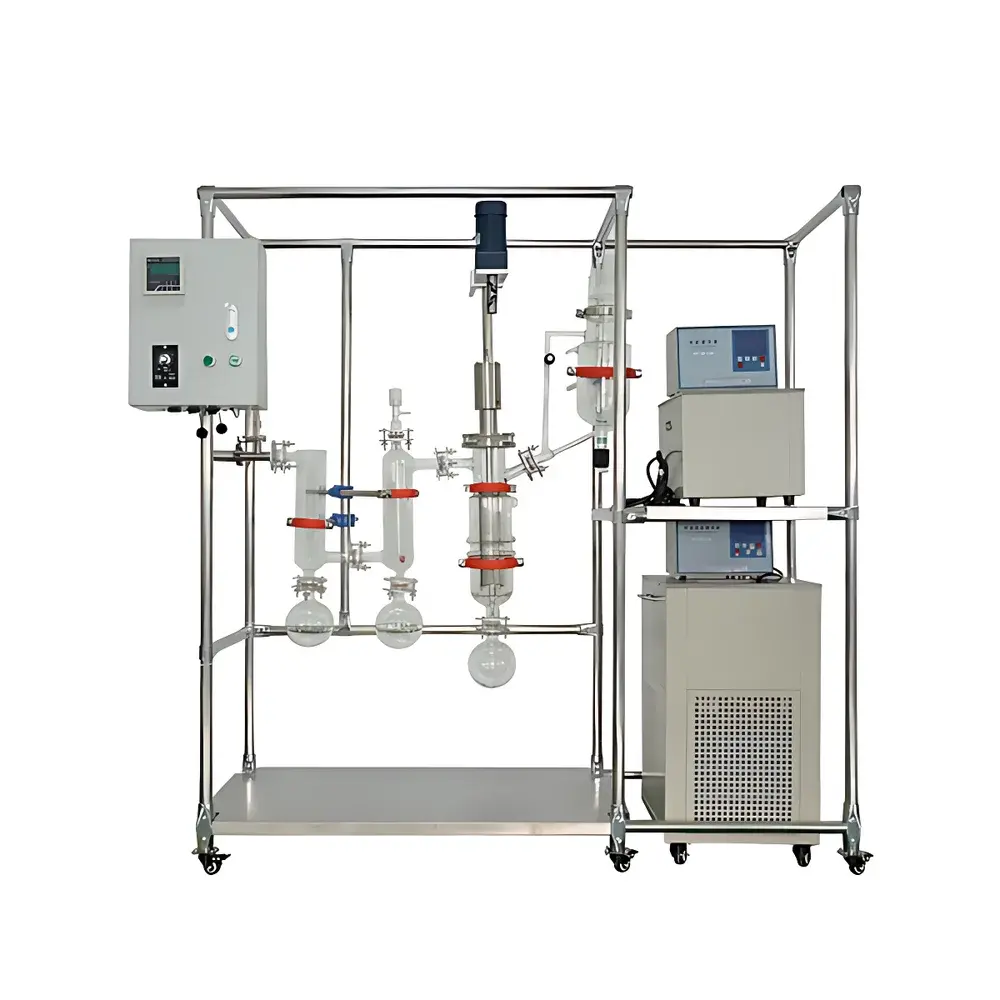
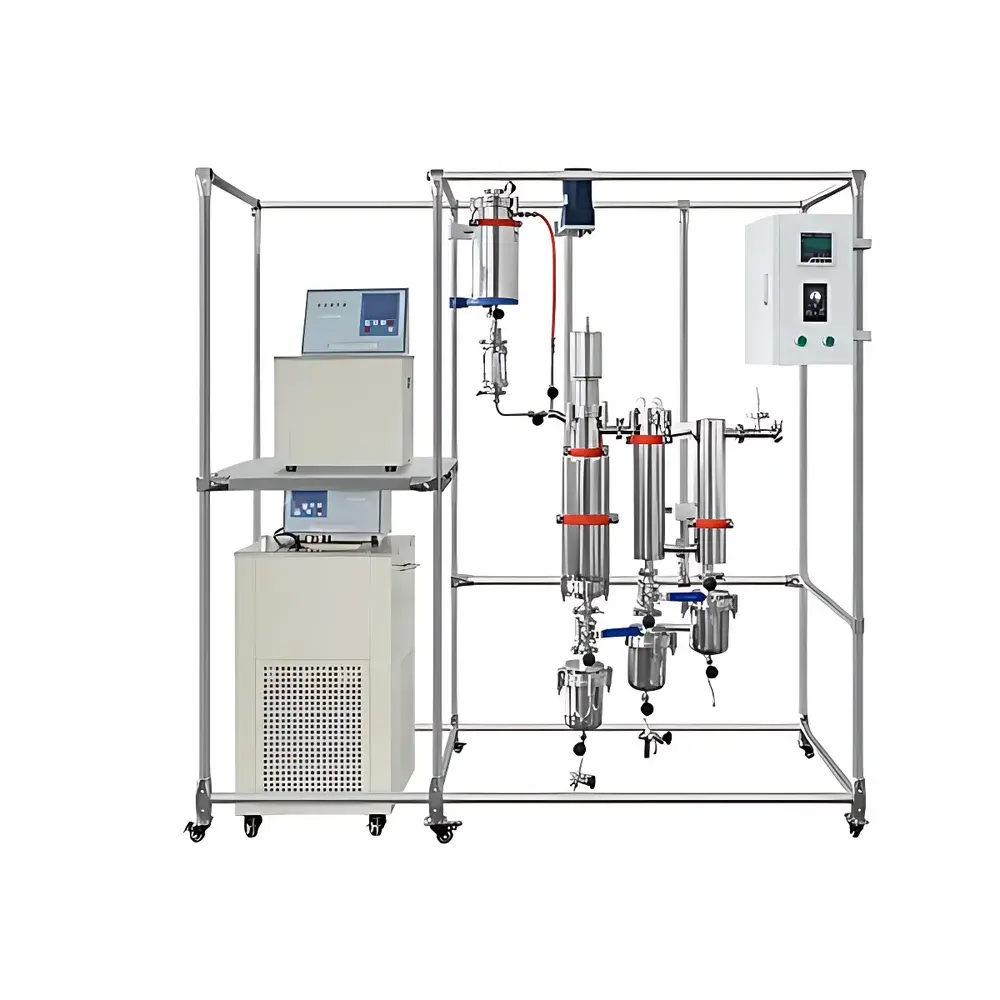
ANYAN AYAN-F220-S Stainless Steel Molecular Distillation System
| Brand | ANYAN |
|---|---|
| Model | AYAN-F220-S |
| Construction Material | 304/316L stainless steel |
| Effective Evaporation Area | 0.5 m² |
| Evaporator Inner Diameter | 300 mm |
| Condensation Area | 0.65 m² |
| Feed Capacity | 5 L (customizable) |
| Number of Collecting Flasks | 2 |
| Operating Vacuum | <10 Pa |
| Heating Temperature Range | Ambient to 200 °C |
| Motor Power | 200 W |
| Max Rotational Speed | ≤450 rpm |
| Cold Trap | Integrated |
| External Condenser | Optional |
| Cooling System | Built-in |
Overview
The ANYAN AYAN-F220-S Stainless Steel Molecular Distillation System is an industrial-grade, high-vacuum short-path distillation instrument engineered for the gentle, high-efficiency separation of thermolabile and high-boiling-point compounds. Operating under ultra-high vacuum conditions (<10 Pa), it exploits the fundamental principle of molecular distillation—where separation is governed by differences in molecular mean free path rather than relative volatility. In this regime, light molecules evaporate from a heated surface and travel directly to a cooled condensing surface positioned within their mean free path (typically <10 cm), while heavier molecules remain in the residue phase due to insufficient kinetic energy and longer collision-free trajectories. This physical separation mechanism avoids thermal degradation, making the system particularly suitable for isolating bioactive constituents from botanical extracts—including essential oils, phospholipids, polyphenols, tocopherols, and unsaturated fatty acids—without chemical alteration or decomposition.
Key Features
- Robust 304/316L stainless steel construction ensures long-term corrosion resistance, structural integrity, and compliance with hygienic design standards for pharmaceutical and nutraceutical processing.
- Optimized short-path geometry with 300 mm evaporator inner diameter and 0.5 m² effective evaporation area enables uniform thin-film formation and rapid heat transfer under high vacuum.
- Polytetrafluoroethylene (PTFE)-sealed rotary feed and wiper assembly maintains leak-tight integrity at pressures down to 0.1 Pa, supporting reproducible operation across extended batch cycles.
- Automated feed control and dual-flask collection system (two independently controllable receiving vessels) allow sequential fractionation and real-time process monitoring without manual intervention.
- Integrated cold trap and built-in chiller system ensure stable condensation performance across the full operating temperature range (ambient to 200 °C), minimizing backstreaming and maximizing light-fraction recovery.
- Variable-speed wiper motor (0–450 rpm) permits precise adjustment of film thickness and residence time, critical for optimizing separation selectivity and yield in complex natural product matrices.
Sample Compatibility & Compliance
The AYAN-F220-S accommodates viscous, heat-sensitive, and high-molecular-weight feedstocks including crude plant extracts, fish oil concentrates, lanolin derivatives, and synthetic intermediates. Its all-metal wetted path and PTFE-sealed interfaces meet material compatibility requirements for USP Class VI and FDA-regulated applications. The system supports GLP-compliant documentation workflows when integrated with external data loggers or validated SCADA systems. While not intrinsically 21 CFR Part 11 compliant, its operational parameters (temperature, vacuum, rotation speed, feed rate) are fully recordable and traceable—enabling audit-ready process validation per ISO 22000, ASTM D6304 (vacuum distillation), and ICH Q5C stability guidelines.
Software & Data Management
The system operates via a programmable digital controller with local HMI interface, offering preset profiles for common separation protocols (e.g., vitamin A enrichment, CBD isolation, lecithin purification). All critical process variables—including evaporator temperature, condenser temperature, vacuum level, wiper speed, and feed pump rate—are continuously monitored and logged with timestamped entries. Optional RS485/Modbus RTU output allows integration into centralized laboratory information management systems (LIMS) or MES platforms for automated data archiving, trend analysis, and electronic batch record generation. Raw sensor data export (CSV format) facilitates post-run statistical evaluation using JMP, Minitab, or Python-based analytical pipelines.
Applications
- Purification of omega-3 fatty acid ethyl esters (EPA/DHA) from marine oils with minimal cis-trans isomerization.
- Isolation of standardized monoterpenes and sesquiterpenes from citrus and conifer extracts for fragrance and pharmaceutical use.
- Deacidification and deodorization of edible oils and biodiesel feedstocks without stripping natural antioxidants.
- Recovery of high-purity tocopherol fractions from soybean distillates for nutraceutical formulation.
- Preparative-scale separation of alkaloids and flavonoid glycosides from traditional herbal decoctions under non-oxidative conditions.
- Recycling of thermal stabilizers and plasticizers from polymer waste streams via low-residence-time fractionation.
FAQ
What vacuum level is required for optimal molecular distillation performance?
A stable base pressure below 10 Pa is required; the system achieves this using a two-stage vacuum pump configuration (rotary vane + diffusion or dry scroll) and includes a calibrated Pirani/capacitance manometer for real-time verification.
Can the AYAN-F220-S be used for continuous processing?
It is configured for semi-batch operation with automated feed and collection; continuous mode requires external peristaltic feed control and PLC synchronization, which can be implemented via optional I/O expansion modules.
Is the evaporator surface heated uniformly?
Yes—the jacketed evaporator uses silicone oil circulation with PID-controlled heating, ensuring radial and axial temperature uniformity within ±1.5 °C across the 0.5 m² surface.
How is film thickness controlled during operation?
Film thickness is dynamically regulated by the rotating wiper blade speed and feed rate; typical operational range is 0.1–0.5 mm, adjustable via motor frequency inverter and calibrated peristaltic dosing.
Does the system support cleaning-in-place (CIP) procedures?
While not fully CIP-certified, the open-access design, smooth-welded stainless steel surfaces, and absence of dead-leg piping enable efficient manual or semi-automated cleaning using ethanol, acetone, or dilute nitric acid solutions per SOP-defined protocols.



