
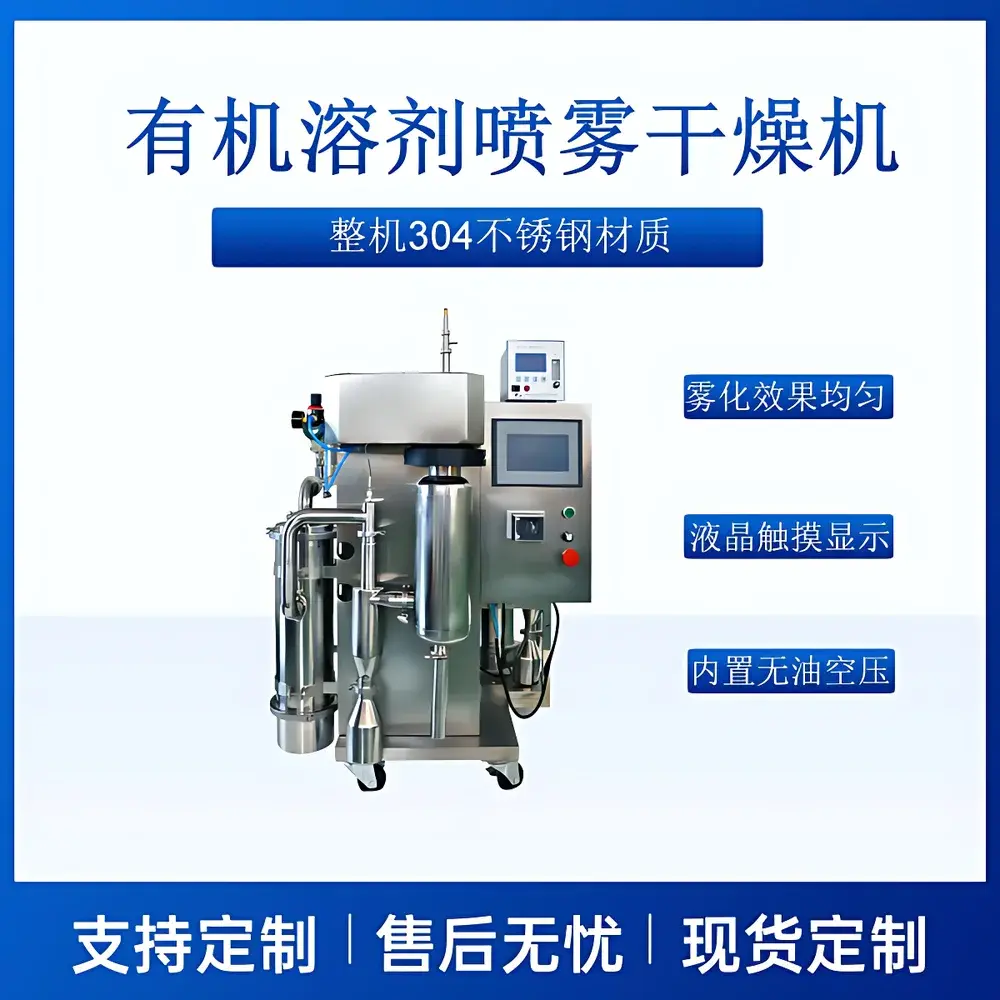
ANYAN CY-8000YT Closed-Loop Organic Solvent Spray Dryer for Laboratory Use
| Brand | ANYAN (Hangzhou Anyan Instrument Co., Ltd.) |
|---|---|
| Origin | Zhejiang, China |
| Model | CY-8000YT |
| Sample Compatibility | Aqueous & organic solvent-based solutions, suspensions, emulsions |
| Max. Feed Rate | 20–1000 mL/h (rated capacity: 1500 mL/h) |
| Temperature Range | 0–250 °C |
| Vacuum Range | −0.05 to −0.06 MPa |
| Heating Control Accuracy | ±1 °C (PID-regulated) |
| Nozzle Orifices | 0.7, 1.0, 1.5, 2.0 mm (interchangeable) |
| Minimum Sample Volume | 50 mL |
| Power Supply | 5.8 kW / 380 V |
| Dimensions (W×D×H) | 850 × 1000 × 1650 mm |
| Particle Size Distribution | Normal (Gaussian), optimized for flowability and reconstitution |
Overview
The ANYAN CY-8000YT is a benchtop closed-loop spray dryer engineered specifically for safe, reproducible drying of heat-sensitive, oxidation-prone, and volatile organic solvent-based feedstocks in research laboratories. Unlike conventional open-atmosphere spray dryers, this system operates under controlled vacuum conditions (−0.05 to −0.06 MPa) and integrates an inert gas (typically nitrogen) recirculation loop—eliminating explosion hazards while preserving molecular integrity of active pharmaceutical ingredients (APIs), natural extracts, polymers, and nanocarriers. Its core drying mechanism relies on two-fluid nozzle atomization: compressed gas shears liquid feed into fine droplets (<10–50 µm median diameter), which are rapidly dehydrated upon contact with precisely temperature-regulated heated gas in the drying chamber. The resulting powder exhibits narrow particle size distribution, high bulk density, and excellent redispersibility—attributes critical for downstream formulation development and analytical characterization.
Key Features
- Vacuum-assisted low-temperature drying: Enables processing at inlet air temperatures as low as 40 °C while maintaining effective solvent removal—ideal for thermolabile compounds including peptides, enzymes, and essential oils.
- Closed-loop nitrogen circulation: Fully sealed gas path with integrated condenser and oxygen sensor ensures <1% O₂ residual concentration; meets NFPA 484 and ATEX Zone 2 compliance prerequisites for Class I, Division 1 solvent handling.
- PID-controlled thermal management: Real-time feedback regulation across full 0–250 °C range delivers ±1 °C stability—essential for method transfer and GLP-compliant process validation.
- Modular dual-fluid stainless-steel nozzle: Interchangeable orifices (0.7–2.0 mm) allow optimization of droplet Sauter mean diameter (SMD) and specific surface area without hardware replacement.
- Automated needle clearing system: Programmable tungsten-carbide通针 (cleaning pin) prevents nozzle clogging during continuous operation with viscous or particulate-laden feeds.
- Integrated oil-free scroll compressor: Eliminates hydrocarbon contamination risk; certified per ISO 8573-1 Class 0 for instrument air purity.
- Full-touch HMI with data logging: Chinese-language interface supports recipe storage, parameter recall, and time-stamped event logging—compatible with 21 CFR Part 11 audit trail requirements when paired with optional software license.
Sample Compatibility & Compliance
The CY-8000YT accommodates aqueous solutions, ethanol/methanol/acetone/acetonitrile-based formulations, polymer dispersions (e.g., PLGA, chitosan), colloidal suspensions, and nanoemulsions. It has been validated for use with USP sterile powder intermediates and complies with ISO 22000 food-grade material contact standards (316L SS wetted parts). Vacuum operation satisfies ASTM E2912–22 guidelines for flammable solvent drying safety protocols. All electrical components meet CE EN 61000-6-3 EMC and EN 61000-6-4 immunity standards. Optional IQ/OQ documentation packages available for GMP-regulated environments.
Software & Data Management
The embedded controller records temperature profiles, vacuum pressure, feed rate, and nozzle backpressure at 1-second intervals. Exportable CSV files support post-run statistical analysis (e.g., ANOVA of residual moisture vs. inlet T). When connected to ANYAN’s optional LabLink Pro software (Windows-based), users gain remote monitoring, multi-unit fleet synchronization, electronic signature workflows, and automated report generation aligned with ALCOA+ data integrity principles. Audit trails include operator ID, timestamp, parameter change history, and reason-for-change fields—fully traceable for FDA inspection readiness.
Applications
- Pharmaceutical R&D: Preparation of amorphous solid dispersions, inhalable dry powders (DPI), and nanoparticle-loaded microparticles for preclinical PK/PD studies.
- Natural product stabilization: Encapsulation of anthocyanins, curcuminoids, and omega-3 fatty acids to enhance shelf-life and bioavailability.
- Materials science: Synthesis of battery cathode precursors (e.g., LiCoO₂), MOF nanoparticles, and catalyst supports with controlled morphology.
- Food & nutraceuticals: Gentle drying of probiotics, vitamins, and enzyme blends without activity loss.
- Academic teaching: Hands-on demonstration of mass/heat transfer fundamentals, residence time distribution, and scale-up correlations (e.g., dimensionless numbers: Re, Pr, Sc).
FAQ
Can the CY-8000YT handle chlorinated solvents such as dichloromethane or chloroform?
Yes—provided the optional corrosion-resistant condenser and Hastelloy C-276 nozzle insert are specified at time of order. Standard configuration is rated for alcohols, ketones, and esters only.
Is nitrogen consumption rate documented for lifecycle cost estimation?
At steady-state operation with 1500 mL/h feed and 80 °C inlet T, typical N₂ make-up is 0.8–1.2 L/min depending on solvent volatility and vacuum setpoint.
Does the system support continuous fraction collection?
No—it is batch-mode only. For sequential fractionation, integration with external cyclonic separators or electrostatic precipitators requires custom engineering consultation.
What maintenance intervals are recommended for the oil-free compressor?
Compressor service is required every 6,000 operating hours; filter elements should be replaced quarterly under continuous use.
Can particle size be correlated to nozzle orifice and feed concentration?
Empirically, SMD scales linearly with orifice diameter and inversely with square root of solution viscosity—validated reference curves are included in the user manual for common solvent systems.



