
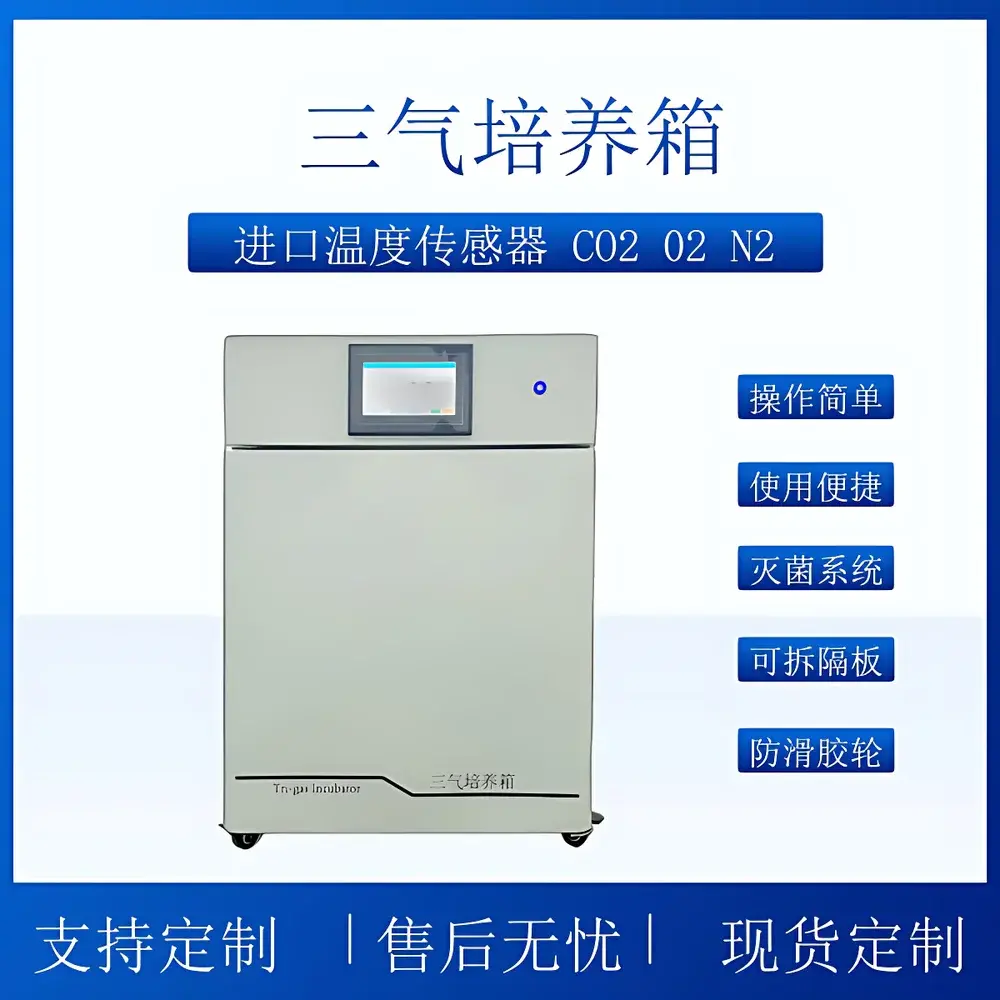
ANYAN CYSQ-80-III Tri-Gas Incubator with Hypoxic O₂ Control (1–95% vol)
| Brand | ANYAN |
|---|---|
| Origin | Zhejiang, China |
| Model | CYSQ-80-III |
| Chamber Volume | 80 L |
| Temperature Range | +3 to +60 °C |
| Temperature Uniformity | ±0.3 °C (@37 °C) |
| Temperature Stability | ±0.2 °C (@37 °C) |
| CO₂ Range | 0–20 % vol, Accuracy: ±0.1 % |
| O₂ Range | 1–95 % vol, Accuracy: ±0.3 % |
| Humidity | ≥90 % RH (passive water-jacket evaporation, uncontrolled) |
| Gas Control Method | IR sensor for CO₂ |
| Sterilization | UV lamp |
| Display | 5.0-inch capacitive touchscreen |
| Dimensions (W×D×H) | 640 × 650 × 1040 mm |
| Power Consumption | 400 W |
| Compliance | Designed for GLP-compliant cell culture workflows |
Overview
The ANYAN CYSQ-80-III is a precision-engineered tri-gas incubator designed for reproducible hypoxic, normoxic, and hyperoxic cell culture environments. It actively regulates three critical atmospheric parameters—temperature, carbon dioxide (CO₂), and oxygen (O₂)—within a sealed, stainless-steel chamber to emulate physiologically relevant conditions for primary cells, stem cells, tumor spheroids, and anaerobic or microaerophilic microorganisms. Unlike standard CO₂-only incubators, the CYSQ-80-III employs dual independent gas control loops: an infrared (IR) absorption sensor for real-time CO₂ quantification and a calibrated electrochemical O₂ sensor for high-fidelity oxygen modulation down to 1% vol. This architecture enables stable low-oxygen operation—essential for modeling ischemic tissue, cancer metabolism, placental development, and HIF-1α pathway studies—without cross-interference between gas subsystems. The unit operates on a gas-mixing principle: nitrogen (N₂) and oxygen (O₂) are metered separately into the CO₂-augmented air stream, allowing dynamic, closed-loop adjustment of O₂ partial pressure while maintaining target CO₂ concentration. Temperature is maintained via a six-sided heating jacket (five wall surfaces + door) with PT100 platinum resistance sensors, minimizing thermal gradients and mitigating ambient drift.
Key Features
- Independent dual-sensor gas regulation: IR-based CO₂ detection (0–20 % vol, ±0.1 % accuracy) and electrochemical O₂ sensing (1–95 % vol, ±0.3 % accuracy)
- Six-zone temperature control architecture with distributed PT100 sensors ensures chamber uniformity of ±0.3 °C at 37 °C
- Passive humidity maintenance via 304 stainless-steel evaporative water pan (≥90 % RH, non-regulated)
- UV sterilization module with programmable exposure cycles for routine decontamination
- Intelligent airflow management: micro-circulation system mimics natural convection, reducing gas recovery time after door opening by >40 % vs. static-air designs
- Fail-safe thermal protection: dual independent overtemperature cutoffs—digital controller limit and hardware-based relay—complying with IEC 61000-4-5 surge immunity standards
- 5.0-inch industrial-grade capacitive touchscreen interface with multi-level user access (operator, technician, administrator)
- Gas-saving logic: automatic suspension of circulation fan and closure of pneumatic valves upon door opening to minimize gas loss and external contamination ingress
Sample Compatibility & Compliance
The CYSQ-80-III supports a broad spectrum of biological samples including adherent and suspension mammalian cell lines (e.g., HeLa, A549, iPSCs), primary neurons, organoids, bacterial cultures requiring microaerophilic conditions (e.g., H. pylori, C. jejuni), and mesenchymal stem cells under hypoxia (1–5 % O₂). Its construction meets ISO 13408-1 requirements for sterility assurance in biopharmaceutical manufacturing environments and aligns with ASTM E1907 guidelines for environmental control in cell-based assay development. While not certified for GMP production, its logging-capable controller and traceable calibration records support GLP-compliant documentation per FDA 21 CFR Part 11 when paired with validated third-party data archiving software. Chamber interior is electropolished 304 stainless steel with radius-curved corners to prevent microbial harborage and facilitate cleaning validation.
Software & Data Management
The embedded controller logs timestamped temperature, CO₂, and O₂ values at user-defined intervals (1–60 min) to internal flash memory (≥12 months of continuous data at 10-min intervals). Export is supported via USB 2.0 port in CSV format for integration with LIMS or ELN platforms. Audit trail functionality records all parameter changes, door events, sterilization cycles, and alarm triggers with operator ID tagging—enabling full traceability for regulatory review. Optional RS485 Modbus RTU interface permits integration into centralized facility monitoring systems (e.g., Siemens Desigo, Schneider EcoStruxure). Firmware updates are performed offline via encrypted firmware packages to maintain cybersecurity integrity.
Applications
- Hypoxia research: long-term culture of cancer cell lines under 1–5 % O₂ to study angiogenesis, metabolic reprogramming, and treatment resistance
- Stem cell expansion: maintenance of pluripotency in human embryonic stem cells (hESCs) and induced pluripotent stem cells (iPSCs) at physiological O₂ (2–5 %)
- Microbiology: cultivation of fastidious pathogens requiring precise O₂ tension, including Helicobacter pylori (5–10 % O₂) and Prevotella melaninogenica (anaerobic with trace O₂)
- Tissue engineering: co-culture systems where stromal and epithelial compartments require differential O₂ gradients
- Drug discovery: phenotypic screening under pathologically relevant gas conditions to improve translational predictivity
- Toxicology assays: assessment of mitochondrial toxicity under variable respiratory chain inhibition states
FAQ
What is the minimum achievable O₂ concentration, and how is stability maintained at low levels?
The CYSQ-80-III achieves stable setpoints as low as 1 % O₂ vol using high-purity N₂ (≥99.999 %) as the diluent gas. Stability is ensured by real-time electrochemical feedback, proportional-integral (PI) control algorithm, and minimized chamber dead volume.
Does the incubator support automated humidity control?
No. Humidity is maintained passively via a stainless-steel water reservoir; relative humidity remains ≥90 % RH under standard operating conditions but is not actively regulated or displayed.
Is the UV sterilization cycle validated for mycoplasma reduction?
UV-C irradiation (254 nm) delivers ≥10 mJ/cm² surface dose per 30-minute cycle, achieving ≥4-log reduction of common mycoplasma strains (e.g., M. orale, M. hyorhinis) on exposed stainless-steel surfaces per ISO 15216-1.
Can the unit be integrated into a building management system (BMS)?
Yes—via optional RS485 Modbus RTU interface for remote status monitoring, alarm relay output, and basic parameter readout (temperature, CO₂, O₂, door state).
What calibration documentation is provided with shipment?
Each unit ships with a factory calibration certificate covering PT100 temperature sensors, IR CO₂ sensor, and electrochemical O₂ sensor, traceable to NIST standards. Calibration intervals are recommended annually or after major maintenance.





