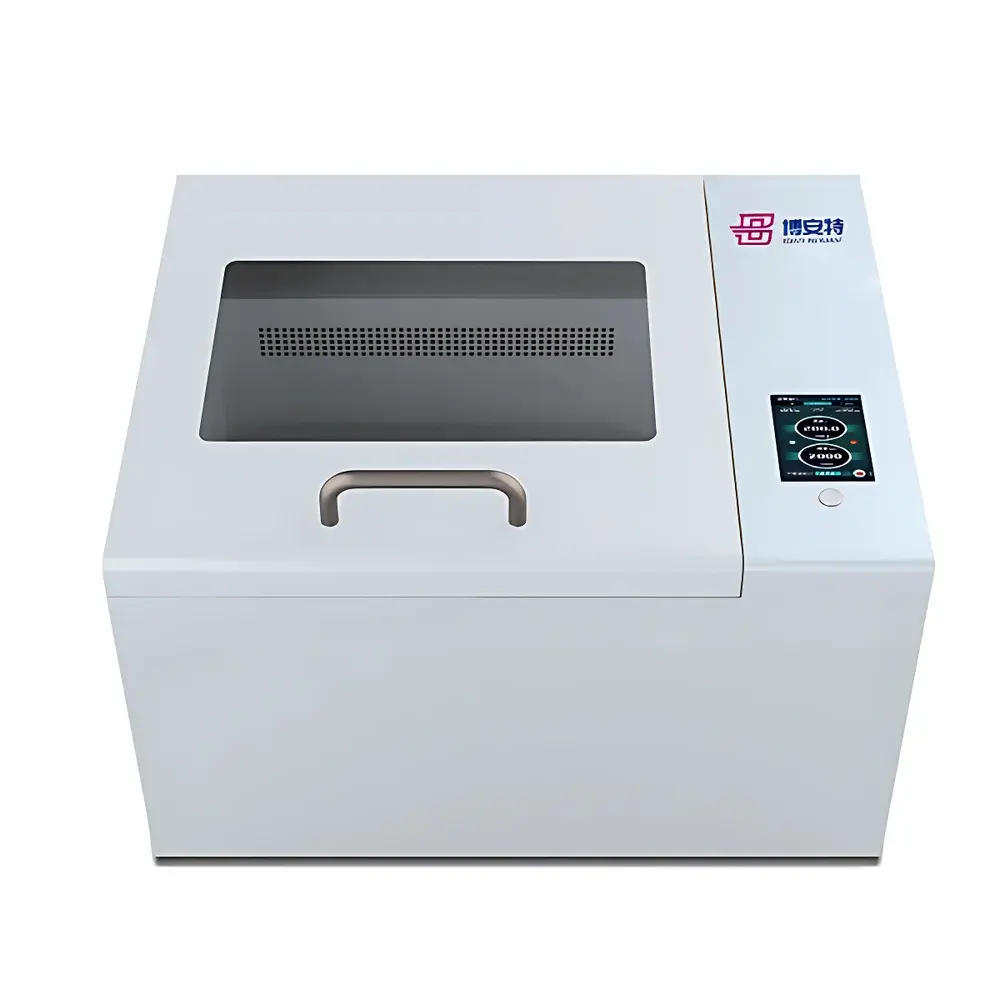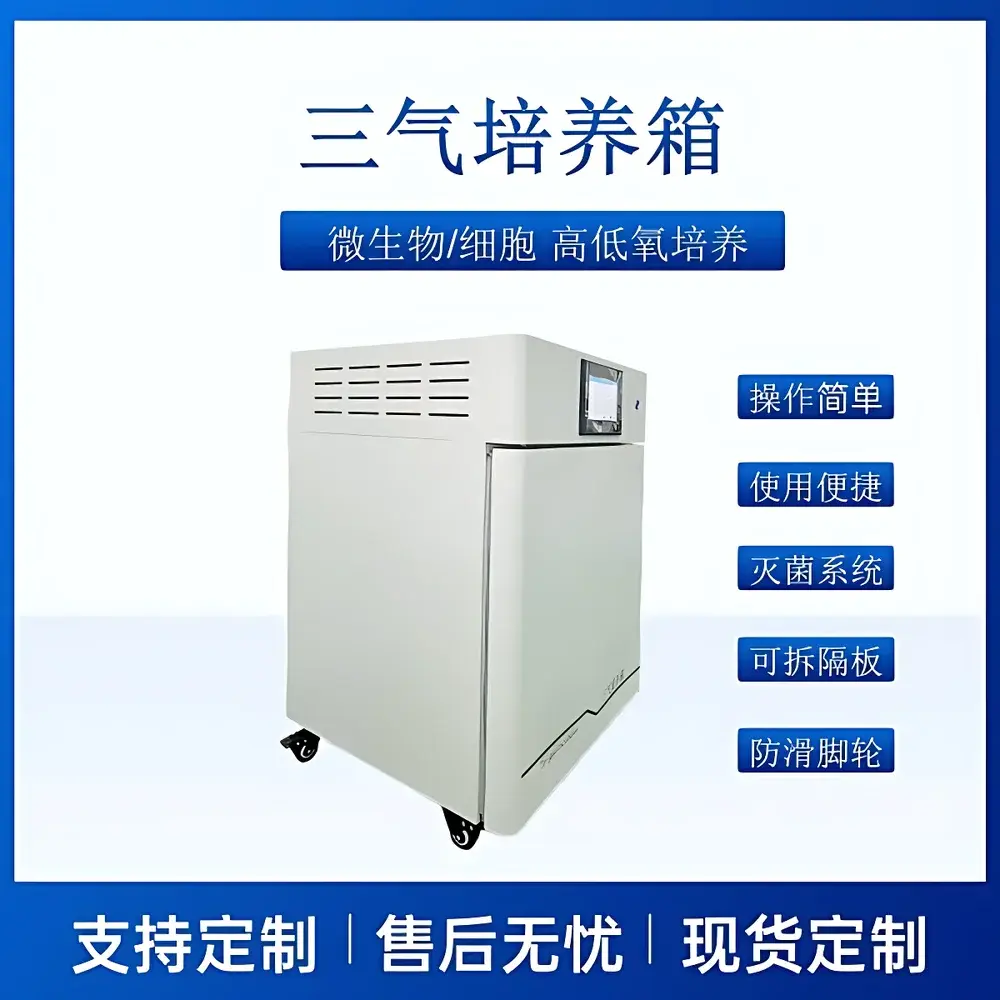
ANYAN CYSQ-80 Tri-Gas Incubator with 5.0″ Touchscreen and ±0.3% O₂ Control Accuracy
| Brand | ANYAN |
|---|---|
| Origin | Zhejiang, China |
| Model | CYSQ-80 |
| Type | Air-Jacketed Tri-Gas Incubator |
| O₂ Range | 1–95% (v/v) |
| O₂ Accuracy | ±0.3% (v/v) |
| Temperature Range | +3 to +60 °C |
| Temp Uniformity | ±0.3 °C (@37 °C) |
| Temp Stability | ±0.2 °C (@37 °C) |
| CO₂ Range | 0–20% (v/v) |
| CO₂ Accuracy | ±0.1% (v/v) |
| Humidity | ≥90% RH (passive water-jacket evaporation, uncontrolled) |
| Chamber Volume | 80 L (customizable) |
| CO₂ Sensor | IR-based |
| O₂ Sensor | Electrochemical (imported) |
| Temp Sensor | PT100 (imported) |
| Sterilization | UV lamp |
| Power | 400 W |
| Chamber Dimensions (W×D×H) | 400×400×500 mm |
| External Dimensions (W×D×H) | 540×520×790 mm |
| Shelf | 1 stainless steel shelf (304) |
| Compliance | Designed for GLP-aligned cell culture workflows |
Overview
The ANYAN CYSQ-80 Tri-Gas Incubator is an air-jacketed, microprocessor-controlled environmental chamber engineered for precise, long-term maintenance of mammalian cells, primary tissues, anaerobic/microaerophilic bacteria, and stem cell cultures under dynamically regulated oxygen (O₂), carbon dioxide (CO₂), and temperature conditions. Unlike standard CO₂ incubators, the CYSQ-80 integrates independent control loops for O₂ (1–95% v/v), CO₂ (0–20% v/v), and temperature (+3 to +60 °C), enabling simulation of physiologically relevant hypoxic (e.g., 1–5% O₂ for tumor spheroids), normoxic (21% O₂), or hyperoxic (up to 95% O₂) microenvironments. Its measurement architecture employs dual high-stability sensors: a non-dispersive infrared (NDIR) sensor for CO₂ quantification and a calibrated electrochemical O₂ sensor with traceable linearity—both selected for low drift, minimal cross-sensitivity, and extended operational lifetime (>2 years typical). The incubator operates on gas mixing principles: for O₂ < 19.8%, it blends high-purity N₂ and CO₂; for O₂ > 23%, it blends high-purity O₂ and CO₂—ensuring stoichiometric fidelity without compromising CO₂ setpoint integrity.
Key Features
- Air-jacketed thermal design with five-sided heating elements plus independent door-heating circuit, minimizing thermal gradients and external ambient influence.
- 5.0-inch capacitive touchscreen interface with intuitive icon-driven navigation, real-time parameter logging, and user-accessible calibration offset adjustment.
- Micro-fan-assisted convection system optimized for laminar, low-turbulence airflow—reducing recovery time after door opening (<6 min to re-establish ±0.3 °C uniformity and ±0.3% O₂ at 37 °C/5% CO₂/5% O₂).
- Passive humidity maintenance via 304 stainless steel water pan (evaporative, unregulated); achieves ≥90% RH in steady-state operation without ultrasonic humidification or condensation risk.
- Dual safety architecture: independent mechanical overtemperature cut-off relay + software-enforced upper limit alarm (configurable threshold), compliant with IEC 61010-1 Class II requirements.
- UV germicidal lamp (254 nm) with manual activation timer (0–60 min), positioned to irradiate chamber walls and shelf surfaces without shadow zones.
- Single-tier 304 stainless steel shelf with rounded corners; fully removable for autoclaving or chemical decontamination (e.g., 70% ethanol, hydrogen peroxide vapor).
Sample Compatibility & Compliance
The CYSQ-80 supports standard T-flasks (up to T225), multiwell plates (6–96-well), Petri dishes, and roller bottles. Its chamber geometry (400 × 400 × 500 mm) accommodates stacked configurations while preserving airflow symmetry. All wetted materials—including gasket seals, water pan, and interior chamber—are 304 stainless steel or medical-grade silicone, eliminating organic leachables and supporting routine cleaning with alcohols, quaternary ammonium compounds, or vaporized H₂O₂. While not certified to ISO 13485 or FDA 21 CFR Part 11 out-of-box, the system’s audit-ready features—including timestamped event logs (door openings, gas alarms, temp excursions), password-protected parameter locks, and factory calibration certificates—facilitate integration into GLP and GMP-aligned laboratories conducting preclinical cell expansion, bioprocess development, or regenerative medicine research.
Software & Data Management
Data acquisition is handled by embedded firmware with internal non-volatile memory storing up to 30 days of 1-minute interval records (temperature, O₂, CO₂, door status, UV cycle). Export is supported via USB flash drive (CSV format) for post-hoc analysis in MATLAB, Python (pandas), or Excel. No cloud connectivity or remote access is implemented—ensuring data sovereignty and eliminating cybersecurity exposure vectors common in networked lab equipment. Calibration history, sensor zero/span adjustments, and maintenance timestamps are retained separately and exportable. The interface supports multilingual UI (English default) and configurable alarm escalation (visual + audible).
Applications
- Hypoxia studies in cancer biology: stable 1–5% O₂ maintenance for HIF-1α stabilization assays and 3D tumor organoid culture.
- Stem cell differentiation protocols requiring O₂ modulation (e.g., 5% O₂ for mesenchymal stromal cell expansion; 13% O₂ for neural progenitor maturation).
- Microaerophilic pathogen cultivation (e.g., Helicobacter pylori, Campylobacter jejuni) using 5–10% O₂ + 10% CO₂ atmospheres.
- Embryonic stem cell banking where atmospheric O₂ (21%) induces oxidative stress—replaced by 5% O₂ for improved genomic stability.
- Co-culture systems demanding simultaneous control of two gas species (e.g., endothelial–pericyte interactions under 5% O₂/5% CO₂).
FAQ
What is the O₂ concentration accuracy specification, and how is it validated?
The O₂ control accuracy is ±0.3% (v/v) across the full 1–95% range, verified using NIST-traceable electrochemical O₂ analyzers during factory calibration. Users may perform field verification using external paramagnetic or zirconia-based analyzers.
Does the incubator actively control relative humidity?
No. Humidity is maintained passively via evaporation from a stainless steel water pan. RH remains ≥90% under steady-state conditions but is not regulated; no feedback loop or humidification hardware is included.
Can the CYSQ-80 be used for anaerobic culture (0% O₂)?
Not natively. The minimum O₂ setpoint is 1% (v/v). For true anaerobic work, a dedicated anaerobic chamber or gas-purge incubator with O₂ scavenging capability is required.
How often must the water pan be refilled, and what water quality is required?
Refill frequency depends on ambient humidity and door-open frequency—typically every 3–7 days. Only distilled or deionized water should be used to prevent mineral scaling and corrosion of the 304 stainless steel pan.
Is third-party IQ/OQ validation support available?
YES. ANYAN provides protocol templates (in English) aligned with ASTM E2500 and EU GMP Annex 15, including test scripts for temperature mapping (9-point grid), gas recovery time, and sensor linearity verification—enabling qualified labs to execute full installation and operational qualification.