
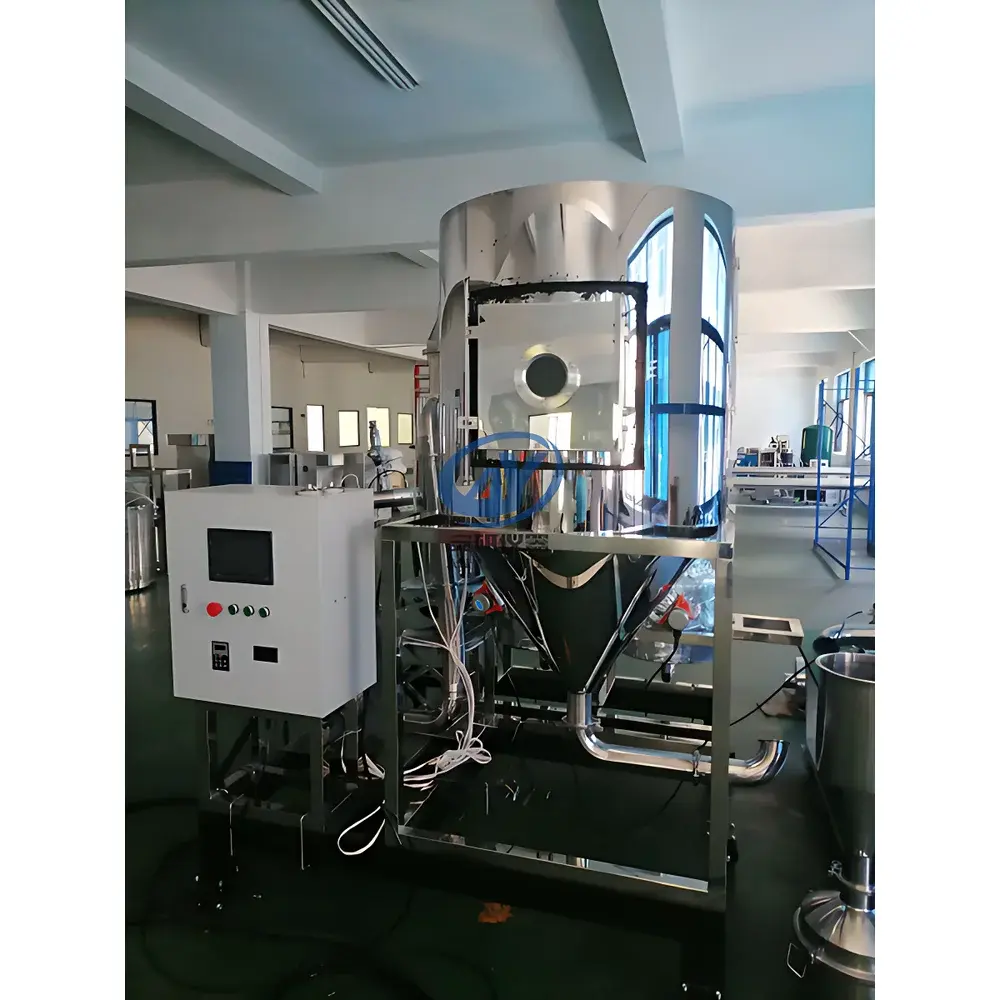
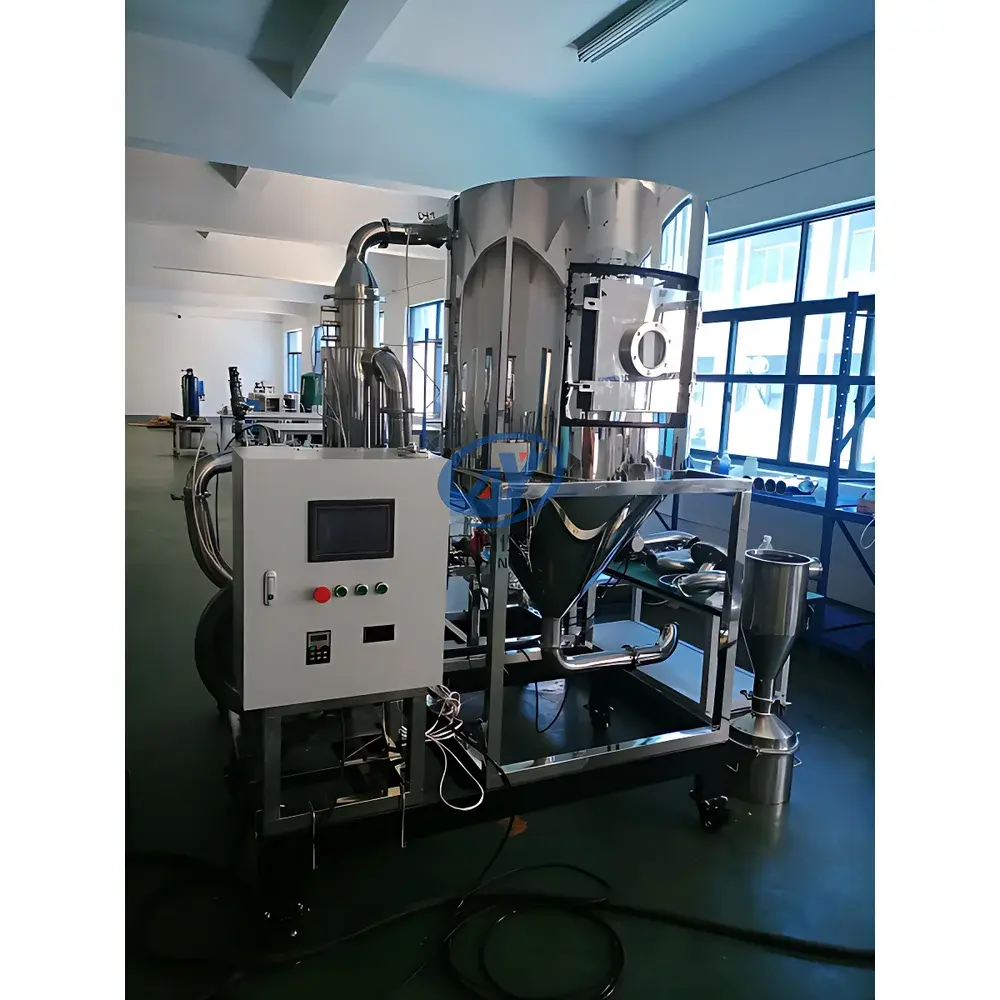
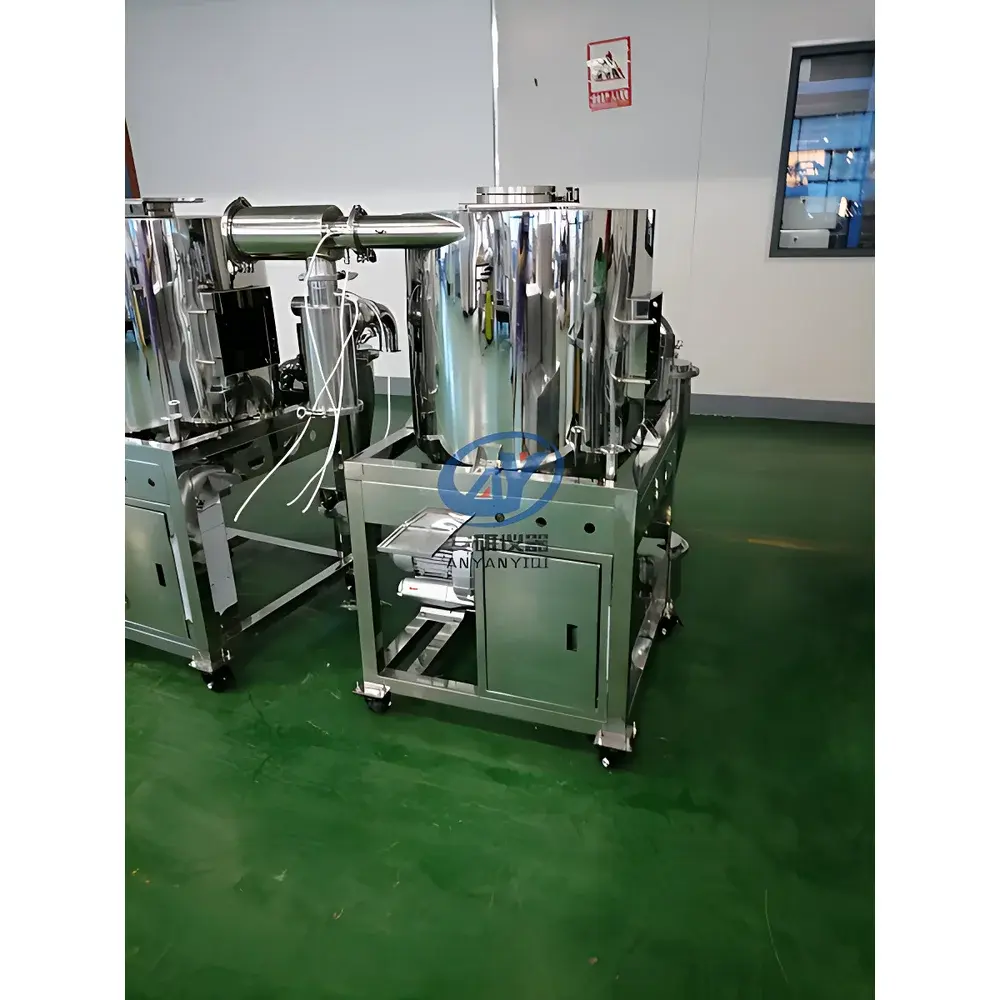
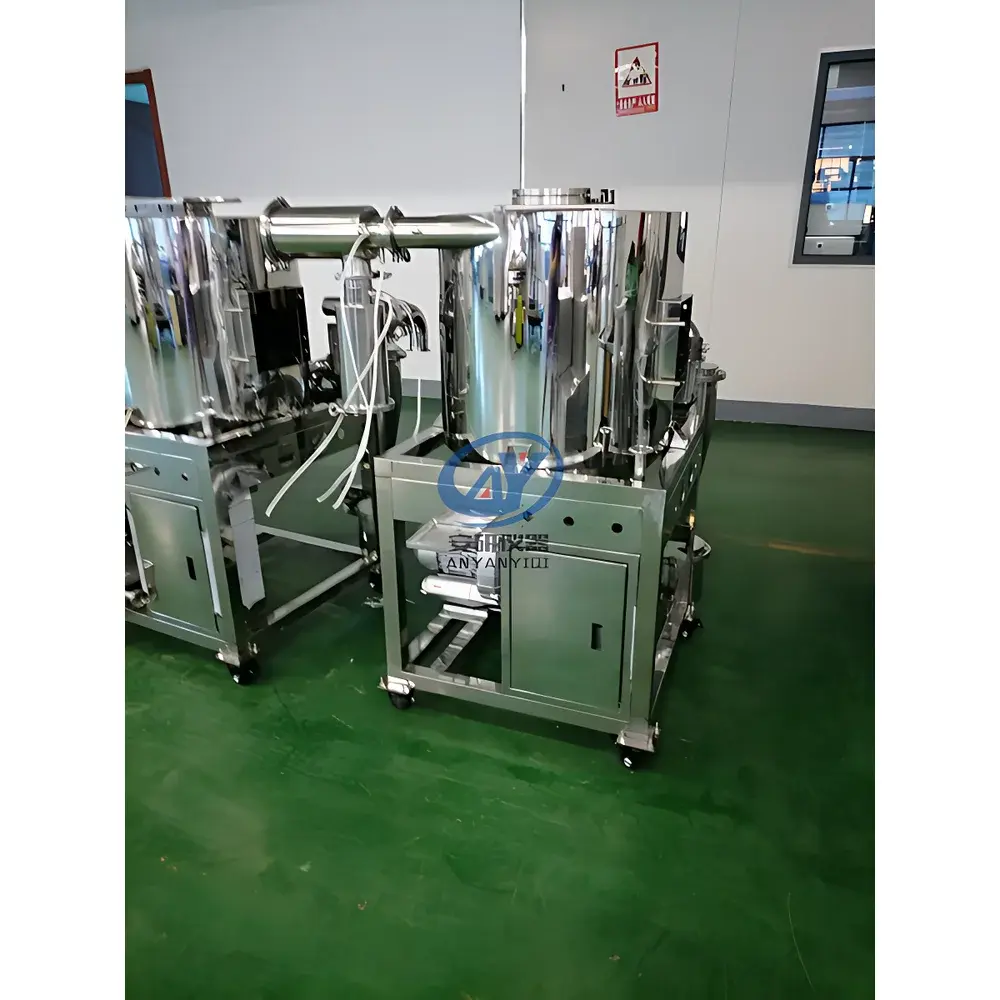
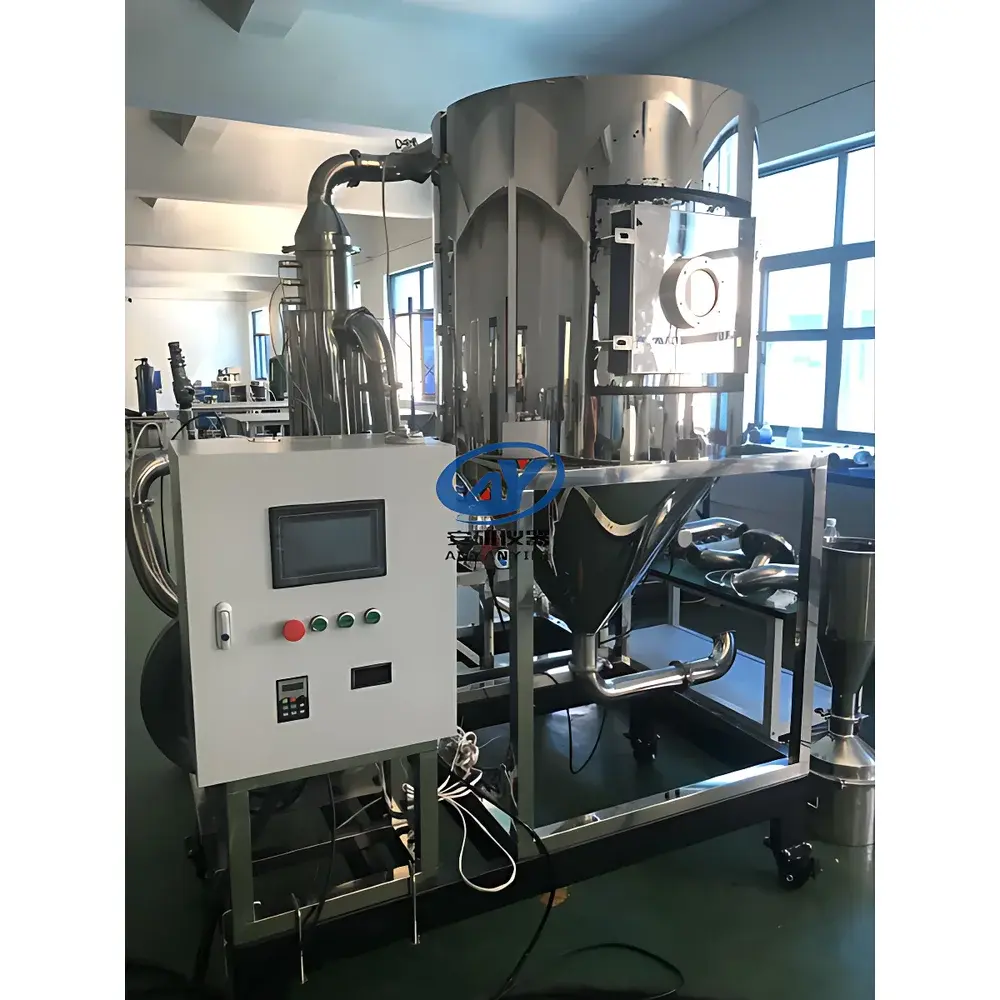
Anyan DGZJ5L Nitrogen-Closed Loop Spray Dryer
| Brand | Anyan Instruments |
|---|---|
| Origin | Zhejiang, China |
| Manufacturer Type | Authorized Distributor |
| Country of Origin | China |
| Model | DGZJ5L |
| Inlet Air Temperature | Ambient–300 °C (±0.5 °C, with temperature curve memory) |
| Outlet Air Temperature | Ambient–200 °C (±0.5 °C) |
| Primary Condenser Temp | −20–30 °C (±0.5 °C) |
| Secondary Condenser Temp | −10–30 °C (±0.5 °C) |
| Duct Temperature Range | Ambient–100 °C (±0.5 °C) |
| Feed Rate | 50–5000 mL/h |
| Atomization | Centrifugal |
| Oxygen Detection Range | 0–100% vol (0.1% resolution) |
| Pressure Monitoring Range | 0–100 kPa |
| Nitrogen Flow Rate | 100 L/min (99.9% purity) |
| Airflow Regulation | 0–300 m³/h (variable-frequency blower) |
| Filtration Efficiency | ≥99.9% for particles ≥1 µm |
| Tower Dimensions | Ø800 × H1500 mm |
| Cleaning Port | 340 × 340 mm |
| Filter Recovery Unit | Ø260 × H1300 mm |
| Dual Condensers | Ø340 × H1300 mm each |
| Collection Vessels | Ø550 × H1560 mm ×2 |
| Overall Dimensions | 2000 × 1500 × 2500 mm (L×W×H) |
| Total Power | 26 kW |
| Voltage | 380 V AC, 3-phase |
Overview
The Anyan DGZJ5L Nitrogen-Closed Loop Spray Dryer is an engineered solution for the safe, controlled, and oxidation-sensitive drying of heat-labile or hazardous materials dissolved in flammable organic solvents—such as acetone, ethanol, ethyl acetate, or tetrahydrofuran. Unlike conventional open-loop spray dryers that use ambient air as the drying medium, the DGZJ5L operates within a fully sealed nitrogen atmosphere. This closed-cycle architecture eliminates oxygen exposure during atomization, drying, and collection—preventing combustion risks, thermal degradation, and oxidative decomposition of active pharmaceutical ingredients (APIs), natural extracts, battery electrode slurries, or nanomaterial precursors. The system employs Couette-flow-based centrifugal atomization, coupled with precisely regulated nitrogen recirculation, multi-stage condensation, and real-time O₂/pressure monitoring to meet stringent process safety requirements under laboratory-scale GMP- and GLP-aligned workflows.
Key Features
- Nitrogen Recirculation Architecture: Integrated dual-stage condensation (primary at −20 °C, secondary at −10 °C) enables >95% solvent recovery efficiency while maintaining <3% O₂ concentration throughout operation—critical for Class I flammable solvent handling per NFPA 30 and ATEX Zone 2 compliance logic.
- Automated Safety Interlocks: Real-time oxygen sensing (0–100% vol, ±0.1% resolution) triggers feed suspension if O₂ exceeds user-defined thresholds; pressure transducers (0–100 kPa range) activate mechanical rupture discs and programmable relief valves at ≥0.02 MPa—fully configurable via touchscreen interface.
- Thermal Precision & Material Integrity: Dual-zone heating with jacketed tower walls ensures uniform thermal distribution and minimizes localized overheating; inlet/outlet/duct temperature sensors (±0.5 °C accuracy) support precise thermal profiling for thermosensitive biopolymers or enzyme-loaded microparticles.
- High-Efficiency Particle Recovery: Stainless-steel cyclonic separator with removable vortex chamber and 1-µm-rated sintered metal filter cartridge reduce fine-particle loss—particularly essential for low-yield APIs or expensive catalysts.
- Intuitive Process Control: 7-inch industrial-grade capacitive touchscreen displays live temperature curves, O₂ trends, pressure logs, and feed rate profiles; all parameters are timestamped and exportable in CSV format for audit-ready documentation.
- Modular Expandability: Optional on-site nitrogen generator integration eliminates dependency on high-pressure gas cylinders—reducing logistics overhead and enabling continuous multi-day operation in regulated environments.
Sample Compatibility & Compliance
The DGZJ5L accommodates aqueous and organic solutions, suspensions, and emulsions with total solids content ranging from 5% to 50% w/w. It is routinely deployed for drying lithium iron phosphate (LiFePO₄) slurries, curcumin nanoemulsions, peptide-loaded PLGA nanoparticles, and pyrophoric metal-organic frameworks (MOFs). All wetted parts—including drying tower, cyclone, filters, and collection vessels—are constructed from AISI 316L stainless steel, passivated per ASTM A967, and compatible with USP Class VI extractables testing protocols. The system’s electrical design conforms to IEC 61000-6-2/6-4 immunity/emission standards, and full CE marking documentation—including risk assessment per ISO 12100 and machinery directive 2006/42/EC—is available upon request for EU-based installation and validation.
Software & Data Management
Data acquisition is handled by embedded firmware compliant with ALCOA+ principles: all sensor readings (temperature, pressure, O₂, flow, feed rate) are recorded at 1-second intervals with immutable timestamps and user ID tagging. The system supports 21 CFR Part 11-compliant electronic signatures when paired with external authentication servers. Audit trails—including parameter changes, alarm events, and manual overrides—are stored locally on encrypted SD card and synchronized to network drives via Ethernet. Export formats include .csv for statistical analysis in JMP or Minitab, and .pdf reports with embedded calibration certificates for IQ/OQ documentation packages.
Applications
- Pharmaceutical R&D: Lyophilization-alternative drying of sterile-filtered protein solutions without aggregation.
- Battery Materials: Solvent-based synthesis of cathode/anode composites under inert atmosphere to preserve redox-active surface chemistry.
- Nutraceuticals: Encapsulation of omega-3 oils or anthocyanins in maltodextrin matrices without lipid peroxidation.
- Specialty Chemicals: Production of flame-retardant microcapsules or photoactive dye powders requiring strict O₂ exclusion.
- Academic Research: Kinetic studies of solvent evaporation dynamics under controlled partial pressures using programmable N₂ flow ramping.
FAQ
Is the DGZJ5L suitable for GMP manufacturing environments?
Yes—when installed with documented IQ/OQ protocols, calibrated against NIST-traceable references, and operated under SOPs covering change control, maintenance logs, and personnel training, it meets Annex 15 and WHO TRS 986 requirements for lab-scale batch release.
Can the system handle chlorinated solvents such as dichloromethane?
Yes—provided condenser temperatures are adjusted to −35 °C (via optional ultra-low temp chiller) and all seals are verified for chemical compatibility per ASTM D471; material compatibility reports are supplied for common solvents.
What validation support does Anyan provide?
Factory acceptance testing (FAT) includes functional checks of all safety interlocks, temperature uniformity mapping (DIN EN ISO 14644-3), and O₂ sensor linearity verification; site acceptance testing (SAT) templates and URS alignment assistance are included.
How often must the sintered metal filter be replaced?
Under typical operation with 15 kPa across the filter housing—validated via built-in differential pressure monitoring.
Does the system comply with explosion protection directives?
The DGZJ5L is designed to operate in non-hazardous areas (Zone 22 dust, Zone 2 gas) per IEC 60079-10-1; intrinsic safety barriers and purged enclosures can be added for Zone 1 deployment—consult engineering team for ATEX-certified configurations.



