
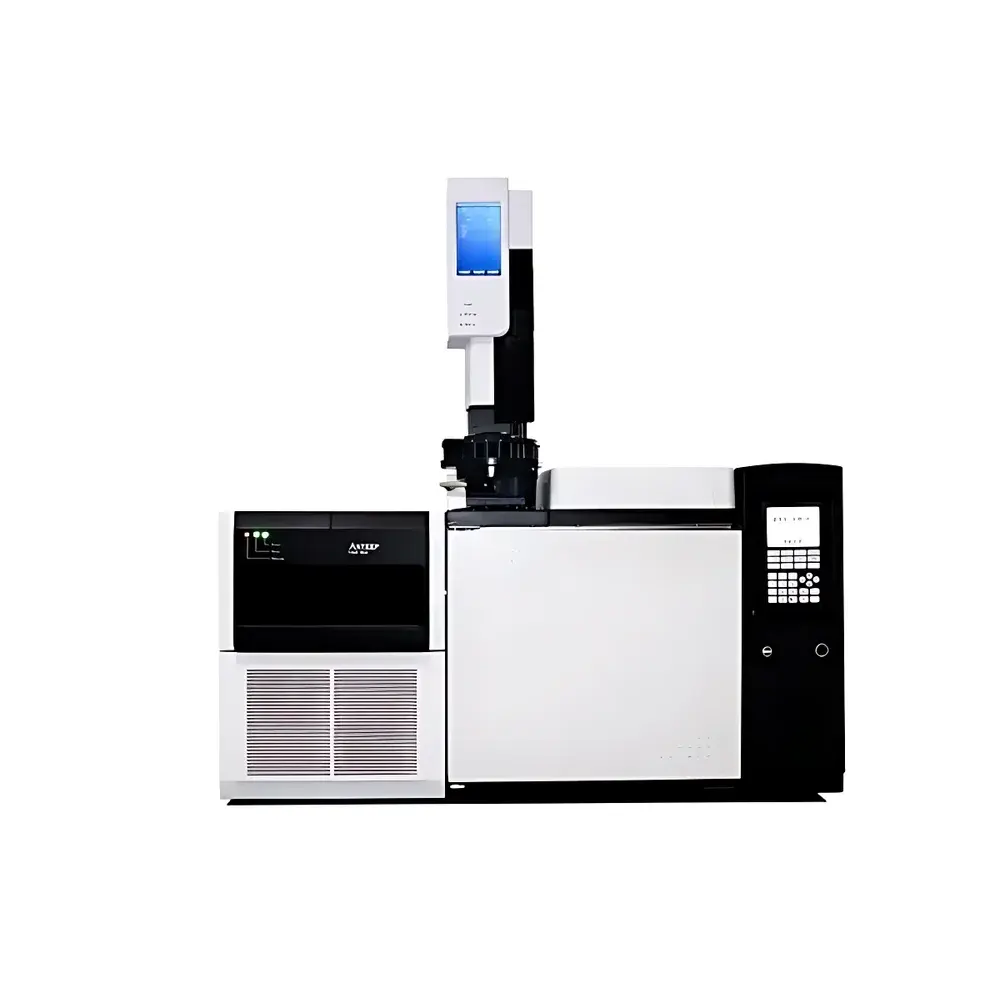
Anyeep 7600 Gas Chromatography Mass Spectrometry System
| Brand | Anyeep |
|---|---|
| Origin | Jiangsu, China |
| Manufacturer Type | Original Equipment Manufacturer (OEM) |
| Instrument Category | Domestic |
| Model | Anyeep 7600 |
| Price Range | USD 42,000–70,000 (FOB Jiangsu) |
| Instrument Type | Single Quadrupole Mass Spectrometer |
| GC Configuration | Conventional Capillary GC Interface |
| Mass Range | 1.5–1050 u |
| Resolution (10% Valley) | 2000 |
| Sensitivity | 1 pg Octafluoronaphthalene (OFN), m/z 272, S/N ≥ 600:1 (RMS) |
| Scan Speed | 20,000 u/s |
| Oven Ramp Rate | Up to 120 °C/min |
| Pressure Control Accuracy | ±0.001 psi |
Overview
The Anyeep 7600 Gas Chromatography Mass Spectrometry (GC-MS) system is a benchtop single quadrupole instrument engineered for robust qualitative and quantitative analysis in regulated and research laboratory environments. It integrates a high-performance capillary gas chromatograph with a thermally stable, electron ionization (EI) source and a mass-filtering quadrupole mass analyzer. The system operates on the principle of compound separation by retention time in the GC column followed by mass-to-charge (m/z) discrimination and detection in the mass spectrometer. Its design emphasizes analytical reproducibility, operational stability under extended duty cycles, and compatibility with standard 0.25–0.32 mm ID fused-silica columns. The 1.5–1050 u mass range supports detection of small volatile organics through mid-weight semi-volatiles, including pesticides, plasticizers, PAHs, PCBs, and fragrance compounds—making it suitable for routine compliance testing and method development workflows.
Key Features
- Single quadrupole mass analyzer with real-time RF/DC voltage control for precise mass filtering and high transmission efficiency
- Electron ionization (EI) source operating at 70 eV, optimized for library-matchable spectra and compatible with NIST/EPA spectral libraries
- Programmable temperature-controlled GC oven supporting ramp rates up to 120 °C/min and precise isothermal hold capability
- Digital pressure control module with ±0.001 psi accuracy across carrier gas (He, H₂, or N₂) flow paths, ensuring retention time stability and method transferability
- Fast scan acquisition at 20,000 u/s enabling high-resolution peak capture for co-eluting analytes in complex matrices
- Integrated vacuum system with dual-stage turbomolecular pump (≥200 L/s) and backing pump, achieving base pressure <5×10⁻⁶ Torr within 15 minutes
- Modular hardware architecture facilitating field-upgradable components including detector electronics and data acquisition firmware
Sample Compatibility & Compliance
The Anyeep 7600 accepts liquid, solid (via thermal desorption or solvent extraction), and gaseous samples introduced via split/splitless injectors, PTV, or headspace autosamplers. It supports EPA Methods 502.2, 524.4, 8260D, 8270E, and ASTM D7011 for environmental volatiles and semi-volatiles. For food safety applications, it aligns with ISO 17025-accredited workflows and supports residue analysis per EU Regulation No. 396/2005 and China’s GB 23200 series standards. Data integrity features include electronic signatures, audit trail logging, and user-access level management—enabling alignment with FDA 21 CFR Part 11 requirements when deployed in validated environments under GLP or GMP frameworks.
Software & Data Management
The system ships with Anyeep GC-MS Navigator™ software—a Windows-based platform supporting method building, real-time acquisition, spectral deconvolution (AMDIS-compatible), quantitation via internal/external standard calibration, and customizable report generation. Raw data files adhere to ANDI/NetCDF format for cross-platform interoperability. Software modules support automated peak integration with baseline correction algorithms, isotope ratio calculation (for confirmation), and batch processing of up to 200 samples per sequence. All audit trails—including parameter changes, calibration events, and user logins—are timestamped, immutable, and exportable as PDF or CSV for regulatory review.
Applications
- Environmental Monitoring: Analysis of VOCs in ambient air, SVOCs in wastewater and soil extracts, and dioxin-like compounds in fly ash
- Food Safety: Multi-residue screening of organophosphate and pyrethroid pesticides in fruits/vegetables; migration testing of phthalates and BPA from food contact materials
- Petrochemical QA/QC: Hydrocarbon fingerprinting in crude oil fractions, sulfur compound profiling in fuels, and additive identification in lubricants
- Forensic Toxicology: Detection and confirmation of drugs of abuse, explosives residues (e.g., TNT, RDX), and toxic industrial chemicals in evidentiary samples
- Pharmaceutical R&D: Residual solvent analysis per ICH Q3C guidelines and degradation product characterization in stability studies
- Academic Research: Method development for novel derivatization protocols, metabolite profiling in plant extracts, and polymer additive leaching kinetics
FAQ
What regulatory standards does the Anyeep 7600 support for data integrity?
It provides full audit trail functionality, electronic signature support, and role-based access control—designed to meet the technical controls required under FDA 21 CFR Part 11, EU Annex 11, and ISO/IEC 17025:2017.
Is the system compatible with third-party GC injectors or autosamplers?
Yes—the GC module features standard 1/16″ Swagelok fittings and RS-232/USB interfaces for seamless integration with CTC PAL, Gerstel MPS, or Thermo AI/AS systems.
Can the quadrupole be operated in selected ion monitoring (SIM) mode?
Yes—SIM acquisition is fully supported with dwell times configurable from 10 ms to 1 s per ion, enabling enhanced sensitivity for targeted quantitation without compromising cycle time.
What maintenance intervals are recommended for the ion source and detector?
Ion source cleaning is advised every 2–3 months under routine use; detector gain calibration should be performed quarterly or after major vacuum events. Full preventive maintenance is recommended annually by certified service engineers.
Does the system include spectral library search capability?
Yes—the software includes embedded NIST MS Search 2.4 with over 300,000 reference spectra and supports custom library import in .LSP or .MSL formats.
Related Products






