
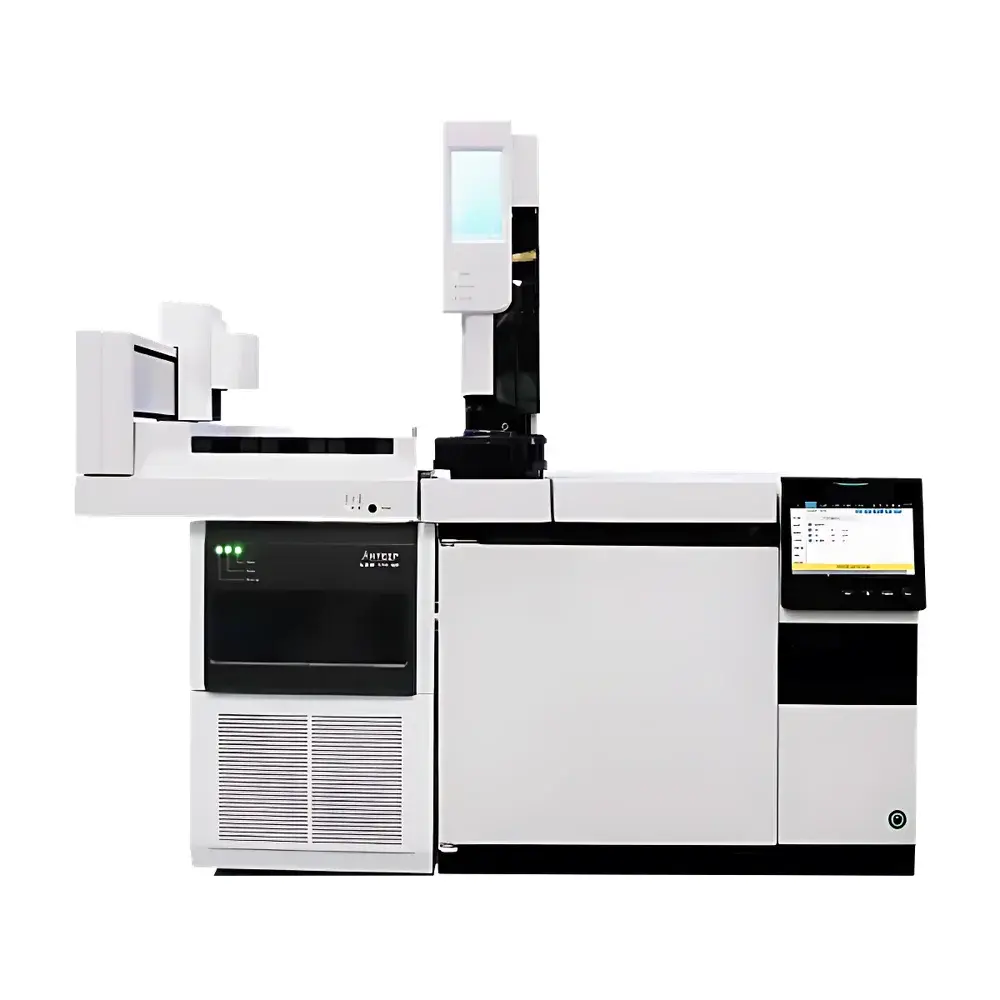
Anyeep 7700 Single Quadrupole Gas Chromatography Mass Spectrometry System
| Brand | Anyeep |
|---|---|
| Origin | Jiangsu, China |
| Manufacturer | Anyeep Precision Instruments Co., Ltd. |
| Instrument Type | Single Quadrupole GC-MS |
| GC Configuration | Conventional Gas Chromatography Interface |
| Mass Range | 0–1250 amu |
| Vacuum Architecture | Dual-Chamber, Dual-Turbomolecular Pump System (Independent Ion Source & Quadrupole Exhaust) |
| Startup-to-Analysis Time | ≤30 min |
Overview
The Anyeep 7700 is a single quadrupole gas chromatography mass spectrometry (GC-MS) system engineered for robust routine analysis in environmental monitoring, food safety testing, forensic toxicology, and pharmaceutical quality control laboratories. It operates on the fundamental principle of coupling capillary gas chromatography with electron ionization (EI) and/or chemical ionization (CI) mass spectrometry, where volatile and semi-volatile analytes are separated by retention time in the GC column and subsequently ionized, mass-filtered via a radiofrequency (RF)/direct current (DC)-driven quadrupole mass analyzer, and detected using an electron multiplier. The system’s dual-chamber vacuum architecture—featuring independent turbomolecular pumping for the ion source and quadrupole mass filter—ensures rapid attainment of operational vacuum (≤1×10⁻⁵ Torr in the ion source; ≤5×10⁻⁶ Torr in the mass analyzer), minimizes cross-contamination between analytical cycles, and significantly extends the service interval for ion source cleaning.
Key Features
- Dual-chamber, dual-turbomolecular pump vacuum system: Enables independent pressure control and optimized mean free path for both ion generation and mass filtering stages.
- Rapid vacuum recovery: Achieves stable operating vacuum within 30 minutes after power-on, reducing instrument downtime and supporting high-throughput workflows.
- High-efficiency EI/CI ion source: Designed for low carryover, reproducible ionization efficiency, and compatibility with standard NIST spectral libraries.
- Quadrupole mass analyzer with real-time RF/DC tuning: Delivers unit-mass resolution across the full 0–1250 amu range with calibrated mass accuracy better than ±0.1 amu (external calibration).
- Robust GC interface: Compatible with industry-standard 0.18–0.53 mm ID fused-silica capillary columns and supports split/splitless injection modes.
- Modular hardware design: Facilitates field-serviceable components including filament assemblies, detector housings, and vacuum gauges—reducing mean time to repair (MTTR).
Sample Compatibility & Compliance
The Anyeep 7700 supports analysis of thermally stable, volatile, and semi-volatile organic compounds—including pesticides, polycyclic aromatic hydrocarbons (PAHs), phthalates, residual solvents, and volatile organic compounds (VOCs)—in matrices such as water, soil extracts, food homogenates, and biological fluids. Sample introduction is compatible with autosamplers meeting ASTM D5845 and ISO 17993 specifications. The system meets essential electromagnetic compatibility (EMC) requirements per IEC 61326-1 and conforms to general safety standards under IEC 61010-1. While not pre-certified for regulated environments, its architecture supports implementation of audit trails, user access controls, and electronic signatures when integrated with compliant LIMS or chromatography data systems (CDS), aligning with principles outlined in FDA 21 CFR Part 11 and EU Annex 11 for data integrity in GLP/GMP settings.
Software & Data Management
The system is controlled via Anyeep GC-MS Navigator™ software—a Windows-based platform supporting method development, acquisition, processing, and reporting. Key capabilities include automated tune optimization, retention time locking, library search (NIST MS Search 2.7g compatible), quantitative batch processing with internal standard normalization, and customizable report templates. Raw data files adhere to ANDI/NetCDF format for long-term archival and third-party reprocessing. Audit trail functionality logs all user actions—including method edits, data reprocessing, and instrument parameter changes—with timestamps and operator IDs. Data export options include CSV, PDF, and XML formats suitable for regulatory submission packages.
Applications
- Environmental analysis: Detection and quantification of priority pollutants in wastewater, sediment, and air samples per EPA Methods 8270D, 8260C, and ISO 17993.
- Food safety: Screening for pesticide residues, mycotoxins, and packaging migrants in fruits, vegetables, dairy, and infant formula.
- Forensics: Identification of drugs of abuse, synthetic cannabinoids, and novel psychoactive substances in blood and urine specimens.
- Pharmaceutical QC: Residual solvent analysis in active pharmaceutical ingredients (APIs) per ICH Q3C guidelines.
- Academic research: Structural elucidation of natural products and reaction intermediates via EI/CI spectral interpretation and retention index correlation.
FAQ
What is the typical maintenance interval for the ion source?
Under normal operation with clean sample extracts, the ion source requires cleaning every 2–4 weeks; the dual-chamber vacuum design extends this interval by up to 50% compared to single-pump systems.
Is the system compatible with third-party GC controllers or data systems?
Yes—it supports standard RS-232, Ethernet, and USB communication protocols and can be integrated into enterprise CDS platforms via OpenLab CDS, Chromeleon, or Empower APIs.
Does the Anyeep 7700 support selected ion monitoring (SIM) mode?
Yes—full SIM capability with up to 100 ions per run, configurable dwell times, and automated peak integration for trace-level quantitation.
Can the system be upgraded to support tandem MS (MS/MS) functionality?
No—the Anyeep 7700 is a dedicated single quadrupole platform; MS/MS capability requires a separate triple quadrupole (QqQ) configuration.
What calibration standards are recommended for routine performance verification?
Perfluorotributylamine (PFTBA) for mass calibration and tuning, and a mixture of chlorinated benzenes or alkylbenzenes for resolution and sensitivity checks per ASTM D7293.




