
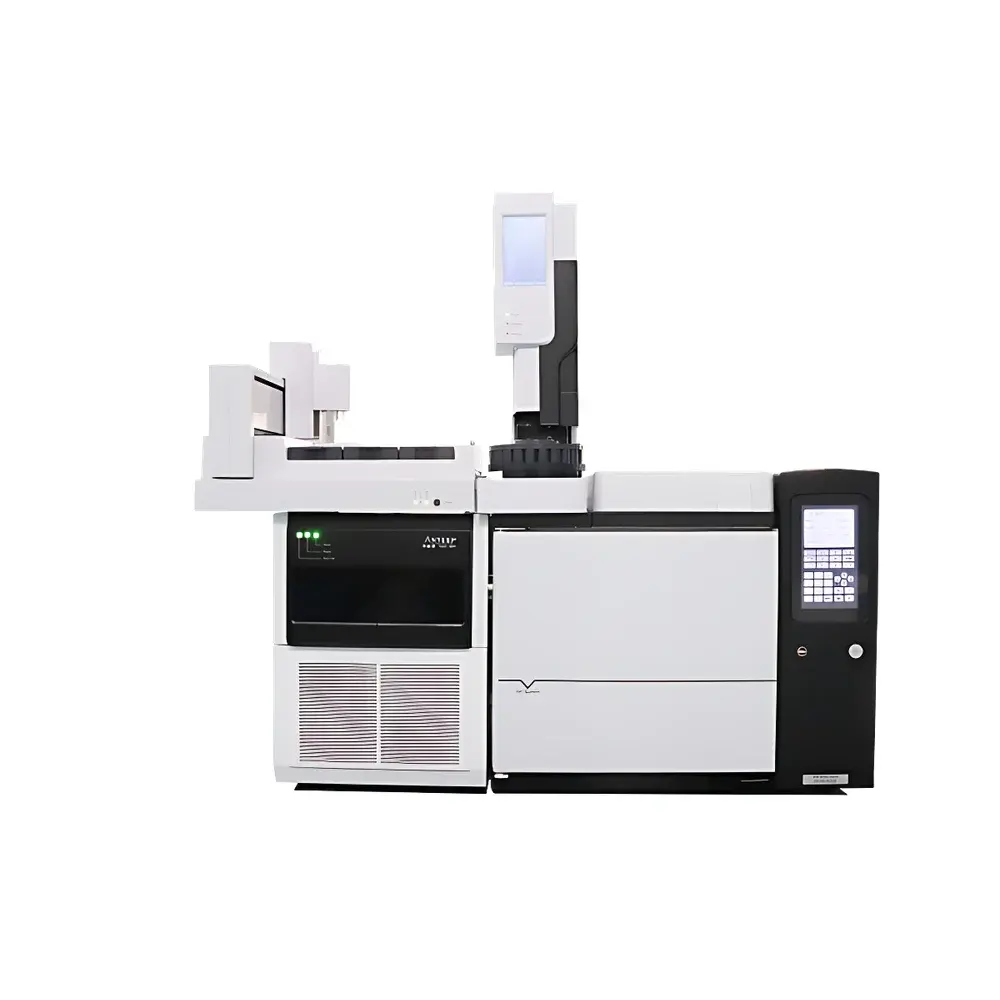
Anyeep 7800 High-Performance Dual-Hyperbolic Quadrupole Gas Chromatography-Mass Spectrometer
| Brand | Anyeep |
|---|---|
| Origin | Jiangsu, China |
| Manufacturer Type | Original Equipment Manufacturer (OEM) |
| Instrument Type | Single Quadrupole Mass Spectrometer |
| GC Configuration | Conventional Capillary Gas Chromatograph Coupling |
| Mass Analyzer | Dual-Hyperbolic Rod Quadrupole |
| Resolution (FWHM at m/z 69) | 0.25 Da |
| Isotopic Ratio Accuracy | Enhanced for PFBA, PFTBA, and Low-Mass Ions (He⁺, H₂O⁺, N₂⁺, O₂⁺) |
| RF Power Supply | Upgraded Wide-Mass-Range Stable Frequency Generator |
Overview
The Anyeep 7800 is a high-performance single quadrupole gas chromatography–mass spectrometry (GC-MS) system engineered for demanding routine and research-level organic compound identification, quantitation, and isotopic fidelity validation. At its core lies a proprietary dual-hyperbolic rod quadrupole mass analyzer — a departure from conventional cylindrical rods — designed to generate a near-ideal quadrupolar electric field across the full mass range (m/z 10–1000). This geometry minimizes field distortion, enabling improved ion transmission efficiency, enhanced mass resolution, and superior isotopic ratio reproducibility compared to standard cylindrical quadrupoles. The instrument couples with industry-standard capillary gas chromatographs via a heated transfer line and electron ionization (EI) source operating at 70 eV, supporting both full-scan and selected ion monitoring (SIM) acquisition modes. Its architecture complies with fundamental design principles outlined in ASTM E260, ISO/IEC 17025, and USP for analytical instrument qualification.
Key Features
- Dual-hyperbolic rod quadrupole mass filter fabricated in-house using precision CNC machining and ultra-stable surface finishing — eliminating field aberrations inherent in cylindrical rod geometries.
- Mass resolution of ≤0.25 Da (full width at half maximum, FWHM) at m/z 69 (C₅F₉⁺), verified using perfluorotributylamine (PFTBA) tuning standards; enables accurate differentiation of adjacent isotopic peaks (e.g., m/z 219/220, 502/503).
- Upgraded RF power supply with dynamic frequency stabilization, ensuring consistent mass calibration across low-mass region (m/z 2–50), critical for residual gas analysis (He⁺, H₂O⁺, N₂⁺, O₂⁺) and method robustness in humid or ambient-lab environments.
- Thermally insulated, low-dead-volume ion source with replaceable emission filaments and bake-out capability up to 350 °C — optimized for high-sensitivity trace analysis and reduced memory effects.
- Integrated vacuum system featuring dual-stage turbomolecular pumping (≥300 L/s for MS chamber) and pressure-regulated foreline backing — achieving base pressure <5 × 10⁻⁸ Torr under operational conditions.
Sample Compatibility & Compliance
The Anyeep 7800 supports volatile and semi-volatile organic compounds (VOCs/SVOCs) amenable to GC separation, including pesticides, PAHs, phthalates, flame retardants, hydrocarbons, and environmental contaminants. It is compatible with standard 0.25–0.32 mm ID fused-silica capillary columns (e.g., DB-5ms, HP-5MS, Rxi-5Sil MS) and accepts split/splitless, PTV, and cold-on-column injection configurations. The system meets essential functional requirements for GLP-compliant laboratories performing EPA Method 8270D, 8260C, and ISO 17993:2022. Data acquisition and processing modules support audit trail logging, electronic signatures, and user-access control — aligning with FDA 21 CFR Part 11 foundational expectations for regulated environments.
Software & Data Management
Controlled via Anyeep GCMS Navigator v3.x software, the platform provides method development tools, automated tune optimization (using PFTBA), spectral library search (NIST MS Search 2.4-compatible), and quantitative workflow templates. Raw data files (.awd) are stored in vendor-neutral formats with embedded metadata (instrument parameters, calibration history, operator ID, timestamp). Software supports batch processing, QC flagging (e.g., retention time drift >0.05 min, peak area RSD >15%), and export to CSV, mzML, and ANDI-NetCDF for third-party chemometric analysis. All user actions — method edits, data reprocessing, report generation — are recorded in an immutable audit trail with SHA-256 hashing.
Applications
- Environmental testing labs performing regulatory compliance analysis for soil, water, and air matrices per EPA SW-846 methods.
- Food safety laboratories screening for pesticide residues, mycotoxins, and packaging migrants under EU Regulation (EC) No 396/2005.
- Pharmaceutical QC/QA departments conducting residual solvent analysis (ICH Q3C) and extractables/leachables profiling (USP ).
- Academic and industrial research groups requiring high-fidelity isotopic pattern matching for reaction mechanism studies or metabolite identification.
- Forensic toxicology units validating low-level drug metabolites in biological fluids with enhanced specificity at m/z 100–300.
FAQ
What distinguishes the dual-hyperbolic quadrupole from conventional cylindrical rods?
The hyperbolic geometry produces a mathematically ideal quadrupolar field, reducing fringing fields and improving mass peak shape symmetry — resulting in higher sensitivity and more accurate isotopic abundance ratios.
Is the Anyeep 7800 compliant with 21 CFR Part 11?
While the hardware and software architecture support core Part 11 elements (audit trails, role-based access, electronic signatures), formal validation documentation must be completed by the end-user laboratory per their internal SOPs and risk assessment protocols.
Can the system operate with alternative ionization sources such as CI or APCI?
The current configuration is optimized for EI only; chemical ionization (CI) and atmospheric pressure chemical ionization (APCI) are not supported in the 7800 platform.
What maintenance intervals are recommended for the ion source and detector?
Ion source cleaning is advised every 2–3 weeks under continuous operation; electron multiplier replacement is typically required after 1–2 years depending on total ion dose exposure.
Does the instrument support method transfer from other GC-MS platforms?
Yes — retention time indexing, spectral library compatibility (NIST), and SIM transition tables allow straightforward migration from Agilent 5977/7000, Thermo ISQ, or Shimadzu QP2020 systems with minor retuning.





