
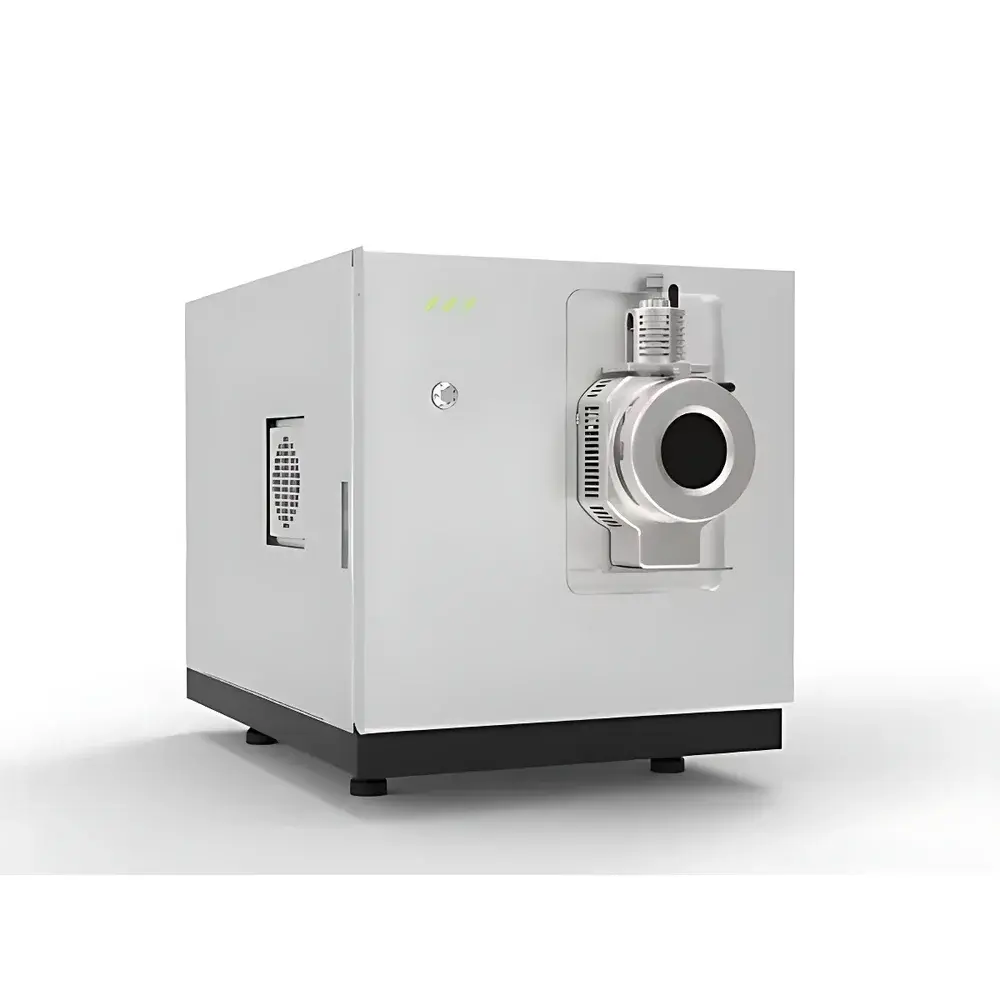
Anyeep LC Cassitrap 120K High-Resolution Liquid Chromatography Mass Spectrometer
| Brand | Anyeep |
|---|---|
| Origin | Jiangsu, China |
| Manufacturer Type | Original Equipment Manufacturer (OEM) |
| Regional Classification | Domestic (PRC) |
| Model | LC Cassitrap 120K |
| Pricing | Upon Request |
Overview
The Anyeep LC Cassitrap 120K is a high-resolution liquid chromatography–mass spectrometry (LC-MS) system engineered for precise molecular characterization in complex matrices. It integrates a quadrupole-based front-end mass filter with a high-field asymmetric waveform ion mobility spectrometry (FAIMS)-compatible trapping mass analyzer, delivering nominal mass resolution up to 120,000 (FWHM at m/z 200). This resolution enables baseline separation of isobaric and near-isobaric species—such as isotopic fine structure peaks, structural isomers, and post-translational modification variants—without reliance on chromatographic peak deconvolution alone. The instrument operates on the principle of trapped-ion accumulation, radial ejection, and time-domain signal acquisition, supporting both data-dependent (DDA) and data-independent (DIA) acquisition modes. Designed for laboratories requiring rigorous identification confidence and quantitative reproducibility, the LC Cassitrap 120K meets the analytical demands of metabolomics, proteomics, environmental contaminant screening, and pharmaceutical impurity profiling.
Key Features
- High mass resolution: Up to 120,000 FWHM at m/z 200, enabling sub-ppm mass accuracy in calibrated mode
- Integrated LC interface with electrospray ionization (ESI) and atmospheric pressure chemical ionization (APCI) sources, configurable for polarity switching within a single run
- Trapped-ion storage architecture with extended transient duration (>1 s), improving signal-to-noise ratio for low-abundance analytes
- Real-time collision-induced dissociation (CID) and higher-energy C-trap dissociation (HCD) capabilities for structural elucidation
- Rugged vacuum system with dual-stage turbo-molecular pumping and active pressure monitoring across all differential stages
- Modular design supporting future upgrades including FAIMS integration, electron-transfer/higher-energy collisional dissociation (EThcD), and extended mass range calibration kits
Sample Compatibility & Compliance
The LC Cassitrap 120K accepts samples introduced via standard HPLC/UHPLC systems (0.1–2 mL/min flow rates), microflow, and nanoflow configurations. It accommodates a broad polarity and volatility range—from small polar metabolites (e.g., amino acids, organic acids) to intact proteins and synthetic polymers—when coupled with appropriate sample preparation workflows (e.g., solid-phase extraction, protein digestion, derivatization). The system complies with ISO/IEC 17025:2017 requirements for analytical laboratory competence and supports audit-ready operation under GLP and GMP environments. Instrument control software includes full 21 CFR Part 11 compliance features: electronic signatures, role-based access control, immutable audit trails, and secure data archiving. Method validation documentation aligns with ICH Q2(R2) and USP guidelines for specificity, linearity, and precision assessment.
Software & Data Management
Control and data processing are managed through Anyeep’s proprietary MassAnalyzer Suite v4.x, a Windows-based platform supporting real-time spectral visualization, automated peak detection, and retention time alignment across multi-batch studies. The software provides native support for open-format data exchange (mzML, mzXML) and integrates with third-party informatics platforms—including Proteome Discoverer, Skyline, XCMS Online, and Compound Discoverer—via standardized APIs. Quantitative workflows include label-free, TMT, and SILAC-compatible algorithms with built-in statistical modules (ANOVA, PCA, hierarchical clustering). All raw data files are stored with embedded metadata (instrument parameters, calibration logs, user annotations), ensuring traceability from acquisition to final report generation.
Applications
- Untargeted metabolomics: Identification and relative quantification of endogenous small molecules in biofluids and tissue extracts
- Top-down and bottom-up proteomics: Characterization of intact protein isoforms, sequence variants, and PTMs such as phosphorylation, glycosylation, and oxidation
- Pharmaceutical development: Structural confirmation of drug candidates, degradation product identification, and genotoxic impurity screening per ICH M7
- Environmental analysis: Detection of persistent organic pollutants (POPs), per- and polyfluoroalkyl substances (PFAS), and pesticide residues at sub-ng/L levels
- Food safety: Authentication of origin, detection of adulterants, and mycotoxin profiling using multi-residue methods
FAQ
What is the maximum achievable mass resolution under routine operating conditions?
The LC Cassitrap 120K achieves up to 120,000 resolution (FWHM at m/z 200) when operated with optimized transient length, ion injection time, and detector gain settings—typically maintained during method development and validation protocols.
Does the system support quantitative analysis with internal standards?
Yes; the platform supports both stable isotope-labeled internal standards (SIL-IS) and external calibration curves. Response linearity is validated over five orders of magnitude for most small-molecule applications.
Is remote instrument monitoring and control available?
Remote access is supported via secure TLS-encrypted client-server architecture, allowing authorized users to monitor acquisition status, review real-time spectra, and initiate method runs from off-site locations.
How frequently does the system require mass calibration?
Mass calibration is performed automatically before each batch using a dual-point lock-mass reference (e.g., purine and HP-0921), with optional manual recalibration intervals defined per SOP or regulatory requirement.
Can the LC Cassitrap 120K be integrated into existing LIMS environments?
Yes; the MassAnalyzer Suite provides ODBC-compliant database connectivity and RESTful API endpoints for bidirectional LIMS synchronization, including sample tracking, result export, and audit log ingestion.




