
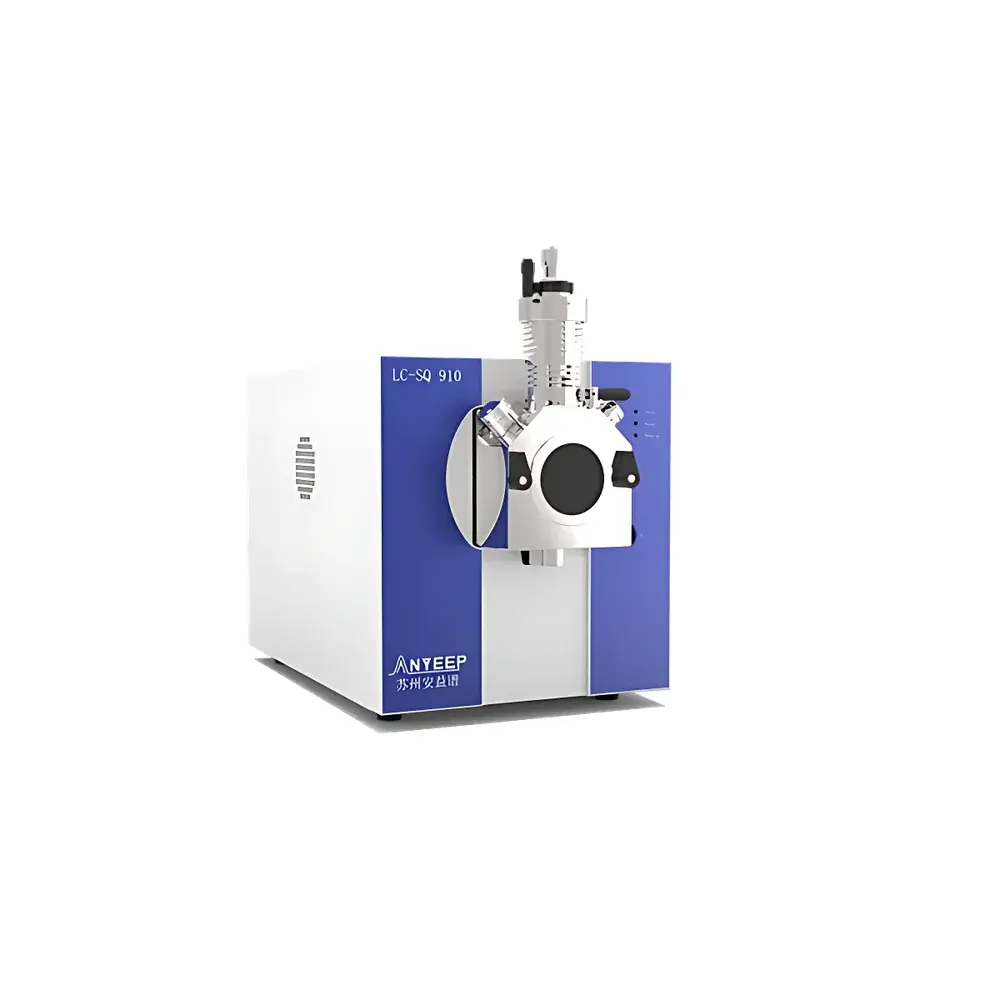
Anyeep SQ910 LC-MS Single Quadrupole Liquid Chromatography-Mass Spectrometer
| Brand | Anyeep |
|---|---|
| Origin | Jiangsu, China |
| Manufacturer Type | Original Equipment Manufacturer (OEM) |
| Regional Classification | Domestic (PRC) |
| Model | SQ910 LC-MS |
| Pricing | Available Upon Request |
Overview
The Anyeep SQ910 LC-MS is a single quadrupole liquid chromatography–mass spectrometry system engineered for routine quantitative and qualitative analysis in regulated and research laboratory environments. It integrates a high-performance liquid chromatograph with a robust atmospheric pressure ionization (API) source—typically electrospray ionization (ESI) and/or atmospheric pressure chemical ionization (APCI)—and a mass-selective quadrupole analyzer operating in unit-mass resolution mode. The system delivers reliable detection, identification, and quantification of small-to-medium molecular weight compounds (typically < 1,500 Da) across diverse matrices including pharmaceutical formulations, synthetic organic intermediates, food contaminants, environmental extracts, and biological fluids. Designed for operational stability and analytical reproducibility, the SQ910 LC-MS adheres to fundamental principles of chromatographic separation coupled with mass-filtered ion current detection, enabling consistent signal-to-noise ratios and low ng/mL to pg/mL level sensitivity under optimized conditions.
Key Features
- Single quadrupole mass analyzer with RF/DC voltage-controlled mass filtering for precise m/z selection and scanning (full scan, selected ion monitoring [SIM], and product ion scan modes)
- Dual-mode atmospheric pressure ion source (ESI/APCI) with rapid polarity switching and thermally assisted desolvation for enhanced ion transmission efficiency
- Integrated HPLC module featuring gradient-capable binary or quaternary pumping, autosampler with 100+ vial capacity, and column oven with temperature control up to 80 °C
- Real-time data acquisition at up to 10 scans per second, supporting high-throughput batch analysis without compromising spectral fidelity
- Modular vacuum system with dual-stage turbomolecular pump and backing pump, maintaining stable operating pressure (< 1 × 10⁻⁵ Torr) in the mass analyzer region
- Front-panel touchscreen interface and embedded control firmware for standalone method setup, instrument diagnostics, and basic data review
Sample Compatibility & Compliance
The SQ910 LC-MS accommodates liquid samples compatible with reversed-phase, hydrophilic interaction (HILIC), and ion-pairing chromatography—including aqueous extracts, methanol/acetonitrile supernatants, derivatized analytes, and enzymatically digested biofluids. Sample introduction is performed via standard 0.1–2.1 mm i.d. columns, with flow rates ranging from 0.05 to 2.0 mL/min. The system supports compliance-critical workflows through configurable audit trails, user access levels (administrator/operator/analyst), and electronic signature support aligned with FDA 21 CFR Part 11 requirements when used with validated software configurations. It is suitable for applications governed by ISO/IEC 17025, USP , ICH Q2(R2), and relevant sections of Chinese GMP Annexes for analytical instrumentation validation.
Software & Data Management
Control and data processing are managed via Anyeep’s proprietary LC-MS Navigator software suite, compatible with Windows 10/11 (64-bit). The platform provides method development tools (peak detection optimization, dwell time allocation, retention time alignment), quantitative calibration curve generation (linear, quadratic, weighted least squares), and report templates compliant with GLP/GMP documentation standards. Raw data files (.raw or .d) are stored in vendor-neutral formats supporting third-party reprocessing (e.g., MS-DIAL, Compound Discoverer). Audit trail logs record all method modifications, sequence changes, calibration events, and user logins with timestamps and operator IDs. Data backup and export functions include PDF reports, CSV peak tables, and mzXML conversion for interoperability with open-source metabolomics pipelines.
Applications
- Pharmaceutical QC/QA: Assay of active pharmaceutical ingredients (APIs), impurity profiling per ICH Q3B, residual solvent analysis (ICH Q3C), and extractables/leachables screening
- Food safety: Detection of mycotoxins (aflatoxins, ochratoxin A), pesticide residues (organophosphates, neonicotinoids), veterinary drug residues (sulfonamides, β-agonists), and adulterants (melamine, dyes)
- Environmental monitoring: Quantification of PAHs, PCBs, phthalates, and emerging contaminants (e.g., PFAS precursors) in water, soil, and air particulate extracts
- Academic & industrial synthesis: Reaction monitoring, intermediate verification, and structural confirmation of novel heterocycles, peptides, and metal-organic complexes
- Clinical research: Targeted quantitation of endogenous metabolites (e.g., acylcarnitines, bile acids), therapeutic drug monitoring (TDM), and biomarker validation studies
FAQ
What ionization sources are supported on the SQ910 LC-MS?
ESI and APCI sources are standard; optional heated ESI (H-ESI) and nano-ESI modules are available upon request.
Is the system compliant with 21 CFR Part 11 for regulated laboratories?
Yes—when deployed with LC-MS Navigator v3.2 or later and configured with role-based authentication, electronic signatures, and immutable audit trails.
Can the SQ910 LC-MS be integrated with third-party HPLC systems?
Yes—via analog/digital I/O triggers and RS-232/USB communication protocols; full synchronization requires Anyeep’s interface adapter kit.
What maintenance intervals are recommended for the vacuum system?
Turbomolecular pump oil inspection every 6 months; backing pump oil replacement every 12 months; ion source cleaning recommended after every 200–300 sample injections depending on matrix complexity.
Does the instrument support isotopic labeling experiments (e.g., SIL, 13C/15N)?
Yes—the quadrupole resolution and mass accuracy support isotopic pattern recognition and ratio-based quantitation in SIM or MRM-like acquisition schemes.




