
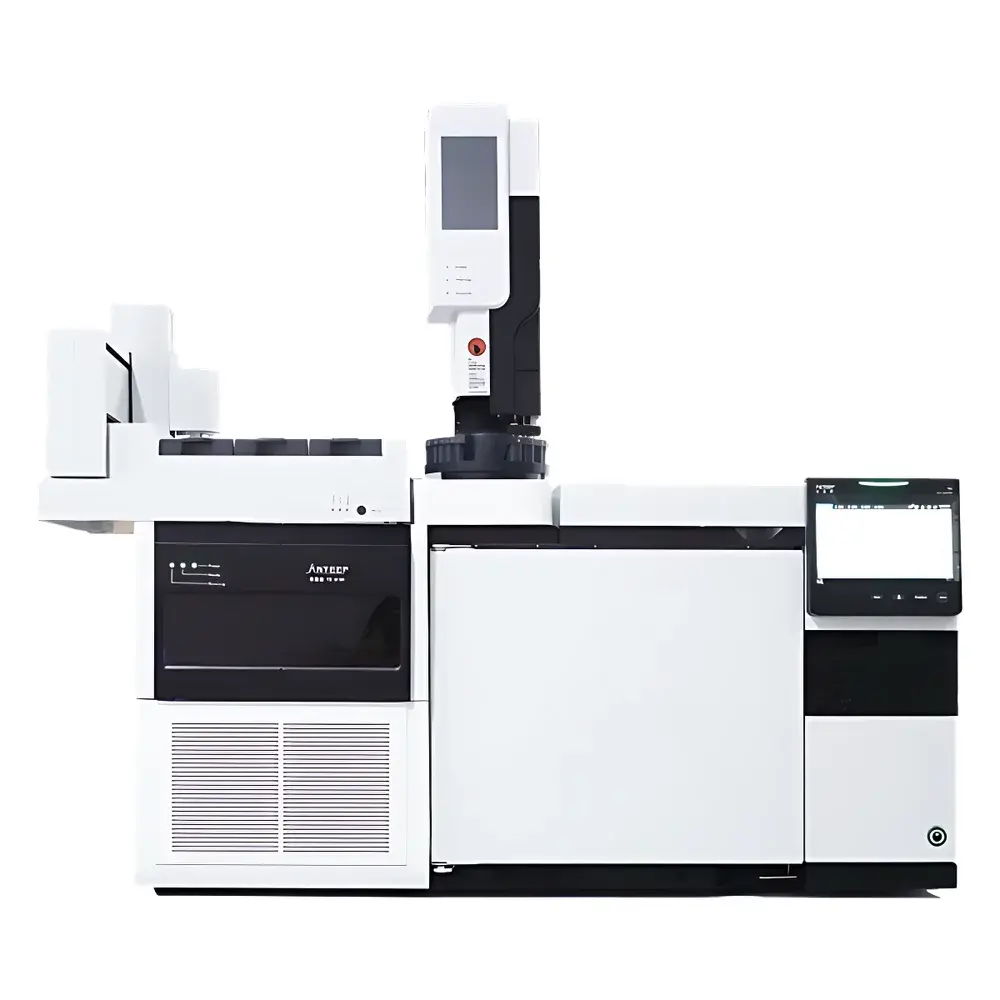
Anyeep TQ8100 Triple Quadrupole Gas Chromatography-Mass Spectrometry System
| Brand | Anyeep |
|---|---|
| Origin | Jiangsu, China |
| Manufacturer Type | Original Equipment Manufacturer (OEM) |
| Instrument Type | Triple Quadrupole Mass Spectrometer |
| GC Configuration | Conventional Capillary Gas Chromatograph |
| Model | Anyeep TQ8100 |
| Compliance | Designed for GLP/GMP-aligned laboratories |
| Software | Integrated acquisition and quantitation platform with audit trail capability |
Overview
The Anyeep TQ8100 is a triple quadrupole gas chromatography–mass spectrometry (GC-MS/MS) system engineered for high-sensitivity, high-specificity trace analysis in regulated and research-intensive environments. Built upon a conventional capillary gas chromatograph coupled to a robust triple quadrupole mass analyzer, the system operates on tandem mass spectrometry principles: Q1 selects a precursor ion, Q2 (collision cell) induces controlled fragmentation via collision-induced dissociation (CID), and Q3 monitors one or more characteristic product ions. This multiple reaction monitoring (MRM) architecture delivers exceptional selectivity and signal-to-noise performance—critical for complex matrix analysis where isobaric interferences or low-abundance analytes challenge single-stage MS detection. The instrument is designed for reproducible quantitative performance across extended run times, supporting method validation requirements aligned with ISO/IEC 17025, ASTM D7622, and USP guidelines.
Key Features
- Triple quadrupole mass analyzer with independently controlled RF/DC voltages for precise ion transmission and energy-resolved fragmentation
- Electron ionization (EI) source with optional chemical ionization (CI) compatibility for complementary spectral information
- High-efficiency ion optics optimized for sensitivity in both full-scan and MRM modes
- Integrated GC oven with programmable temperature ramping (up to 450 °C), precise carrier gas flow control (electronic pneumatic control), and split/splitless injection support
- Rugged vacuum system featuring dual-stage turbomolecular pumping with real-time pressure monitoring and automatic venting protocols
- Modular hardware architecture enabling field-upgradable components including detector assemblies and interface modules
Sample Compatibility & Compliance
The TQ8100 accommodates standard 0.25–0.53 mm ID fused-silica capillary columns and supports common GC stationary phases (e.g., 5% phenyl methylpolysiloxane, polyethylene glycol). It is validated for use with volatile and semi-volatile organic compounds—including pesticides, polycyclic aromatic hydrocarbons (PAHs), endocrine disruptors, and small-molecule metabolites—in matrices such as soil extracts, water concentrates, food homogenates, and biological fluids. System design adheres to IEC 61000-6-3 (EMC) and IEC 61010-1 (safety) standards. Data acquisition and processing workflows are structured to support 21 CFR Part 11 compliance when deployed with appropriate IT infrastructure, including electronic signatures, audit trails, and role-based access controls.
Software & Data Management
The proprietary Anyeep GC-MS/MS Control and Quantitation Suite provides unified instrument control, method development, peak integration, calibration curve generation, and report export. All raw data files conform to ANDI/NetCDF format for third-party software interoperability. Audit trail functionality logs user actions—including method edits, sequence modifications, and result reprocessing—with timestamps and operator identifiers. Batch processing supports internal standard normalization, matrix-matched calibration, and QC sample flagging based on predefined acceptance criteria (e.g., %RSD ≤ 15%, recovery 70–120%). Export options include CSV, PDF, and XML formats compatible with LIMS integration.
Applications
- Residue analysis: Multi-residue pesticide screening in fruits, vegetables, and cereals per EU SANTE/11312/2021 guidelines
- Environmental testing: Quantification of persistent organic pollutants (POPs) in wastewater, sediment, and air particulate matter per EPA Method 1613 and 8270
- Metabolomics: Targeted profiling of central carbon metabolism intermediates and xenobiotic biotransformation products in plasma and urine
- Food safety: Detection of mycotoxins (e.g., aflatoxin B1), veterinary drug residues (e.g., chloramphenicol), and process contaminants (e.g., furan)
- Forensic toxicology: Confirmation and quantitation of drugs of abuse and novel psychoactive substances in blood and hair samples
FAQ
Does the TQ8100 support method transfer from other GC-MS/MS platforms?
Yes—method parameters (retention time, MRM transitions, collision energies) can be imported via CSV or exported for cross-platform validation using standardized compound libraries.
Is remote monitoring and control available?
The system supports secure remote access via TLS-encrypted HTTP(S) interface, allowing real-time status checks, queue management, and diagnostic logging without local workstation dependency.
What maintenance intervals are recommended for routine operation?
Ion source cleaning is advised every 2–4 weeks depending on sample load; turbomolecular pump oil replacement occurs annually; GC inlet liner and column trimming follow ASTM E260 practice.
Can the software generate reports compliant with ISO/IEC 17025 accreditation requirements?
Yes—the reporting module includes mandatory metadata fields (instrument ID, analyst, calibration date, uncertainty estimates), electronic signature capture, and revision history tracking.
Is the TQ8100 compatible with atmospheric pressure chemical ionization (APCI) sources?
No—this model is configured exclusively for EI/CI ionization; APCI requires a dedicated interface and is not supported in the current hardware configuration.




