
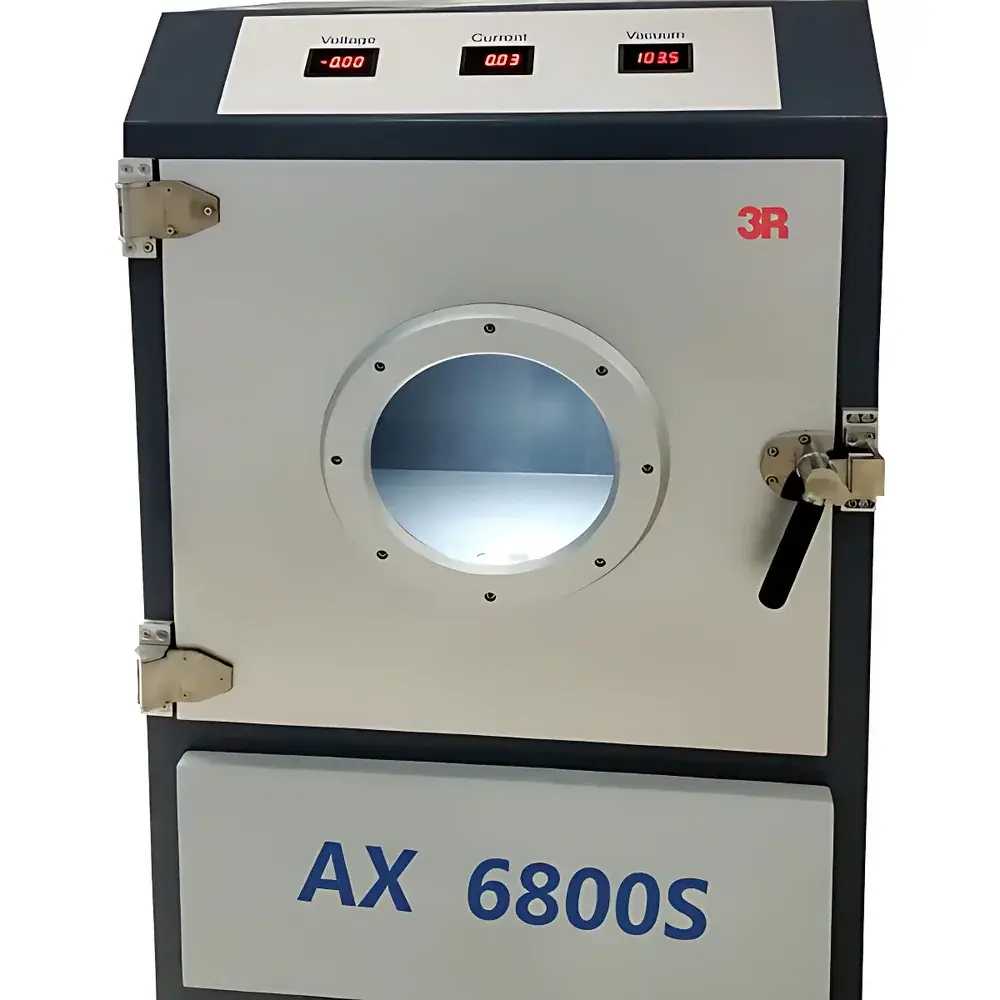
Anyty 3R-AX6800S Energy Dispersive X-Ray Fluorescence Spectrometer
| Brand | Anyty |
|---|---|
| Origin | Beijing, China |
| Manufacturer Type | Direct Manufacturer |
| Instrument Type | Benchtop ED-XRF |
| Model | 3R-AX6800S |
| Element Range | Na (11) to U (92) |
| Detection Limit | 1 ppm (matrix-dependent) |
| Quantification Range | 1 ppm – 99.99 wt% |
| Energy Resolution | 129 ± 5 eV @ Mn Kα |
| Repeatability | ≤ 0.05% RSD (for major elements, n=10) |
| Detector | Electrically Cooled Silicon Drift Detector (SDD) |
| Vacuum System | Integrated scroll pump, ultimate pressure 6.7×10⁻² Pa, pumping speed 60 L/min @ 50 Hz |
| Sample Chamber | Open design, 600 × 550 × 600 mm (L×W×H), equipped with HD coaxial camera |
| Power Supply | AC 220 V ±5 V, 50/60 Hz |
| Dimensions | 800 × 650 × 1400 mm |
| Weight | 230 kg |
Overview
The Anyty 3R-AX6800S is a benchtop energy dispersive X-ray fluorescence (ED-XRF) spectrometer engineered for non-destructive elemental analysis of heterogeneous, irregular, and historically sensitive samples—including archaeological artifacts, museum objects, metallurgical specimens, and industrial raw materials. Based on the fundamental principle of X-ray fluorescence, the instrument irradiates a sample with high-energy X-rays from a micro-focus X-ray tube (up to 50 kV, 1 mA), inducing characteristic secondary X-ray emission from constituent elements. The emitted photons are collected by a high-resolution electrically cooled silicon drift detector (SDD), enabling simultaneous multi-element detection across the full range from sodium (Na, Z = 11) to uranium (U, Z = 92). Its optimized optical path—featuring automatic collimator and filter selection, vacuum-compatible sample chamber, and real-time spectral acquisition—ensures high signal-to-noise ratio, minimal matrix effects, and quantitative reliability without sample dissolution or coating.
Key Features
- Electrically cooled SDD detector with 129 ± 5 eV energy resolution at Mn Kα, eliminating reliance on liquid nitrogen while maintaining thermal stability and long-term calibration integrity.
- Integrated SES (Smart Energy Signal) digital pulse processing system, enhancing peak deconvolution accuracy and lowering detection limits—especially critical for trace element quantification in complex matrices such as ancient ceramics or patinated bronzes.
- Seven-position motorized collimator turret (apertures: 8 mm, 4 mm, 2 mm, 1 mm, 0.5 mm, and two custom variants) combined with five-position programmable filter wheel, enabling >30 optimized excitation/detection configurations for tailored sensitivity across light, medium, and heavy elements.
- Auto-curve selection algorithm that dynamically assigns optimal calibration models based on spectral profile and intensity ratios—minimizing operator dependency and reducing misquantification risk during blind-sample analysis.
- Dual-layer radiation shielding compliant with IEC 61000-4-3 and GBZ 188–2014 occupational exposure standards; measured leakage dose rate < 0.1 µSv/h at 5 cm from housing surface under full-power operation.
- Active thermal management architecture including thermoelectric cooling for the X-ray source and forced-air convection for detector and electronics—ensuring < ±0.5 °C temperature drift over 8-hour continuous operation.
- USB 3.0 interface supporting real-time spectral streaming at up to 4096-channel resolution with zero packet loss, compatible with third-party spectral libraries and laboratory information management systems (LIMS).
Sample Compatibility & Compliance
The 3R-AX6800S accommodates solid, powdered, and liquid samples up to 600 mm × 550 mm × 600 mm in volume, with optional vacuum or helium purge capability for enhanced light-element sensitivity (Na–Mg). Its open-chamber design integrates a high-definition coaxial camera for precise positioning and region-of-interest mapping—essential for spatially resolved analysis of heterogeneous surfaces such as painted pottery shards or corroded metal interfaces. The system meets ISO 8258 (control charts), ASTM E1621 (standard guide for ED-XRF analysis of metals), and ISO 18115-2 (surface chemical analysis — XRF — part 2: reporting). All firmware and software modules support audit trail logging per FDA 21 CFR Part 11 requirements when configured with user authentication and electronic signature protocols.
Software & Data Management
Bundled archaeometric analysis software features a Windows-native GUI with modular workflows: spectrum acquisition, background subtraction (SNIP algorithm), peak fitting (Gaussian-Lorentzian hybrid), matrix correction (Fundamental Parameters + empirical coefficient library), and statistical reporting (mean, SD, RSD, confidence intervals). Preloaded calibration sets cover bronze alloys, ceramic glazes, glass compositions, and geological reference materials (e.g., NIST SRM 2711a, BHVO-2). Raw data (.spe, .csv) and processed reports (.pdf, .xlsx) are timestamped, digitally signed, and exportable to LIMS via ODBC or REST API. Full spectral archives—including live detector temperature logs, high-voltage stability records, and vacuum pressure history—are retained for GLP/GMP-compliant review cycles.
Applications
- Archaeometry & Cultural Heritage: Non-invasive provenance studies of ceramics, coins, jewelry, and ritual bronzes; identification of restoration interventions; corrosion layer stratigraphy.
- Metallurgical QA/QC: Positive material identification (PMI) in piping, valves, and pressure vessels; alloy grade verification (e.g., ASTM B16, UNS numbering); inclusion analysis in castings and forgings.
- Industrial Raw Materials: Screening of catalysts, battery cathode precursors (LiNiCoMnO₂), fly ash, slag, and mineral concentrates for regulatory compliance (RoHS, REACH, ASTM D6443).
- Environmental & Forensic Science: Soil heavy-metal screening (Pb, As, Cd, Hg), paint chip lead analysis, gunshot residue (GSR) characterization, and glass fragment comparison.
- Pharmaceutical Excipients: Elemental impurity testing per ICH Q3D guidelines (Class 1–3 elements) in APIs and final dosage forms.
FAQ
What is the minimum detectable concentration for light elements such as Mg or Al?
Detection limits for Mg and Al are typically 10–50 ppm in air mode and improve to 1–5 ppm under vacuum or He flush, depending on sample homogeneity and matrix absorption.
Does the system support certified reference material (CRM) calibration?
Yes—the software includes built-in CRM libraries (NIST, BAM, USGS) and supports user-defined calibrations with uncertainty propagation per ISO/IEC 17025 Annex A.3.
Can the instrument be integrated into an automated production line?
The 3R-AX6800S offers RS-232, Ethernet, and Modbus TCP interfaces for PLC synchronization and pass/fail output signaling—enabling inline PMI verification in foundry or scrap sorting environments.
Is remote diagnostics and software update supported?
Firmware and application updates are delivered via secure HTTPS; remote session access (with explicit user consent) is available through TLS-encrypted VNC for technical support and preventive maintenance planning.
What vacuum level is required for optimal Na–P quantification?
A stable vacuum below 1×10⁻¹ Pa is recommended for sub-100 ppm quantification of Na, Mg, Al, and Si; the integrated scroll pump achieves this within ≤90 seconds.







