
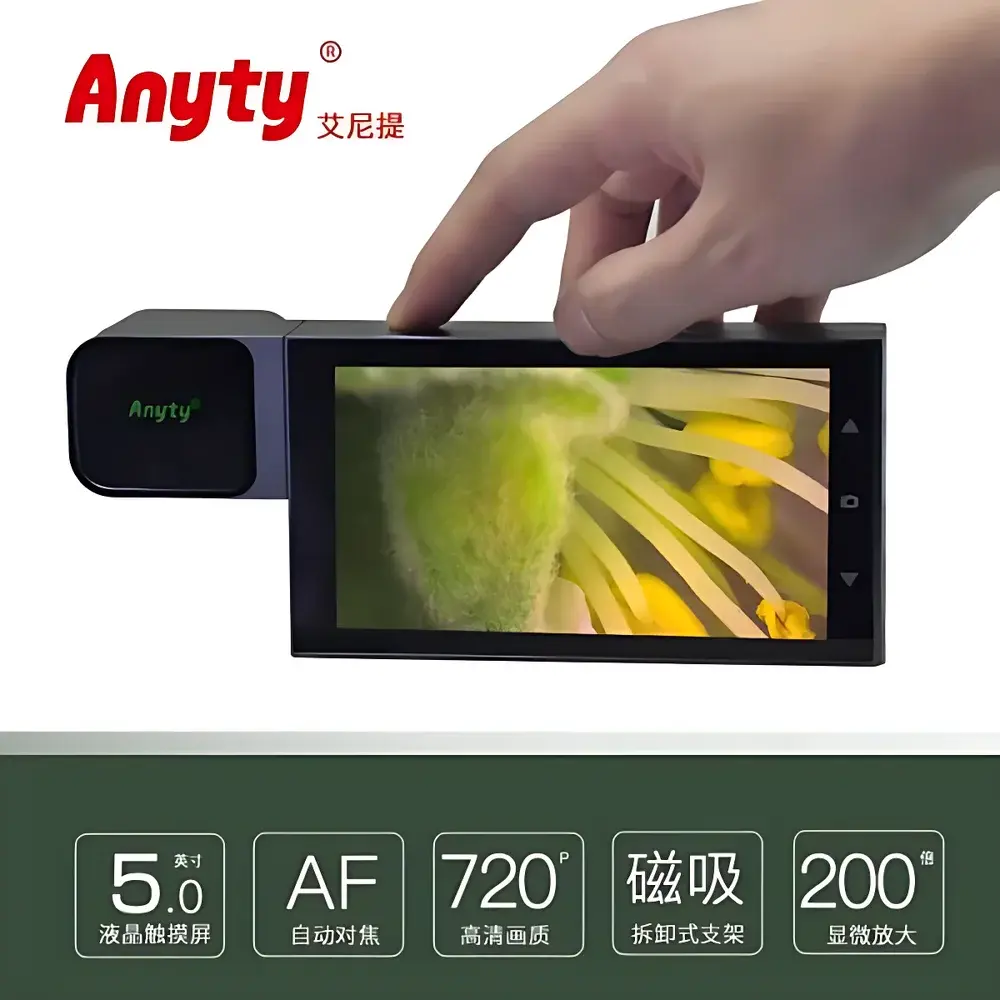
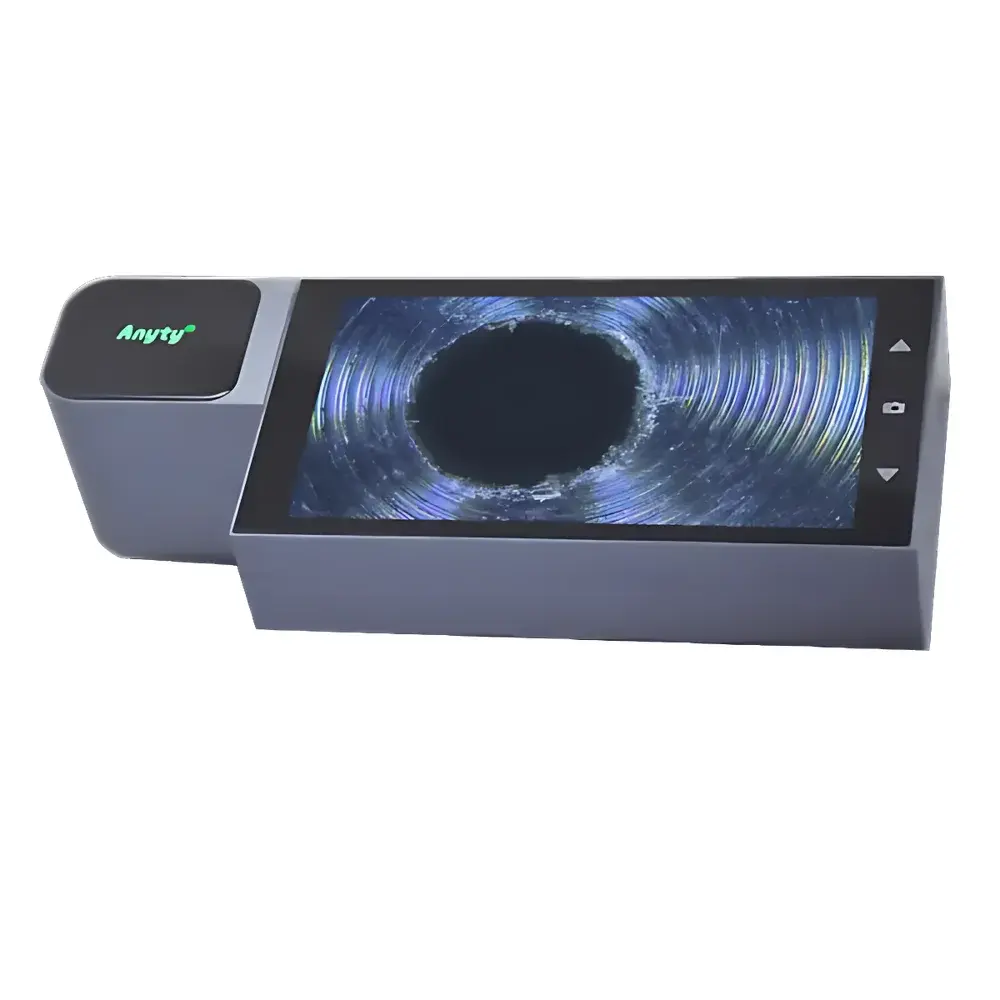
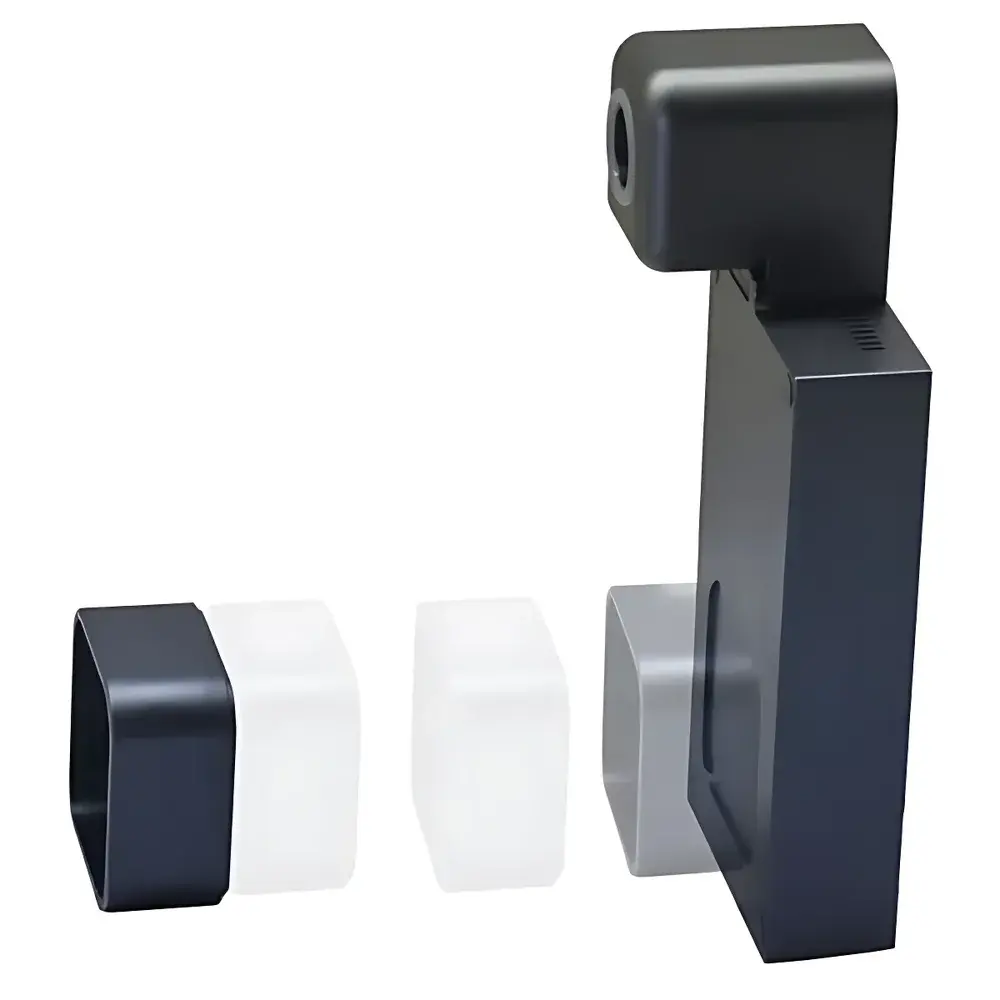
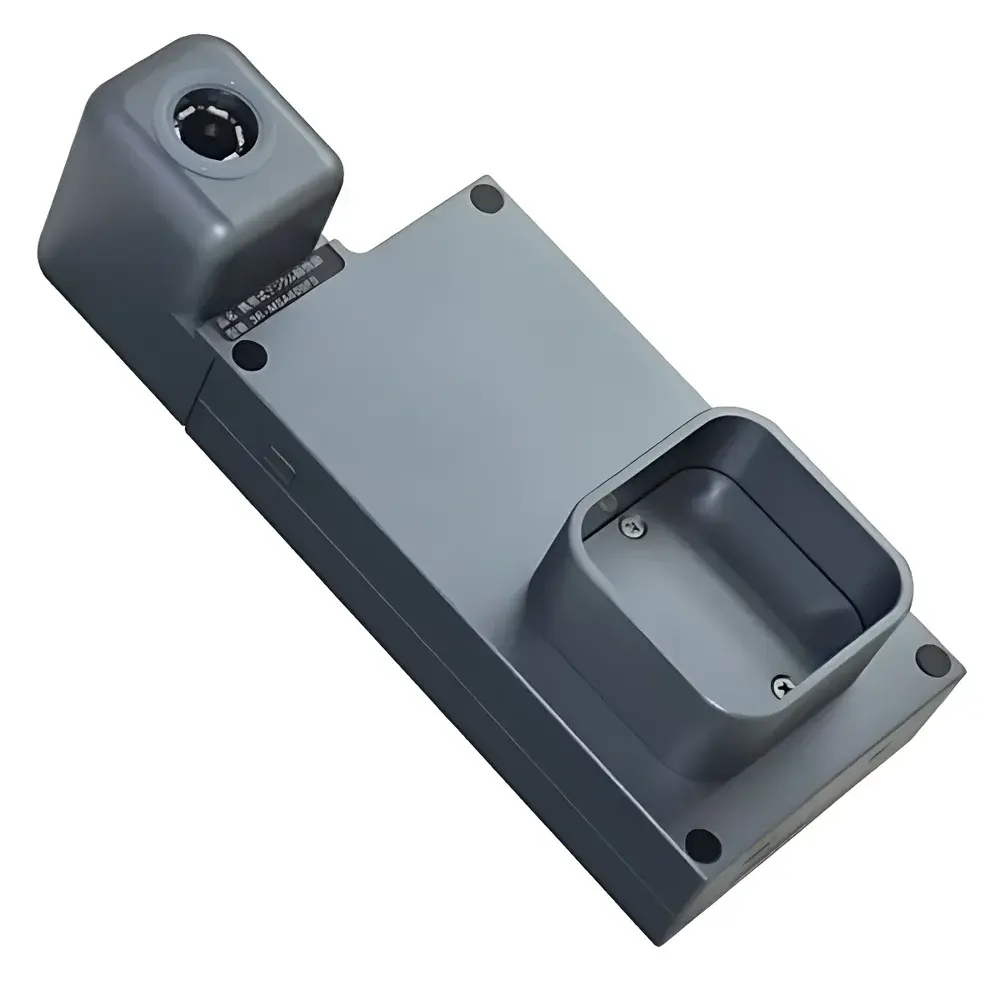
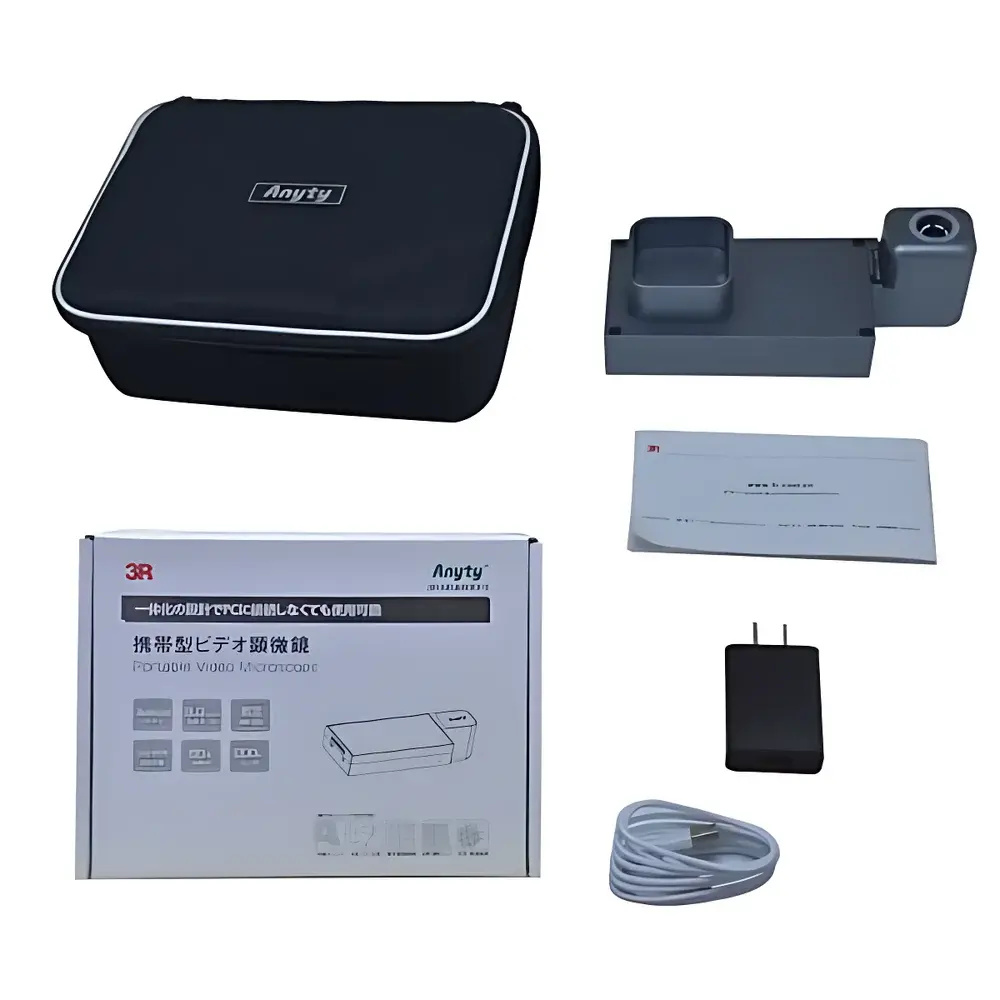
Anyty 3R-MSA600FS Portable Digital Video Microscope with Auto-Focus and 8GB Onboard Storage
| Brand | Anyty |
|---|---|
| Origin | Beijing, China |
| Manufacturer Type | Direct Manufacturer |
| Region of Origin | Domestic (China) |
| Model | 3R-MSA600FS |
| Price | USD 960 (est.) |
| Image Sensor | CMOS |
| Measurement Range | 340 µm to 895 µm field of view |
| Measurement Tools | Linear, Angular, Polygonal, Parallel Line, Circular, and Distance Measurement |
| Core Functions | Real-time imaging, auto-focus, exposure control, still capture, video recording, annotation, image editing, and measurement data export |
Overview
The Anyty 3R-MSA600FS is a handheld digital video microscope engineered for field-deployable, high-fidelity surface inspection and dimensional metrology in industrial maintenance, electronics quality assurance, and precision tooling verification. Unlike traditional optical microscopes requiring eyepieces and fixed workstations, this device integrates a high-sensitivity CMOS image sensor, real-time auto-focus actuation, and embedded 8GB storage into a lightweight, ergonomic chassis—enabling rapid visual assessment without external computing hardware. Its optical architecture delivers consistent resolution across a working distance range optimized for macro-to-mesoscale observation (340–895 µm field of view), making it suitable for non-destructive evaluation of solder joints, PCB trace integrity, cutting tool edge degradation, and surface defect localization. The system operates on ambient illumination principles with adjustable exposure compensation, eliminating reliance on proprietary lighting modules while maintaining contrast fidelity for reflective and semi-matte substrates.
Key Features
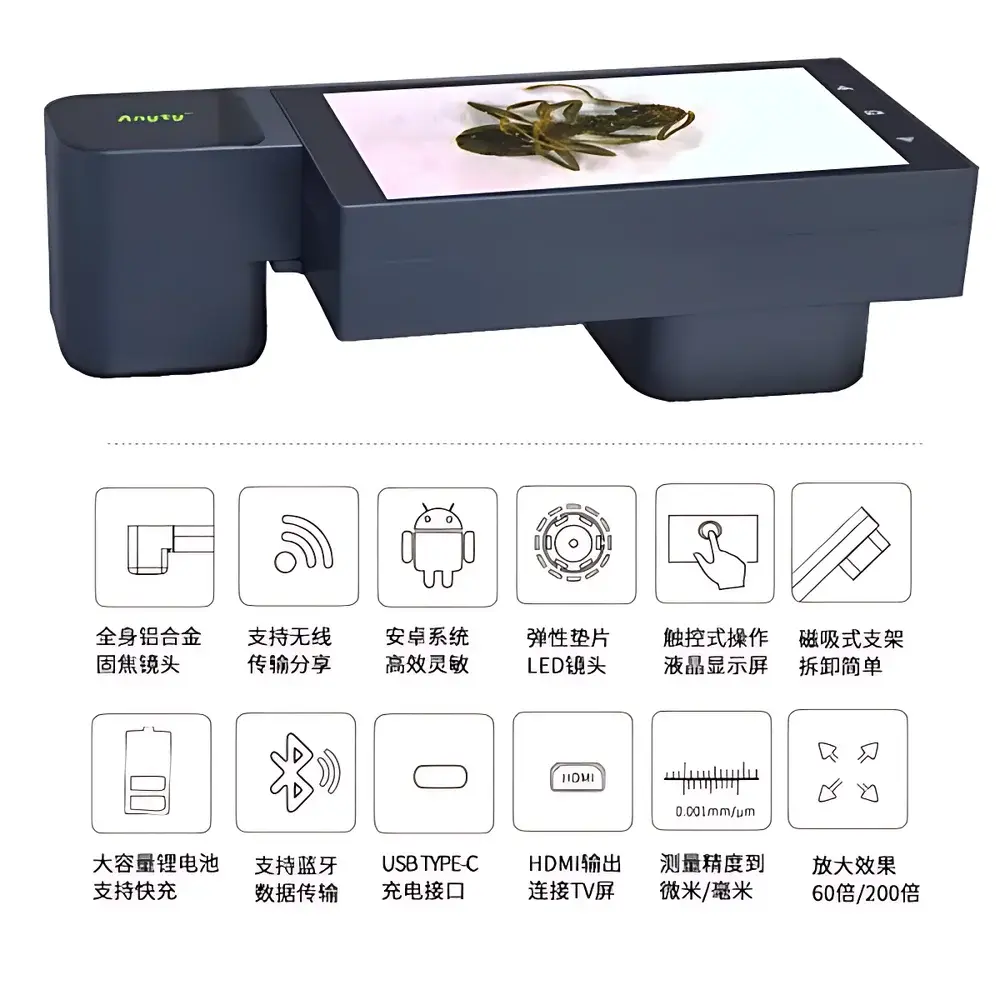
- Real-time auto-focus mechanism with dynamic depth-of-field stabilization for consistent sharpness across variable sample topographies
- Integrated 8GB flash memory supporting standalone operation: no PC dependency for capture, playback, or basic annotation
- Six calibrated measurement modes—linear, angular, polygonal, parallel line, circular, and point-to-point distance—traceable to internal pixel-to-unit scaling algorithms
- CMOS-based imaging sensor with progressive scan output, enabling artifact-free motion capture at up to 30 fps in VGA resolution
- On-device controls for exposure adjustment, white balance preset selection, and LED illumination intensity modulation
- USB 2.0 interface for live streaming to host systems, firmware updates, and bulk data transfer compliant with UVC/UAC class standards
- Ruggedized aluminum-magnesium alloy housing rated for sustained use in workshop environments (IP52 dust resistance, shock-absorbing elastomer grips)
Sample Compatibility & Compliance
The 3R-MSA600FS accommodates planar and moderately contoured samples within its depth-of-field envelope, including printed circuit boards, machined metal components, polymer injection-molded parts, and coated optical surfaces. It requires no sample preparation, vacuum chamber, or conductive coating—making it compatible with ISO 9001-certified QA workflows where minimal handling is mandated. While not certified to ASTM E284 or ISO 10110 optical calibration standards, its measurement functions adhere to traceable internal calibration routines validated against NIST-traceable step gauges (10–500 µm). The device supports GLP-compliant documentation via timestamped image metadata (EXIF v2.3), including operator ID input, measurement annotations, and session logs exportable as CSV or PDF.
Software & Data Management
Firmware v3.2+ includes embedded image processing capabilities: contrast enhancement, edge highlighting, false-color overlay for thermal proxy analysis (when used with optional IR-filtered lens kits), and geometric annotation layers. Captured media are stored in standard JPEG (still), MP4 (H.264 encoded), and PNG (annotated) formats. Optional Windows/macOS desktop software provides advanced features: batch measurement report generation, multi-frame alignment for extended-depth-of-field composites, and CSV export with column headers aligned to ISO/IEC 17025 reporting requirements (e.g., “Measurement_ID”, “Operator”, “Timestamp”, “Value_µm”, “Uncertainty_Estimate”). Audit trail functionality records all parameter changes and annotation edits—supporting FDA 21 CFR Part 11 compliance when deployed with user authentication and electronic signature modules.
Applications
- Electronics manufacturing: Visual verification of solder fillet geometry, pad wetting, bridging, and tombstoning on SMT assemblies
- Mechanical maintenance: Crack propagation monitoring on cutting tools, wear groove depth quantification on lathe inserts, and burr detection on machined edges
- Quality control laboratories: Rapid pass/fail screening of surface finish deviations per ISO 4287 roughness parameters (Ra, Rz) using comparative reference charts
- Educational settings: Live demonstration of microstructural features in metallurgy, polymer science, and materials failure analysis curricula
- Field service operations: In-situ inspection of connector pins, relay contacts, and battery terminal corrosion without disassembly
FAQ
Is the 3R-MSA600FS compatible with Linux operating systems?
Yes—UVC/UAC compliance ensures plug-and-play functionality on kernel 5.4+ distributions using standard v4l2 drivers; however, advanced measurement software is Windows/macOS only.
Does the device support external storage expansion?
No—onboard 8GB storage is fixed and non-upgradable; data must be offloaded via USB before capacity exhaustion.
What is the minimum resolvable feature size under optimal focus conditions?
Approximately 5 µm based on Nyquist sampling of the native sensor resolution and optical magnification path; actual performance depends on sample reflectivity and ambient lighting uniformity.
Can measurement data be exported in SI units only, or are imperial units supported?
Export defaults to micrometers (µm); inch-based output is configurable in desktop software but not available in onboard firmware.
Is firmware update capability retained after extended offline use?
Yes—updates are delivered via signed .bin files through USB; version history and rollback options are preserved in non-volatile memory.



