
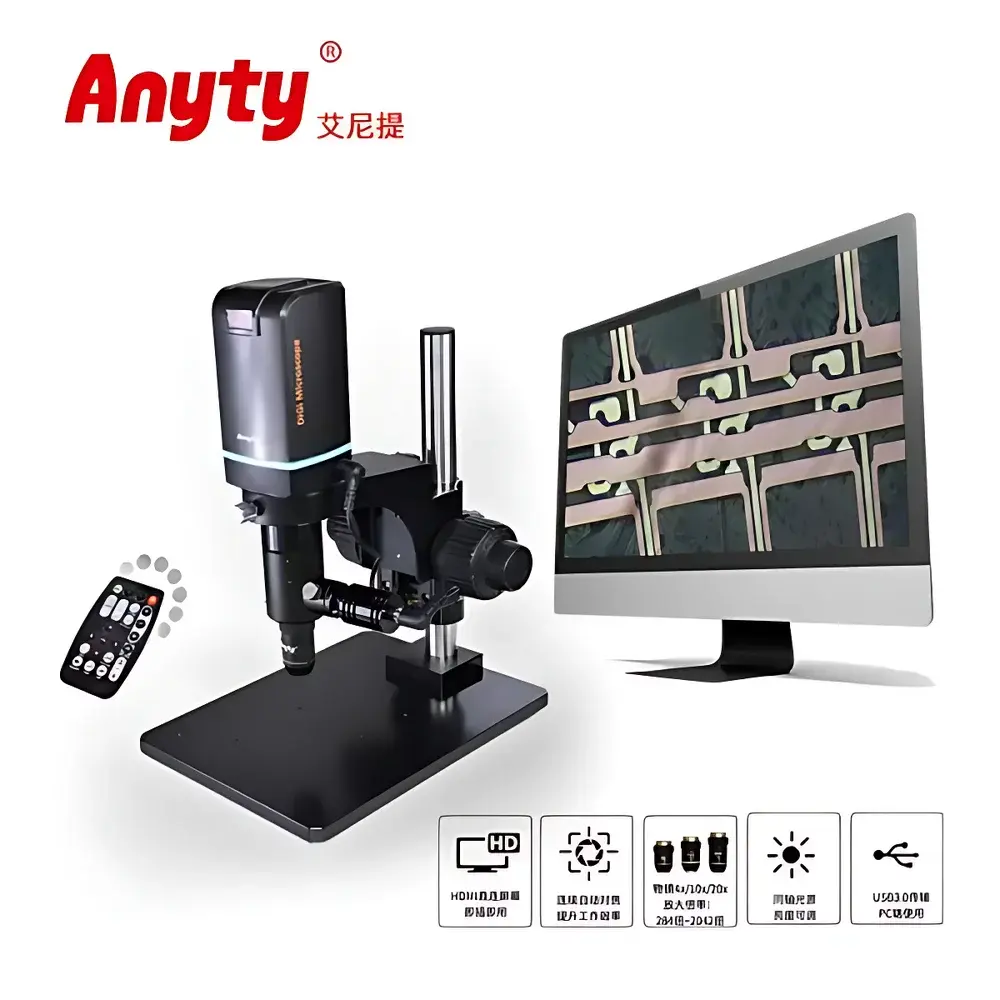
Anyty 3R-MSTVUSB2000 Desktop Coaxial Illumination Metallurgical Digital Microscope
| Brand | Anyty |
|---|---|
| Origin | Beijing, China |
| Manufacturer Type | Original Equipment Manufacturer (OEM) |
| Product Origin | Domestic (PRC) |
| Model | 3R-MSTVUSB2000 |
| Imaging Sensor | CMOS |
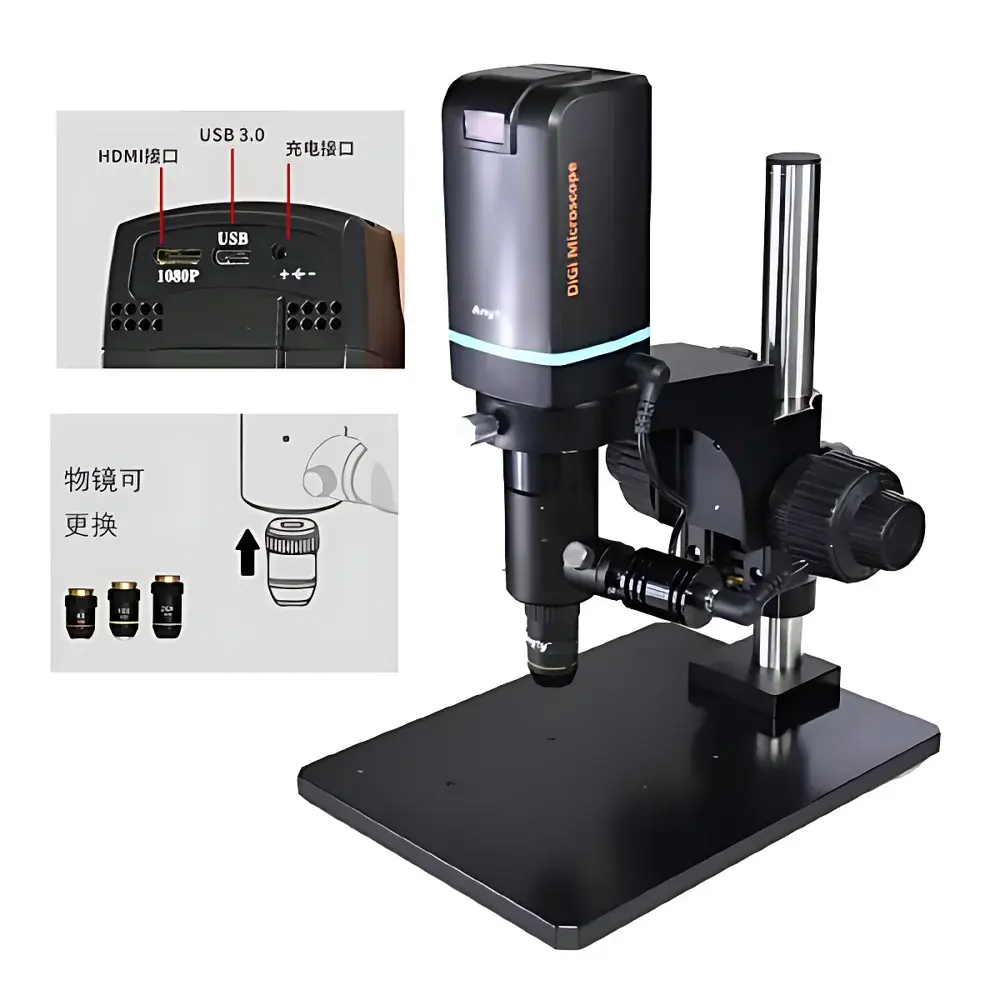
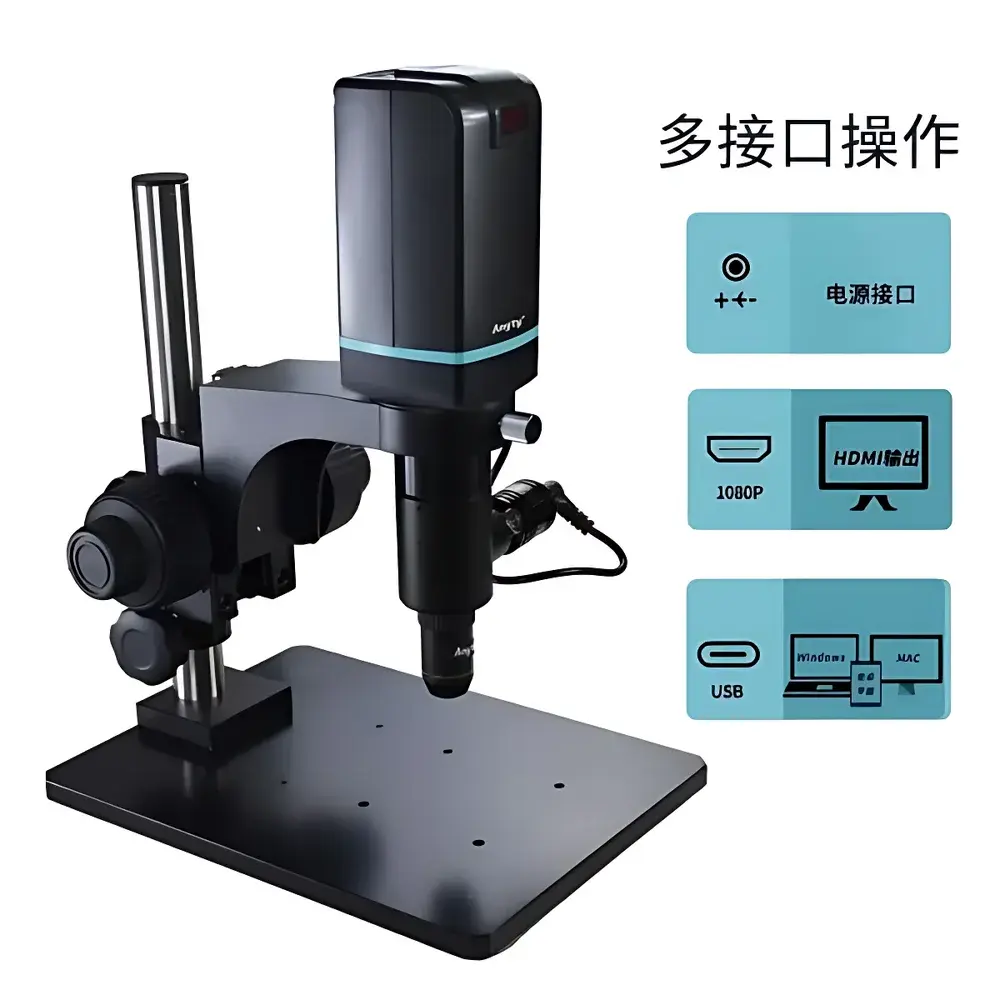
| Interface | USB 3.0 & HDMI |
| Display Compatibility | Windows OS & HDMI-enabled monitors |
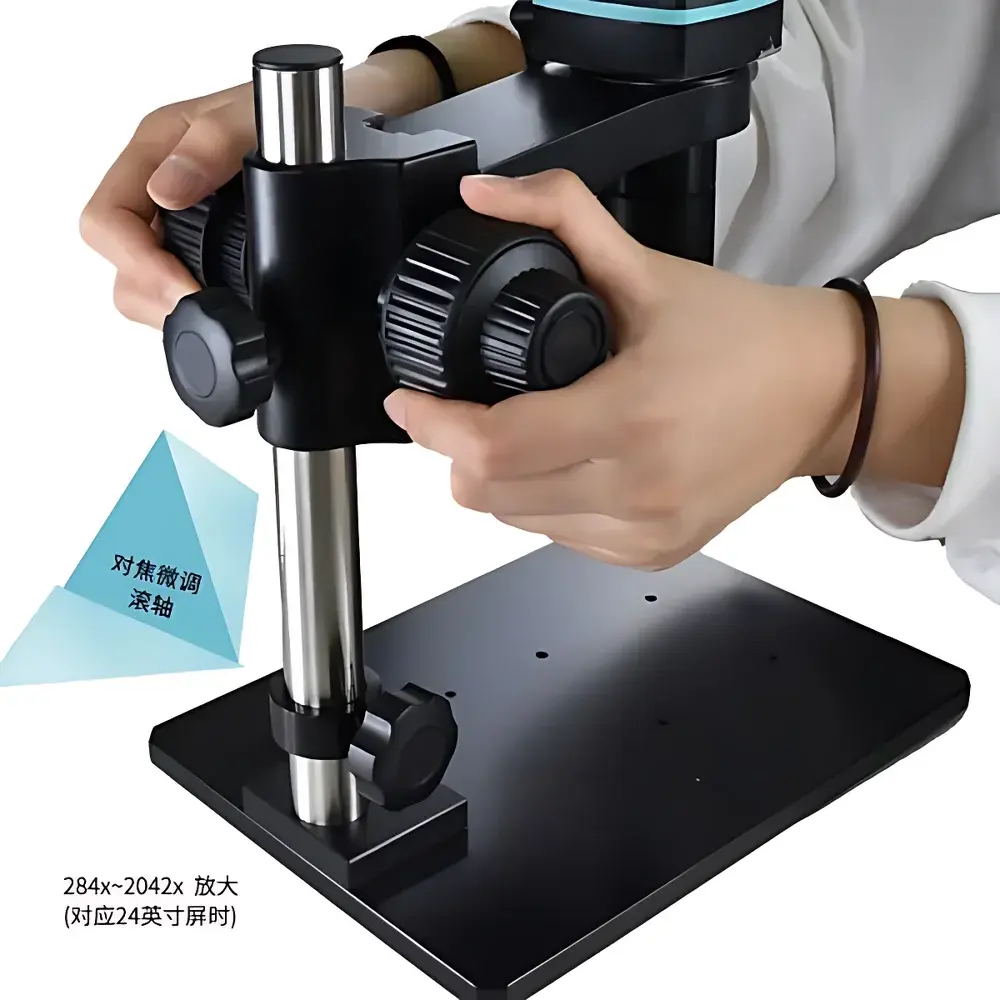
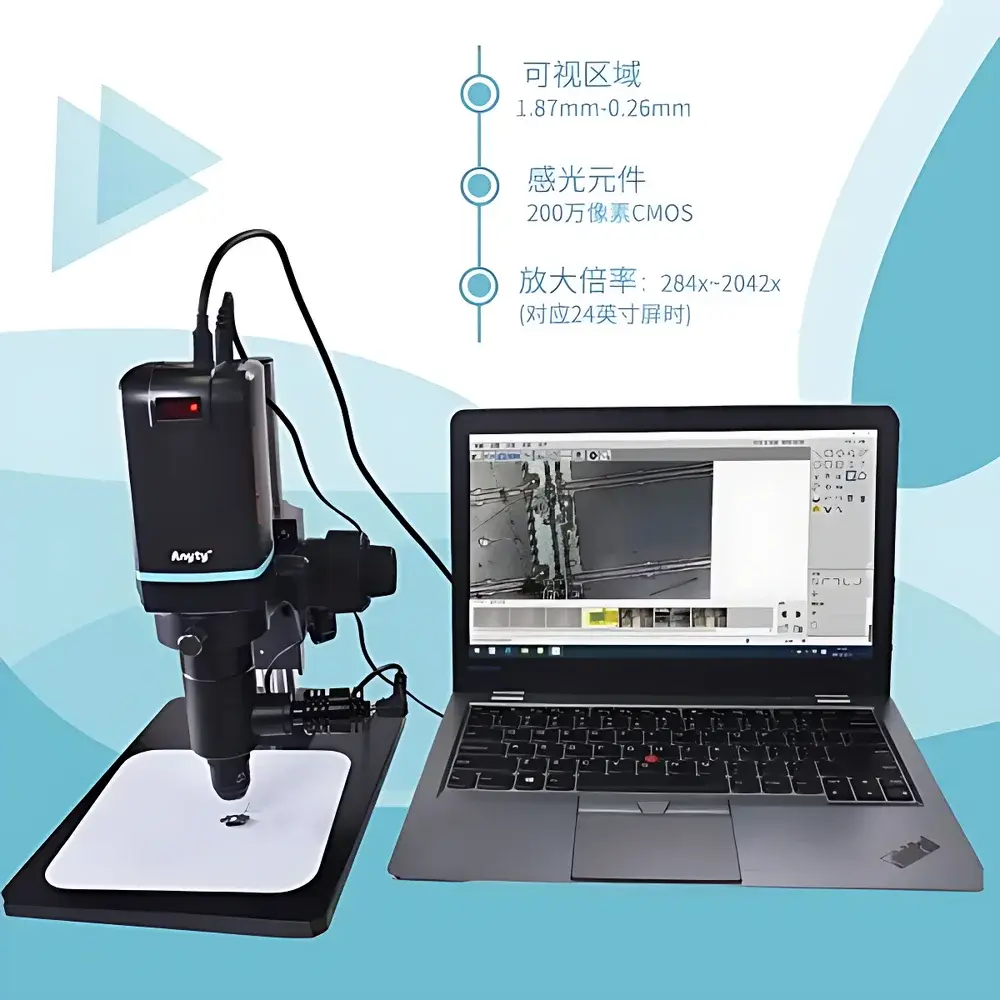
| Magnification Range | 284×–2042× (calculated on 24-inch display) |
| Auto-Focus Speed | ≤3 seconds |
| Illumination | Integrated coaxial LED lighting |
| Form Factor | Benchtop, non-inverted configuration |
Overview
The Anyty 3R-MSTVUSB2000 is a benchtop coaxial illumination metallurgical digital microscope engineered for high-contrast surface inspection of opaque, reflective specimens—particularly polished metallographic samples, printed circuit boards (PCBs), solder joints, coated surfaces, and precision machined components. Unlike conventional brightfield optical microscopes, this system employs coaxial (epi-illumination) LED lighting aligned with the optical axis to eliminate shadowing and specular glare, thereby enhancing edge definition and topographic contrast in highly reflective materials. It operates on a fixed-focus optical path with motorized zoom and software-driven focus control, delivering real-time HD imaging without eyepieces or mechanical stage adjustments. Designed for integration into quality control laboratories, incoming inspection stations, and failure analysis workflows, the 3R-MSTVUSB2000 bridges the functional gap between traditional metallurgical microscopes and modern digital imaging platforms—offering rapid deployment, minimal training overhead, and direct compatibility with industry-standard documentation protocols.
Key Features
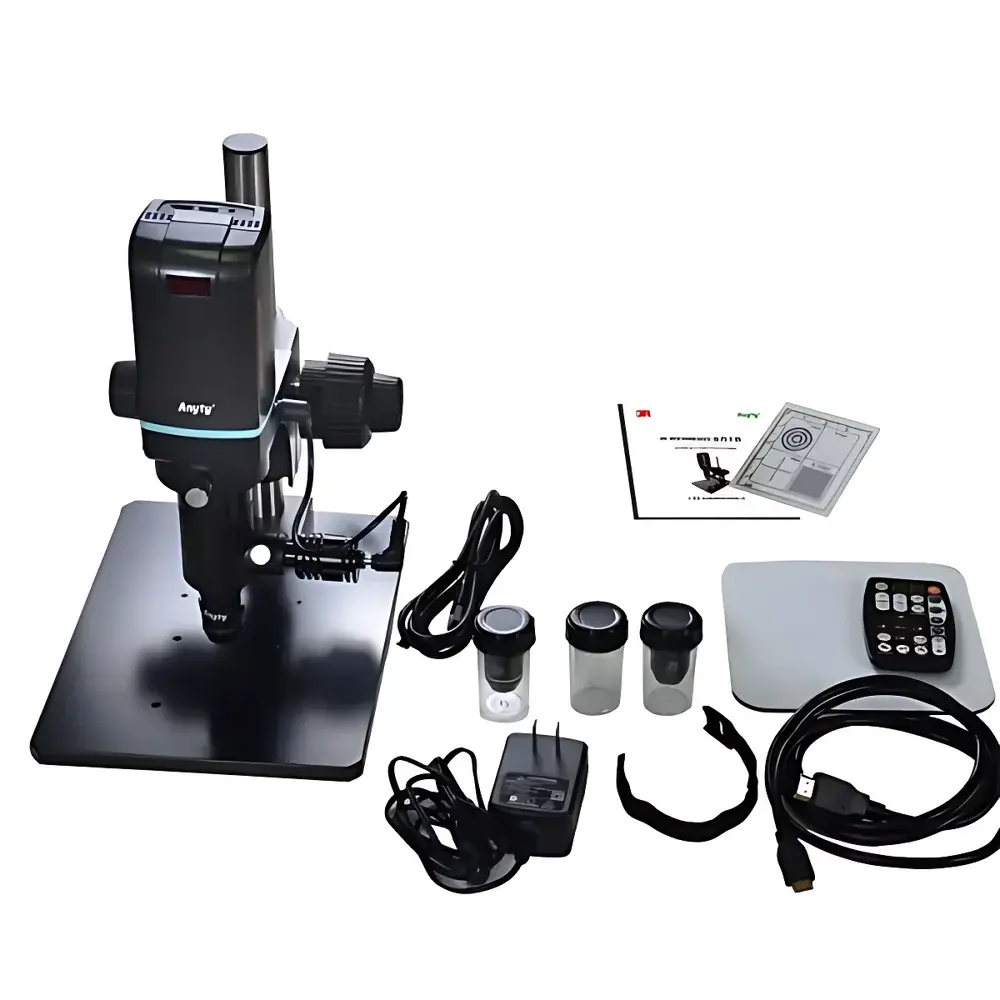
- Benchtop ergonomic design with integrated base, adjustable height column, and rigid aluminum alloy housing for vibration-damped operation in production-floor environments.
- Coaxial LED illumination system with uniform intensity distribution and selectable brightness levels—optimized to suppress Fresnel reflections and maximize feature visibility on polished alloys, anodized aluminum, and electroplated substrates.
- High-sensitivity CMOS image sensor with progressive scan architecture, supporting full HD (1920 × 1080) video streaming at 30 fps via USB 3.0 interface—ensuring low-latency acquisition and minimal motion blur during dynamic inspection.
- Dual-output connectivity: native USB 3.0 for direct PC integration (Windows 7/10/11 compatible drivers included) and HDMI output for standalone monitoring on calibrated industrial displays or QA review stations.
- Software-controlled auto-focus algorithm achieving stable focus lock within ≤3 seconds across the entire magnification range—enabled by closed-loop focus motor feedback and contrast-based iterative search logic.
- Calibrated magnification scaling: reported magnifications (284×–2042×) are referenced to a 24-inch 1080p display; actual pixel-level resolution remains consistent regardless of display size, supporting traceable measurement workflows when paired with certified stage micrometers.
Sample Compatibility & Compliance
The 3R-MSTVUSB2000 accommodates standard metallurgical specimen formats—including 1″ × 3″ (25 × 75 mm) slides, embedded mounts up to 30 mm in height, and wafer fragments secured on vacuum chucks or magnetic holders. Its working distance (≥65 mm) permits clearance for coarse grinding fixtures and probe accessories. While not certified to ISO/IEC 17025 as a metrology instrument, the system supports GLP-compliant documentation through timestamped image capture, user-defined annotation layers, and export of metadata-rich TIFF/PNG files. It meets CE electromagnetic compatibility (EMC) Directive 2014/30/EU and RoHS 2011/65/EU requirements. For regulated manufacturing environments (e.g., automotive Tier-1 suppliers or medical device component vendors), the microscope can be validated per internal SOPs referencing ASTM E3–22 (Standard Guide for Preparation of Metallographic Specimens) and ISO 4520–2005 (Metallic coatings — Measurement of coating thickness — Microscopical method).
Software & Data Management
Bundled proprietary software provides real-time image enhancement (histogram equalization, noise reduction, edge sharpening), multi-frame averaging, and on-screen measurement tools (line, angle, area, circle, and step-height). All measurements are traceable to user-applied calibration factors stored in encrypted project files. Export options include annotated PDF reports, CSV data logs, and AVI video sequences with embedded timecode. The software supports audit trail generation (user ID, timestamp, parameter changes) compliant with FDA 21 CFR Part 11 Annex 11 principles when deployed on domain-joined Windows systems with role-based access controls. No cloud synchronization or remote telemetry is enabled by default—data residency remains fully on-premises unless explicitly configured by the end-user.
Applications
- Metallographic grain structure analysis of ferrous and non-ferrous alloys post-etching.
- Solder joint inspection per IPC-A-610 Class 2/3 criteria, including void detection, fillet profiling, and wetting angle assessment.
- Surface defect mapping of heat-treated tool steels, turbine blades, and additive-manufactured (AM) metal parts.
- Coating thickness estimation via cross-sectional imaging of embedded samples (requires sectioning and polishing prior to observation).
- Failure analysis of brittle fracture surfaces, fatigue striations, and intergranular corrosion patterns.
- Educational demonstration of phase transformations, inclusion identification, and microstructural evolution in materials science labs.
FAQ
Is the 3R-MSTVUSB2000 suitable for quantitative grain size measurement per ASTM E112?
It supports manual or semi-automated grain counting when used with calibrated reference charts and imported scale bars; however, full ASTM E112 compliance requires validation of the entire workflow—including sample preparation, imaging conditions, and analyst training—per laboratory-specific procedures.
Can third-party machine vision software (e.g., HALCON, OpenCV) interface with the CMOS sensor?
Yes—the device enumerates as a UVC-compliant video class device under Windows; SDKs and custom wrappers are available upon request for integration into automated AOI pipelines.
Does the coaxial illumination support polarization filtering?
No built-in polarizer is included, but external linear polarizers (25 mm diameter, mounted in front of the objective lens) may be added to reduce glare from highly anisotropic surfaces.
What is the maximum supported USB cable length without signal degradation?
For sustained 1080p/30fps performance, passive USB 3.0 cables should not exceed 3 meters; active extension solutions (optical or powered repeaters) are recommended for longer runs.
Is firmware update capability provided?
Yes—firmware updates are distributed via the manufacturer’s secure portal and applied through the host software; version history and release notes are published with each revision.



