
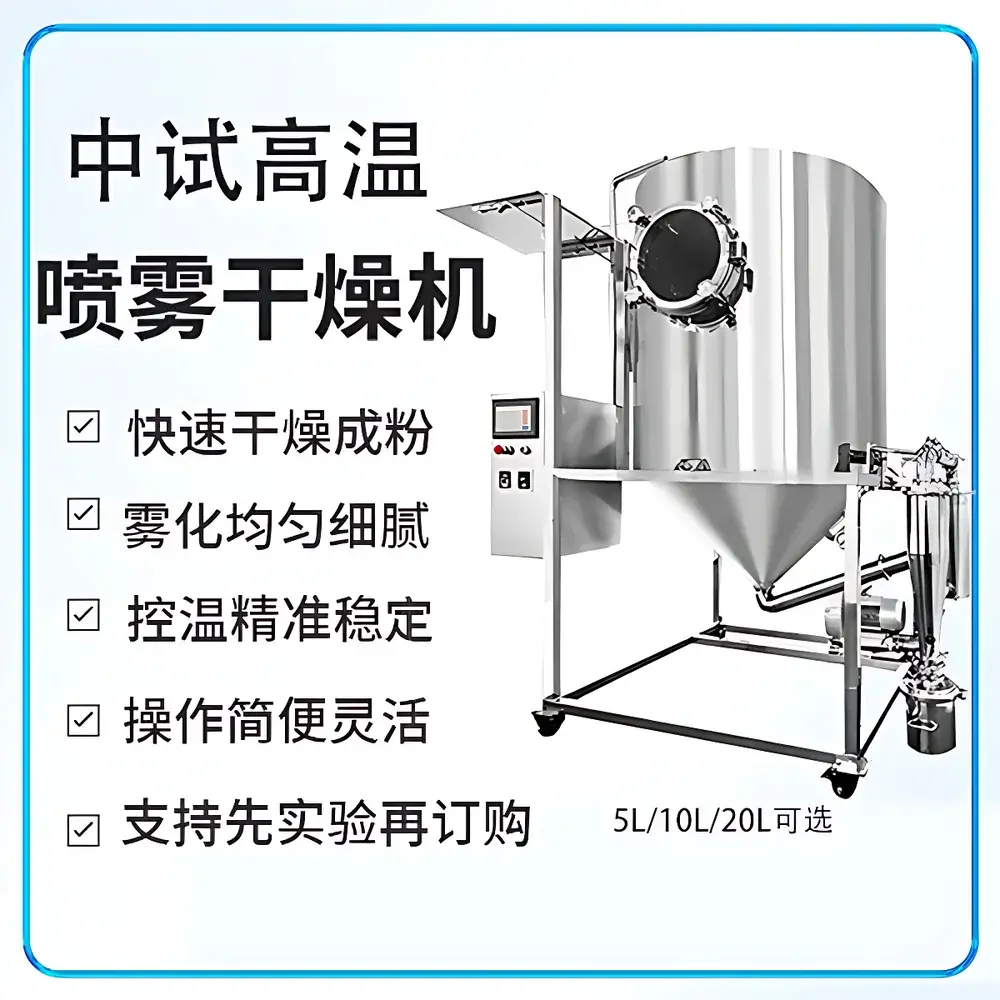
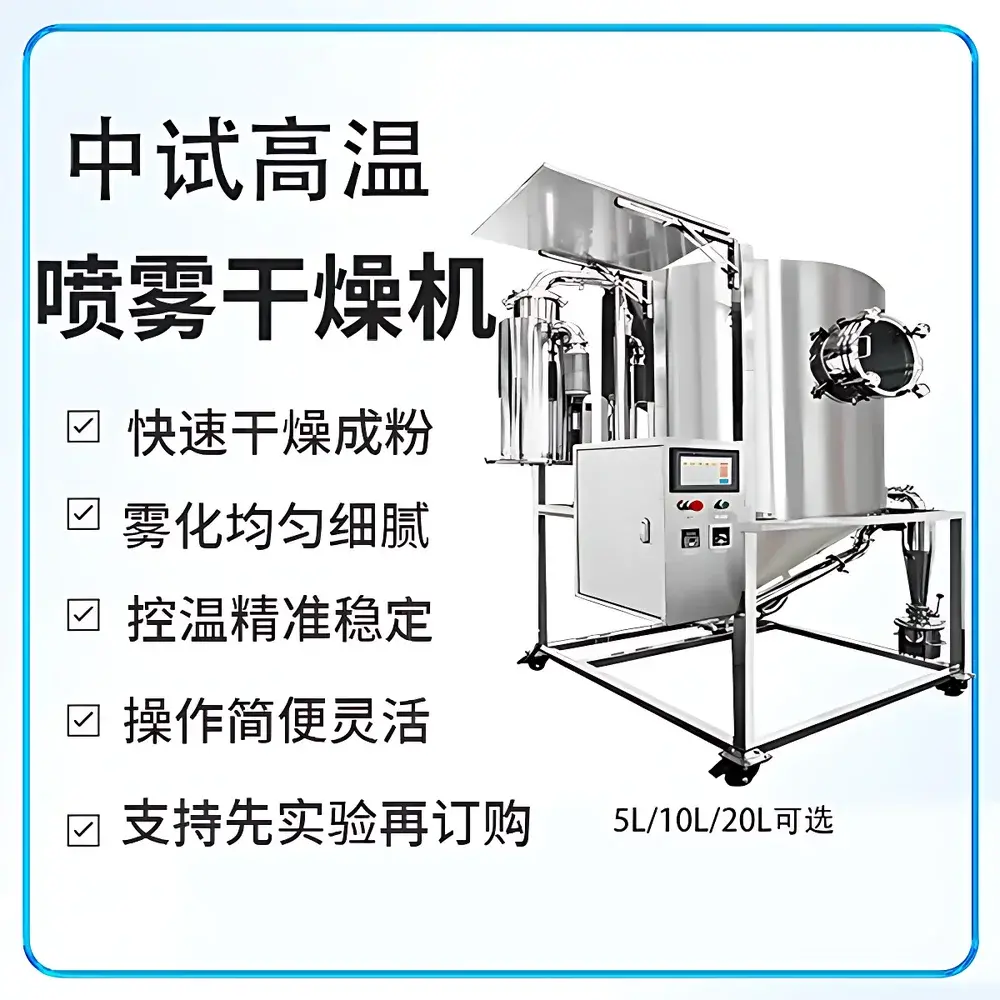
AnYuJie AYJ-GZJ5L Pilot-Scale High-Temperature Spray Dryer
| Brand | AnYuJie |
|---|---|
| Origin | Zhejiang, China |
| Model | AYJ-GZJ5L |
| Sample Types | Aqueous solutions, emulsions, suspensions |
| Max Feed Rate | 5000 mL/h |
| Temperature Range | 30–300 °C |
| Particle Size Range | 5–250 µm |
| Inlet Temp Control | 30–300 °C |
| Outlet Temp Control | 30–140 °C |
| Evaporation Capacity | 1500–5000 mL/h |
| Drying Time | 1.0–1.5 s |
| Chamber ID | 1000 mm |
| Chamber Height | 2000 mm |
| Power Supply | 380 V / 20 kW |
| Fan Power | 2.2 kW |
| Airflow | 315 m³/min |
| Pressure Range | +40 kPa / −32 kPa |
| Control Accuracy | ±1 °C |
| Material Contact Surface | AISI 304 stainless steel |
Overview
The AnYuJie AYJ-GZJ5L Pilot-Scale High-Temperature Spray Dryer is an engineered solution for scalable powder production under controlled thermal conditions. It operates on the principle of concurrent (co-current) spray drying: atomized feed droplets and heated drying air enter the drying chamber in the same direction. This configuration ensures rapid heat and mass transfer while minimizing thermal stress on thermolabile compounds—making it suitable for pharmaceutical actives, biopolymers, functional food ingredients, and ceramic precursors. With an inlet temperature range of 30–300 °C and precise outlet temperature regulation (30–140 °C), the system supports both gentle dehydration of sensitive biomolecules and high-temperature conversion of inorganic precursors. The average residence time of droplets within the hot gas stream is tightly constrained to 1.0–1.5 seconds—sufficient for evaporating 95–98% of solvent content while preserving particle morphology and chemical integrity.
Key Features
- Concurrent-flow drying architecture optimized for thermal sensitivity and reproducibility
- AISI 304 stainless steel contact surfaces throughout the feed path, atomization zone, and drying chamber—ensuring compliance with GMP-grade material compatibility requirements
- Integrated touch-screen HMI for real-time control of peristaltic feed rate (50–5000 mL/h), inlet/outlet temperatures, and airflow parameters
- Dual-pressure capability: adjustable positive pressure up to +40 kPa and negative pressure down to −32 kPa for containment or inert-atmosphere operation
- High-efficiency centrifugal atomizer with stable rotational speed (2800 rpm) enabling consistent droplet size distribution
- Robust thermal management system with ±1 °C temperature control accuracy across all operational setpoints
- Modular design supporting integration into pilot-line workflows—including downstream cyclone collection, bag filtration, or integrated solvent recovery loops
Sample Compatibility & Compliance
The AYJ-GZJ5L accommodates a broad spectrum of liquid feedstocks: aqueous solutions, oil-in-water emulsions, colloidal suspensions, and polymer dispersions. Its ability to process feeds with initial solids content ranging from 5% to 90% w/w eliminates the need for pre-concentration steps in many formulation workflows. All wetted parts meet ASTM A240/A240M specifications for 304 stainless steel, ensuring corrosion resistance against organic solvents and mild acidic/basic media. The unit is designed to support compliance with ISO 22000 (food safety), USP (sterile processing considerations), and ICH Q5C (stability of biotechnological products). While not certified for Class A/B cleanroom use out-of-the-box, its sealed construction and smooth-welded interior surfaces facilitate validation per FDA 21 CFR Part 11 and EU Annex 11 when paired with qualified data logging systems.
Software & Data Management
Embedded firmware records all critical process parameters—including feed rate, inlet/outlet temperatures, chamber pressure differential, fan amperage, and runtime—at 1-second intervals. Data export is supported via USB or Ethernet in CSV format, compatible with LIMS platforms and statistical process control (SPC) software such as JMP or Minitab. Audit trails are timestamped and user-identified; electronic signatures can be enabled to satisfy ALCOA+ principles (Attributable, Legible, Contemporaneous, Original, Accurate). Optional OPC UA connectivity allows integration into MES environments for batch-level traceability and automated report generation aligned with GxP documentation standards.
Applications
- Pharmaceutical development: production of inhalable dry powders, amorphous solid dispersions, and excipient-free API microparticles
- Food science: encapsulation of probiotics, vitamins, and flavor oils using maltodextrin or gum arabic matrices
- Materials engineering: synthesis of spherical metal oxide nanoparticles (e.g., LiCoO₂, SiO₂) for battery cathodes or catalyst supports
- Agrochemical R&D: formulation of water-dispersible granules (WDGs) and controlled-release microcapsules
- Academic research: kinetic studies of solvent evaporation, particle formation mechanisms, and morphology–process parameter correlations
FAQ
What is the minimum batch volume this system can reliably process?
With a minimum feed volume of 50 mL and programmable low-speed peristaltic pumping, the AYJ-GZJ5L supports robust drying trials at laboratory scale—ideal for formulation screening prior to full-scale manufacturing.
Can the system operate under nitrogen or other inert atmospheres?
Yes. The dual-pressure control system enables safe operation under positive nitrogen purge (up to +40 kPa), mitigating oxidation risks during drying of oxygen-sensitive compounds such as unsaturated lipids or reduced metal catalysts.
Is the drying chamber geometry optimized for wall deposition reduction?
The conical base and tangential air inlet design promote laminar recirculation patterns that minimize particle adhesion to chamber walls. Combined with the concurrent flow profile, this reduces fouling and improves powder recovery efficiency above 92% with standard cyclone collection.
How is temperature uniformity validated inside the drying chamber?
Calibration is performed using NIST-traceable PT100 sensors at three axial positions (top, mid, bottom) during FAT. Users may conduct periodic verification using calibrated infrared pyrometers focused on the chamber’s internal reflective surface—consistent with ISO 14644-3 guidance for thermal mapping of process equipment.



