
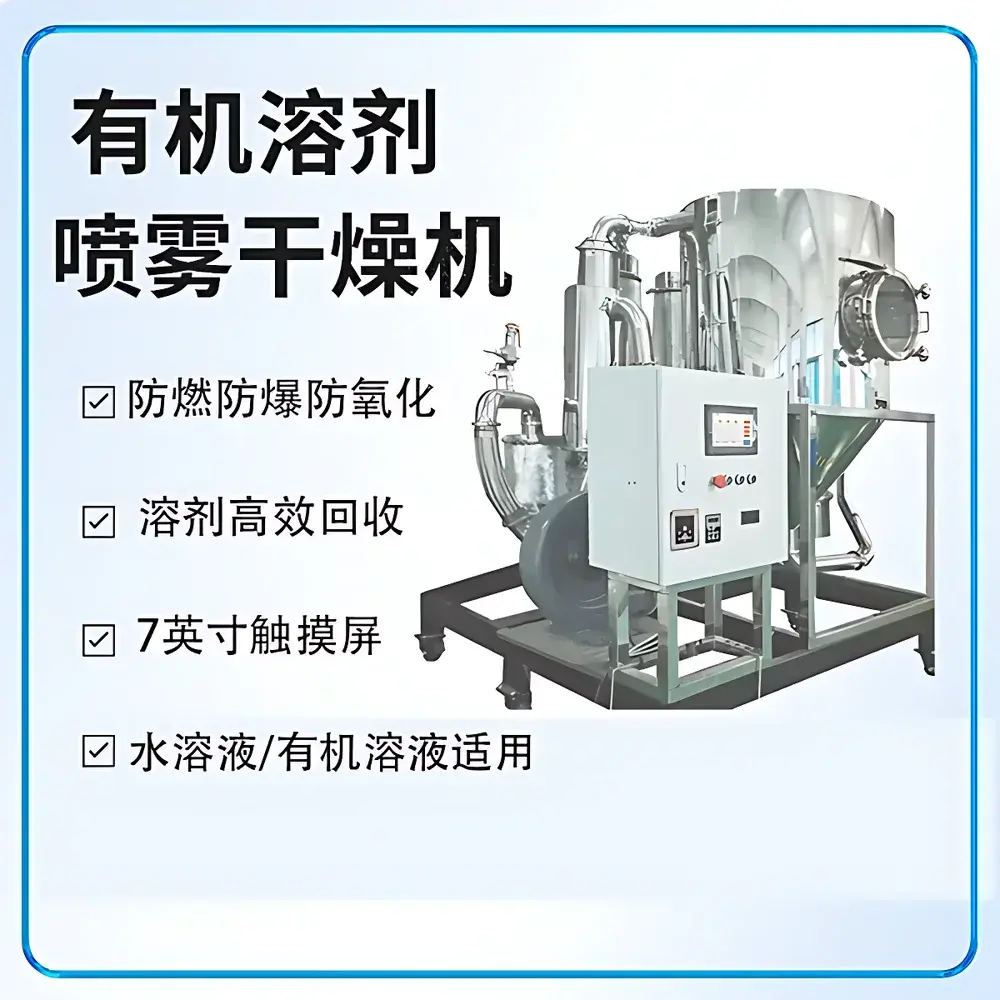
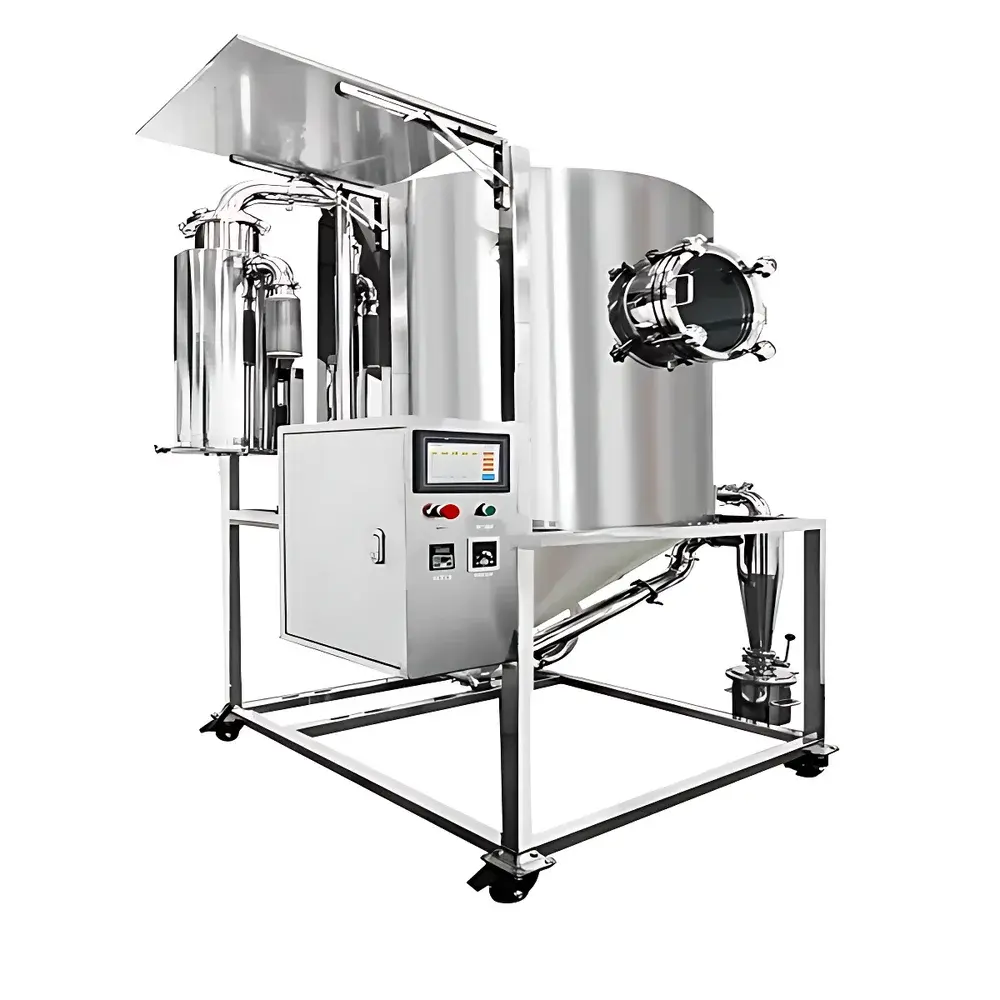
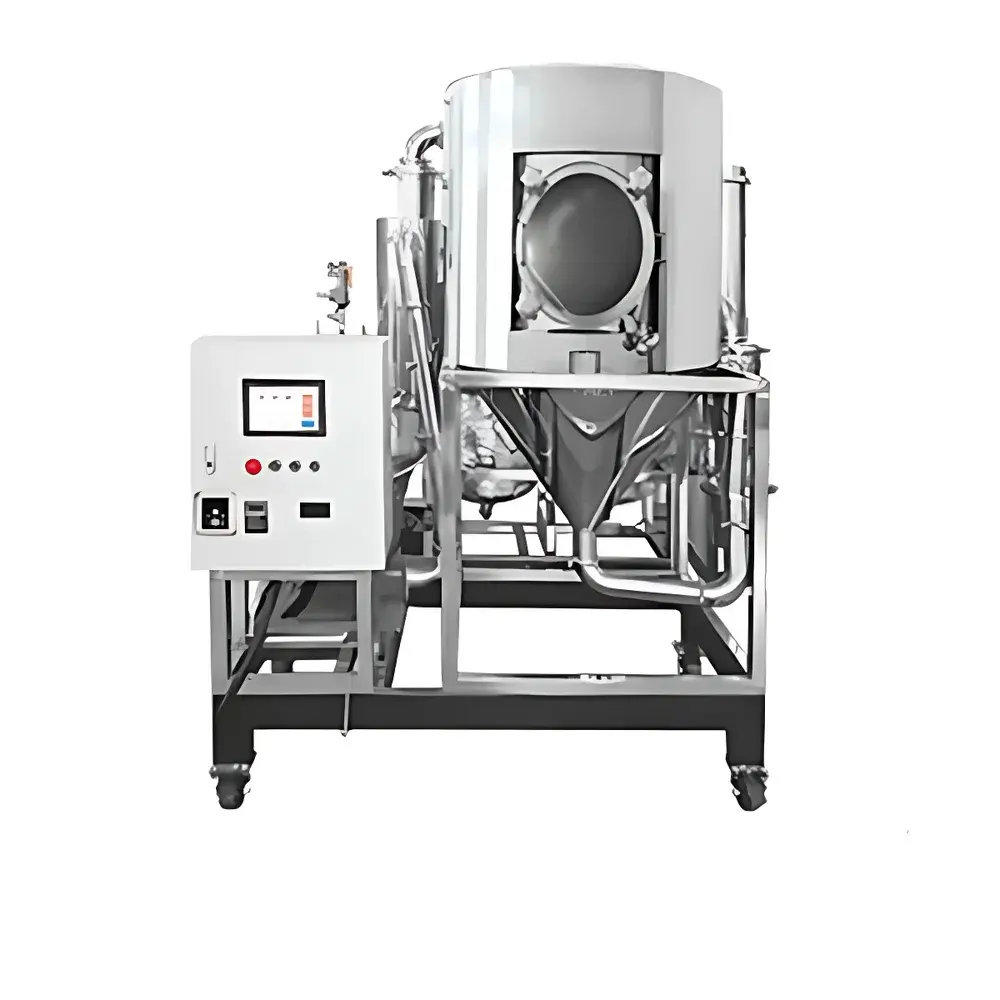
AnYuJie AYJ-GZJ5Y 5L Organic Solvent Spray Dryer
| Brand | AnYuJie |
|---|---|
| Origin | Zhejiang, China |
| Model | AYJ-GZJ5Y |
| Max Feed Rate | 5000 mL/h (dependent on solids content) |
| Inlet Air Temp Range | Ambient to 300°C (±0.5°C control accuracy) |
| Outlet Air Temp Range | Ambient to 200°C (±0.5°C) |
| Primary Condenser Temp Range | −20 to 30°C (±0.5°C) |
| Secondary Condenser Temp Range | −10 to 30°C (±0.5°C) |
| Oxygen Monitoring Range | 0–100% (0.1% resolution |
| Particle Size Output | 5–250 µm |
| Nitrogen Flow Rate | 100 L/min (99.9% purity) |
| Total Power Consumption | 26 kW |
| Voltage | 380 V AC |
| Overall Dimensions | 2000 × 1500 × 2500 mm (L×W×H) |
| Dryer Tower Dimensions | Ø800 × H1500 mm |
| Collection Vessel | Ø550 × H1560 mm ×2 |
| Filtration Rating | ≤1 µm |
| Explosion Relief Threshold | Adjustable ≥0.02 MPa |
| Airflow Control | 0–300 m³/h (variable-frequency blower) |
| Cleaning Access Window | 340 × 340 mm |
Overview
The AnYuJie AYJ-GZJ5Y 5L Organic Solvent Spray Dryer is an engineered laboratory-scale system designed for the safe, efficient, and reproducible conversion of heat-sensitive organic solutions into free-flowing dry powders under inert atmosphere conditions. Unlike conventional aqueous spray dryers, this unit integrates a closed-loop nitrogen circulation architecture with multi-stage solvent recovery, real-time oxygen monitoring, and precision thermal management—enabling processing of flammable solvents such as acetone, ethanol, THF, dichloromethane, and ethyl acetate without risk of combustion or oxidative degradation. The system operates on the principle of centrifugal atomization: liquid feed is accelerated radially outward through a high-speed rotating disk, forming fine droplets that undergo rapid convective drying upon contact with controlled-temperature nitrogen gas. This ensures minimal thermal residence time—critical for preserving molecular integrity in pharmaceutical intermediates, battery cathode precursors, polymer nanoparticles, and functional organic pigments.
Key Features
- 7-inch full-color touchscreen HMI with Chinese/English bilingual interface, real-time temperature curve logging, and historical data recall for audit-ready process documentation.
- Dual-stage condensation system with independently controlled primary (−20 to 30°C) and secondary (−10 to 30°C) chillers—optimized for high-boiling-point solvent recovery (>95% recovery rate typical for ethanol, acetone, and DMF).
- Integrated oxygen monitoring module (0–100% range, ±0.1% resolution) linked to programmable feed interlock logic: material injection initiates only when O₂ concentration remains below user-defined threshold (default: ≤3%), ensuring compliance with NFPA 484 and ATEX Zone 2 safety requirements.
- Explosion-proof design including pressure-relief diaphragm (adjustable activation at ≥0.02 MPa), intrinsically safe instrumentation wiring, and Class II, Division 1-rated electrical components per IEC 60079 standards.
- Stainless steel 316L construction throughout wetted and gas-path components—including dryer tower, cyclone separator, filter housing, and condenser vessels—to resist corrosion from aggressive organic media and facilitate CIP-compatible cleaning.
- Variable-frequency centrifugal blower enabling precise volumetric airflow regulation (0–300 m³/h), minimizing fines entrainment and improving powder yield consistency across varying feed viscosities and solids loadings.
Sample Compatibility & Compliance
The AYJ-GZJ5Y accommodates both aqueous and organic solvent-based feedstocks, including but not limited to methanol, isopropanol, chloroform, acetonitrile, and NMP solutions containing APIs, nanocellulose dispersions, metal-organic frameworks (MOFs), lithium iron phosphate slurries, and encapsulated probiotics. All critical process parameters—including inlet/outlet temperatures, condenser setpoints, O₂ levels, and pressure differentials—are continuously logged with timestamped metadata, supporting GLP-compliant recordkeeping and FDA 21 CFR Part 11 electronic signature readiness when paired with validated software extensions. The system meets CE marking requirements for Machinery Directive 2006/42/EC and Pressure Equipment Directive 2014/68/EU, with optional third-party certification available upon request.
Software & Data Management
Process data—including temperature profiles, oxygen concentration trends, airflow rates, and feed pump speed—is streamed in real time to internal flash storage with CSV export capability via USB port. Optional Ethernet connectivity enables integration into centralized lab informatics platforms (e.g., LabVantage, STARLIMS) using Modbus TCP protocol. All parameter changes are recorded with operator ID, timestamp, and pre-/post-value auditing—fulfilling traceability mandates under ISO/IEC 17025 and USP . Remote diagnostics and firmware updates may be performed securely over encrypted TLS channels.
Applications
- Pharmaceutical R&D: Production of amorphous solid dispersions, inhalable microparticles, and sterile-grade excipient powders under nitrogen blanket.
- Advanced Materials Synthesis: Drying of LiCoO₂, NMC, and silicon-carbon composite slurries without surface oxidation or carbon loss.
- Food & Nutraceuticals: Encapsulation of omega-3 oils, anthocyanins, and thermolabile enzymes using ethanol or supercritical CO₂ co-solvent systems.
- Academic Research: Solvent-mediated crystallization studies, aerosolized catalyst synthesis, and scalable formulation screening for continuous manufacturing workflows.
FAQ
What solvents are compatible with this system?
Commonly used solvents include ethanol, methanol, acetone, isopropanol, ethyl acetate, tetrahydrofuran (THF), dichloromethane (DCM), and N-methyl-2-pyrrolidone (NMP). Compatibility verification for custom solvents requires review of flash point, boiling point, and chemical resistance to 316L stainless steel and fluoropolymer seals.
Can the system operate without external nitrogen supply?
Yes—an optional onboard PSA-based nitrogen generator (99.9% purity, 100 L/min output) can be integrated to eliminate dependency on high-pressure cylinders, reducing operational cost and logistical complexity.
Is validation support provided for GMP environments?
IQ/OQ documentation templates and calibration certificates for all critical sensors (RTDs, pressure transducers, O₂ analyzers) are included. PQ protocols may be developed collaboratively with qualified users per ASTM E2500 and Annex 15 guidelines.
How is cleaning and maintenance performed?
All major components—including the drying tower, cyclone, filters, and condensers—are fully disassemblable via quick-release clamps. A dedicated 340 × 340 mm access window allows direct manual cleaning of internal surfaces, while CIP-compatible geometry minimizes dead-leg accumulation.
What particle size distribution can be expected?
Typical median diameters (D50) range from 20–120 µm depending on feed concentration, solvent volatility, and inlet temperature profile. Narrow distributions (span <1.8) are achievable through optimized atomization disk speed and consistent airflow modulation.



