
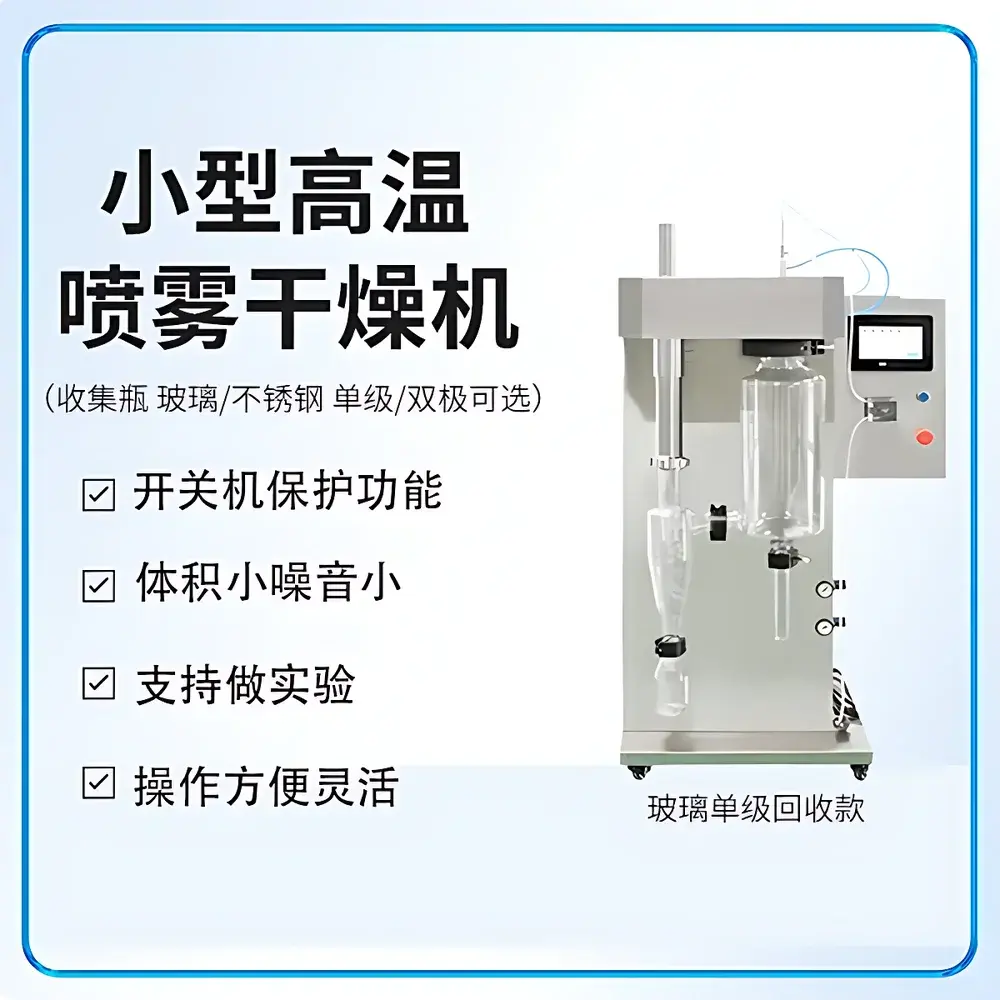
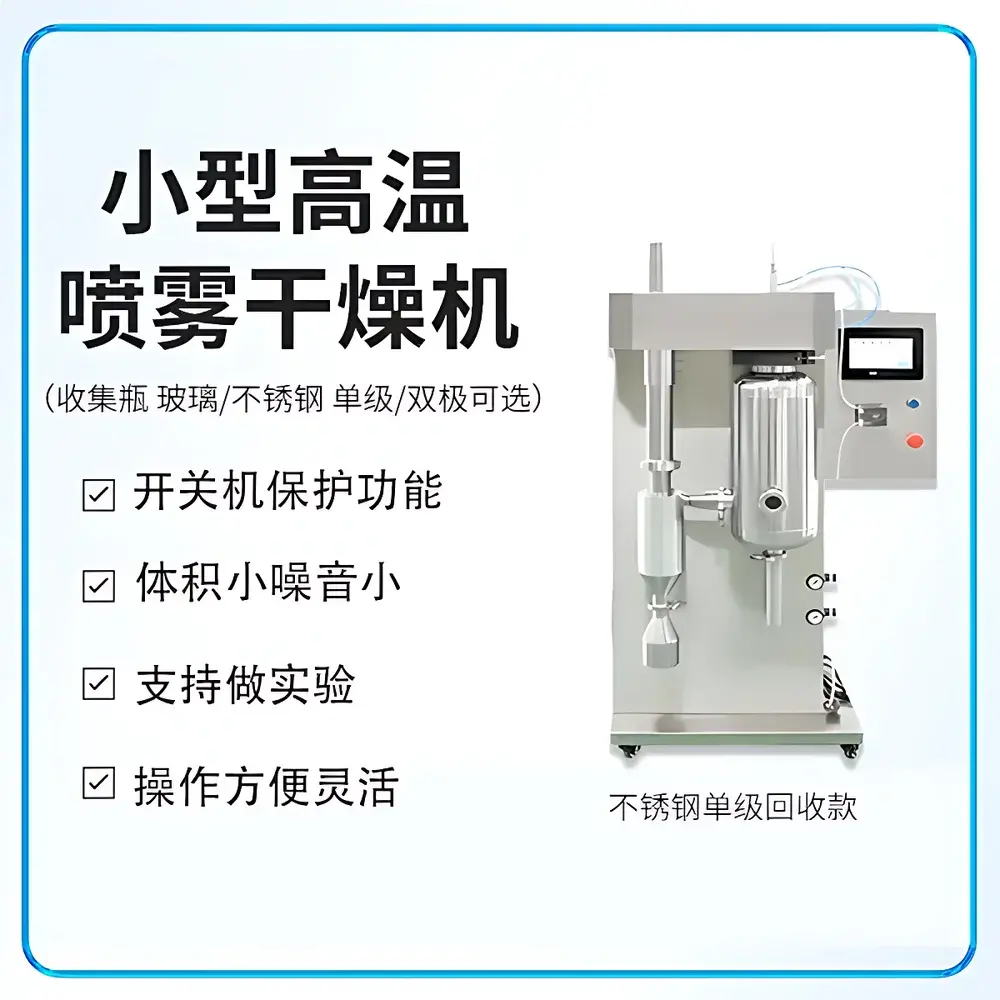
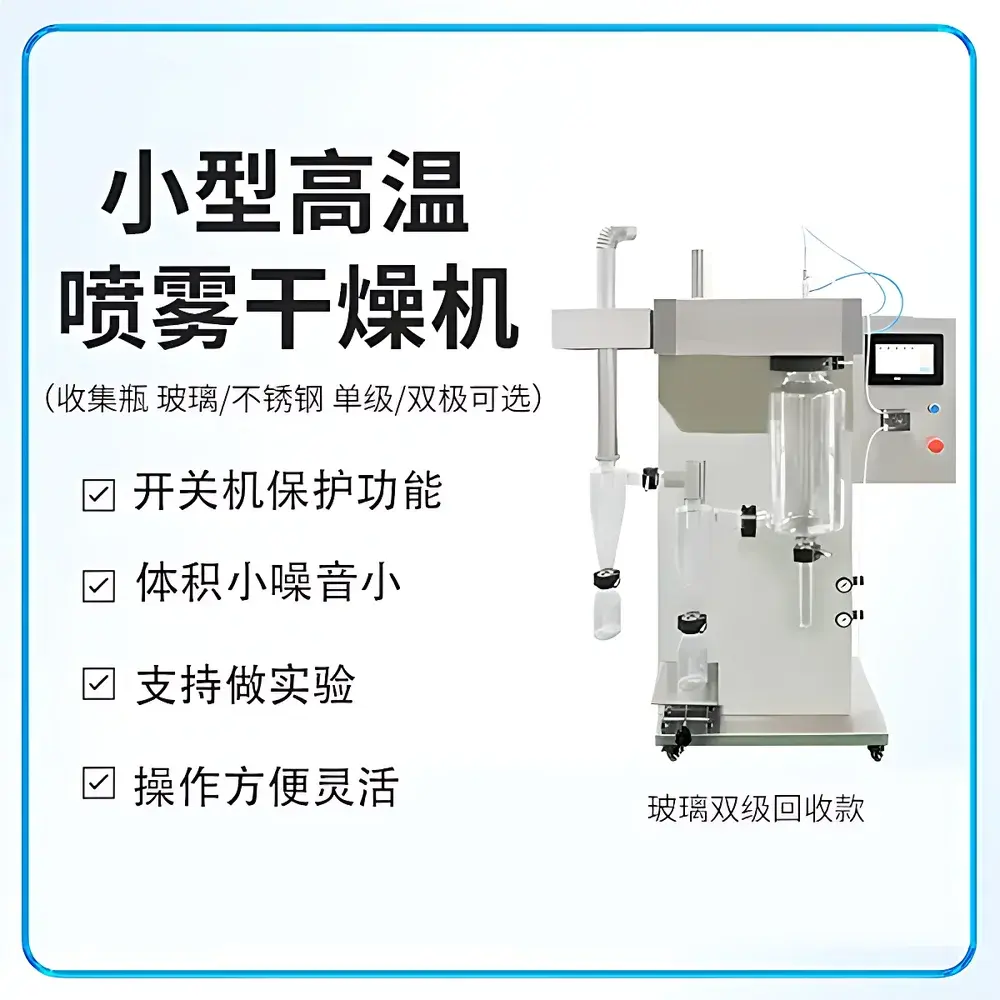
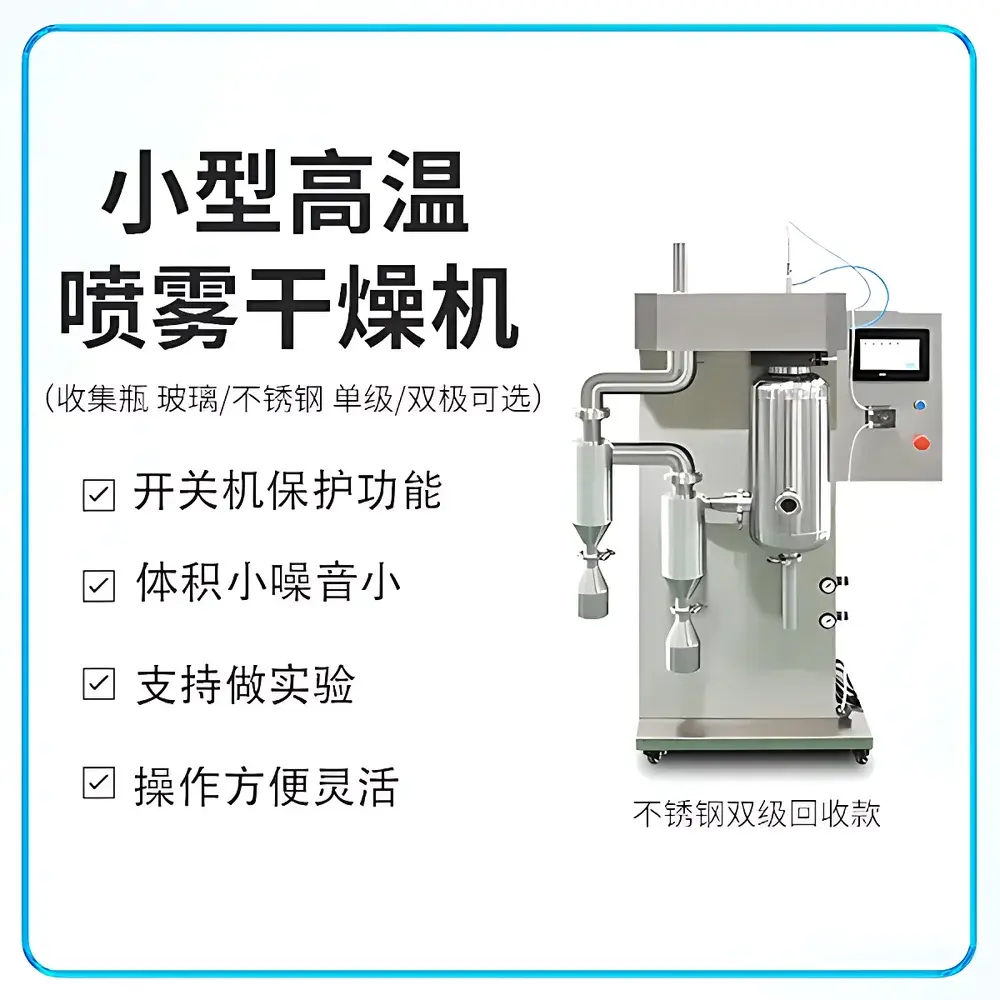
AnYuJie AYJ-PWGZ2000 Benchtop High-Temperature Spray Dryer
| Brand | AnYuJie |
|---|---|
| Origin | Zhejiang, China |
| Model | AYJ-PWGZ2000 |
| Max Feed Rate | 2000 mL/h |
| Temperature Range | 30–300 °C (inlet), 30–200 °C (outlet) |
| Particle Size Distribution | 5–250 µm |
| Feed Types | Aqueous solutions, emulsions, suspensions |
| Drying Time | 0.8–1.0 s |
| Power | 3.8 kW / 220 V |
| Dimensions | 1380 × 770 × 590 mm (H × L × W) |
| Nozzle Orifice Options | 0.5, 0.7, 0.75, 1.0, 1.5, 2.0 mm |
| Control Precision | ±0.5 °C (PID) |
| Noise Level | <60 dB(A) |
| Material Construction | 316L stainless steel frame + borosilicate glass drying chamber (optional stainless steel collection system) |
Overview
The AnYuJie AYJ-PWGZ2000 Benchtop High-Temperature Spray Dryer is an engineered solution for laboratory-scale conversion of liquid feedstocks—including aqueous solutions, oil-in-water emulsions, and colloidal or particulate suspensions—into free-flowing, thermally stable dry powders. It operates on the principle of flash evaporation via two-fluid nozzle atomization: pressurized compressed air shears the liquid feed into fine droplets within a heated, laminar airflow (inlet temperature up to 300 °C), enabling rapid solvent removal in ≤1.0 second. This short residence time minimizes thermal degradation of heat-sensitive actives—such as proteins, probiotics, polymers, and nanostructured APIs—while preserving particle morphology and crystallinity. Designed for reproducible process development and formulation screening, the system supports scalable parameter mapping (e.g., inlet/outlet temperature differentials, feed rate, atomization pressure) aligned with industrial spray drying protocols per ISO 8504-2 and ASTM E2912.
Key Features
- Real-time dual-point PID temperature control with ±0.5 °C accuracy at both inlet and outlet ducts, ensuring thermal consistency critical for GMP-compliant method validation.
- Automated needle-cleaning mechanism (“clearing pin”) with adjustable frequency to maintain nozzle integrity during processing of high-viscosity or particulate-laden feeds (e.g., chitosan solutions, lipid nanoparticle dispersions).
- Integrated oil-free air compressor (CE-certified, Class 0 air quality) delivering stable atomization pressure without hydrocarbon contamination—essential for pharmaceutical and food-grade applications.
- Modular construction using electropolished 316L stainless steel and high-purity borosilicate glass (Duran®-grade), compliant with USP for extractables/leachables testing.
- Full-color 7-inch capacitive touchscreen interface supporting both fully automated sequence execution (one-touch start/stop) and real-time manual override for dynamic parameter tuning during experiments.
- Intelligent shutdown protocol: Upon stop command, heating elements deactivate immediately while the fan continues operation until outlet temperature drops below 60 °C—preventing thermal stress on internal components and eliminating risk of overheating due to operator error.
- Configurable nozzle orifices (0.5–2.0 mm) allow precise control over droplet Sauter mean diameter (SMD), enabling targeted particle size distribution (PSD) engineering between 5 and 250 µm (Dv50).
Sample Compatibility & Compliance
The AYJ-PWGZ2000 accommodates a broad range of thermolabile and viscous feed materials: water-based polymer solutions (e.g., PVP, HPMC), protein-containing buffers (e.g., lysozyme, BSA), nanoemulsions (e.g., curcumin-loaded lecithin systems), and ceramic precursors (e.g., silica sols). Its sealed feed path, HEPA-filtered intake air, and inert-gas compatible design (N₂ purging option available) meet prerequisites for handling oxygen-sensitive compounds under cGMP Annex 1 and ICH Q5C guidelines. All wetted surfaces comply with FDA 21 CFR Part 11 requirements for electronic records when paired with optional audit-trail-enabled software modules.
Software & Data Management
The embedded control firmware logs timestamped operational data—including inlet/outlet temperatures, pump RPM, airflow rate, and clearing-pin actuation events—at 1 Hz resolution. Exportable CSV files support post-run statistical analysis (e.g., ANOVA of PSD vs. temperature gradient) and integration into LIMS or ELN platforms. Optional PC-based software provides remote monitoring, multi-unit fleet management, and automated report generation aligned with ALCOA+ data integrity principles.
Applications
- Pharmaceutical: Development of inhalable dry powder formulations (DPIs), amorphous solid dispersions, and vaccine adjuvant carriers.
- Food Science: Encapsulation of probiotics, flavors, and omega-3 oils; production of instant beverage powders with controlled hygroscopicity.
- Materials Research: Synthesis of spherical metal oxide nanoparticles (e.g., TiO₂, Fe₃O₄), battery cathode precursors, and catalyst supports.
- Academic & Contract Research: Method transfer studies from lab to pilot scale; DOE-based optimization of drying kinetics and residual moisture content (validated by Karl Fischer titration).
FAQ
What feed viscosities can the AYJ-PWGZ2000 handle?
It reliably processes liquids up to 500 mPa·s (measured at 25 °C, 10 s⁻¹ shear rate) using the 1.5 mm or 2.0 mm nozzle configuration. Higher viscosities require pre-dilution or elevated feed temperature control.
Is the system compatible with organic solvents?
Yes—with appropriate explosion-proof modifications (ATEX-rated electrical components, inert gas purge, solvent recovery condenser), subject to custom engineering review.
Can particle size be narrowed beyond the standard 5–250 µm range?
Yes. Narrower distributions (e.g., D90/D10 < 2.5) are achievable via optimized nozzle selection, feed concentration tuning, and cyclone collection efficiency calibration.
Does the unit support 21 CFR Part 11 compliance out-of-the-box?
The base system meets hardware-level requirements; full Part 11 compliance requires optional validated software with electronic signatures, audit trails, and role-based access control.
What maintenance intervals are recommended for the air compressor and pump tubing?
Compressor desiccant cartridges should be replaced every 6 months under continuous use; silicone peristaltic pump tubing is rated for ≥500 hours at 60 rpm and should be inspected weekly for deformation or cracking.



