
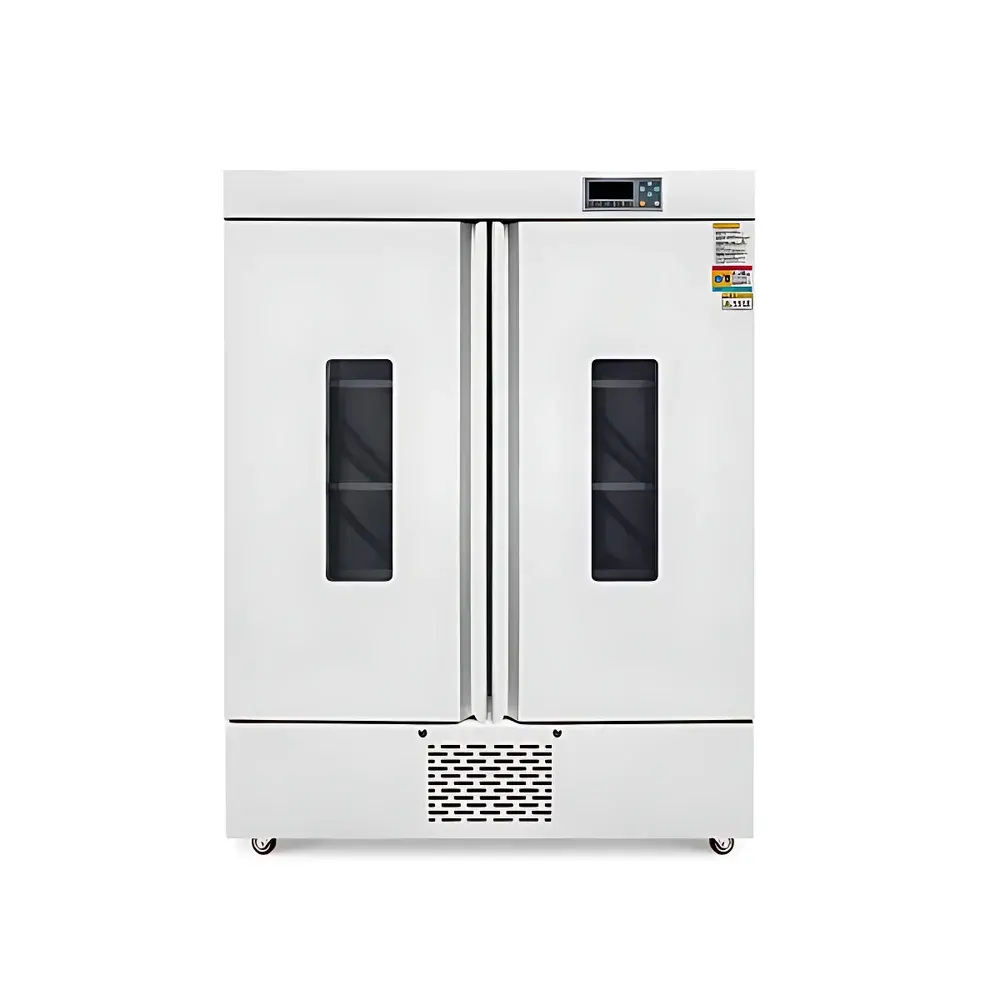
AnYuJie HWS-1000 Large-Capacity Temperature and Humidity Controlled Incubator
| Brand | AnYuJie |
|---|---|
| Origin | Zhejiang, China |
| Model | HWS-1000 |
| Heating Method | Air-Jacketed |
| Cooling Method | Compressor-Based Refrigeration |
| Humidification System | External Water Reservoir with Ultrasonic Humidifier |
| Temperature Range (with Humidification) | 5–50 °C |
| Temperature Range (without Humidification) | 5–50 °C |
| Temperature Fluctuation | ±1 °C |
| Temperature Uniformity | ±1 °C |
| Humidity Range | 40–95 %RH |
| Humidity Accuracy | ±5 %RH |
| Chamber Capacity | 1000 L |
| External Dimensions (W×D×H) | 1210 × 640 × 1850 mm |
Overview
The AnYuJie HWS-1000 is a large-capacity, microprocessor-controlled temperature and humidity regulated incubator engineered for long-term, stable environmental simulation in life science laboratories. It operates on the principle of air-jacketed thermal regulation combined with ultrasonic humidification and compressor-based active cooling—enabling precise, independent control of temperature (5–50 °C) and relative humidity (40–95 %RH) across its 1000 L working chamber. Unlike forced-air-only units, the HWS-1000 integrates a dual-door insulated structure and stainless-steel circulation ducting to minimize thermal gradients and door-induced perturbations, achieving ±1 °C temperature uniformity and stability—critical for BOD assays, seed germination studies, microbial culture maintenance, and pharmaceutical stability testing under ICH Q1 guidelines.
Key Features
- Air-jacketed heating system with independent compressor-based refrigeration ensures rapid thermal response and bidirectional temperature control without condensation buildup.
- Ultrasonic humidification module coupled with an external water reservoir enables consistent, particle-free moisture delivery—eliminating mineral deposits and supporting reproducible RH setpoints.
- Dual-glass observation door with magnetic seal and secondary inner door reduces heat and humidity loss during routine access; thermal insulation meets ISO 15190:2020 laboratory equipment performance criteria.
- Stainless-steel internal chamber and reinforced air circulation ducting support corrosion resistance, ease of decontamination (e.g., vaporized hydrogen peroxide), and laminar airflow distribution for uniform environmental conditions.
- Comprehensive safety architecture includes overtemperature cut-off, sensor fault detection, compressor high/low pressure protection, and delayed startup sequencing to prevent power surge stress.
- Microprocessor controller with PID auto-tuning capability supports adaptive thermal regulation—particularly valuable for protocols requiring tight tolerance windows (e.g., USP <1151> biological assay environments).
Sample Compatibility & Compliance
The HWS-1000 accommodates standard ISO/IEC 60068-2-1 (cold) and 60068-2-2 (dry heat) test profiles, and its humidity control range aligns with ASTM E171-23 for hygrothermal exposure testing. Its chamber geometry permits simultaneous placement of multiple stacked trays (up to 12 standard 200 mm Petri dishes or six 500 mL Erlenmeyer flasks), making it suitable for parallel batch cultivation in QC microbiology labs. All electronic components comply with IEC 61010-1:2010 for laboratory electrical safety, and firmware supports configurable audit trails for GLP/GMP-aligned workflows—though native 21 CFR Part 11 compliance requires optional third-party validation packages.
Software & Data Management
The onboard controller provides real-time display of chamber temperature, relative humidity, setpoint deviation, and operational status via a 4-digit LED interface. While the unit does not include Ethernet or USB data logging as standard, analog output (0–5 V or 4–20 mA) is available for integration into centralized building management systems (BMS) or SCADA platforms. Optional RS-485 Modbus RTU communication enables remote parameter adjustment and alarm forwarding to lab-wide monitoring networks. Calibration records—including sensor offset correction (SC mode) and upper-limit tracking alarm (AL1) configuration—are retained in non-volatile memory for traceability across instrument lifecycles.
Applications
- Biochemical Oxygen Demand (BOD) analysis per APHA Standard Methods 5210B, where sustained 20 °C ±0.5 °C and ≥90 %RH are required to prevent sample desiccation.
- Plant tissue culture and seed viability testing under controlled photoperiod-agnostic conditions—leveraging stable 5–30 °C operation without light source interference.
- Pharmaceutical excipient stability screening (ICH Q1A–Q1E), including accelerated aging at 40 °C/75 %RH and intermediate conditions (30 °C/65 %RH).
- Environmental microbiology: incubation of membrane filtration samples for coliform enumeration (ISO 9308-1) and heterotrophic plate count (HPC) assays.
- Aquaculture research: larval rearing trials requiring precise thermal-hygrometric coupling to mimic natural spawning habitats.
FAQ
What is the recommended calibration frequency for the HWS-1000?
Annual verification against NIST-traceable reference sensors is advised; temperature sensors should be checked before critical experiments using a calibrated thermistor probe.
Can the HWS-1000 operate continuously at 5 °C with 95 %RH?
Yes—its compressor cooling and ultrasonic humidification systems are rated for concurrent operation across the full specified range, though extended low-temperature/high-RH use may require periodic reservoir cleaning to inhibit biofilm formation.
Is the external water reservoir compatible with distilled, deionized, or reverse-osmosis water?
Deionized or reverse-osmosis water is strongly recommended to minimize scaling; distilled water may accelerate ultrasonic transducer wear due to low conductivity.
Does the unit support password-protected parameter locking for multi-user labs?
No—the base controller lacks user-level access control; however, physical key-lock switches can be retrofitted to the front panel for procedural security.
How does the dual-door design impact recovery time after door opening?
Internal measurements show <4.5 min recovery to ±1 °C and ±5 %RH following a 30-second door opening event at 37 °C/50 %RH—consistent with ISO 15190 Annex C thermal recovery benchmarks.





