
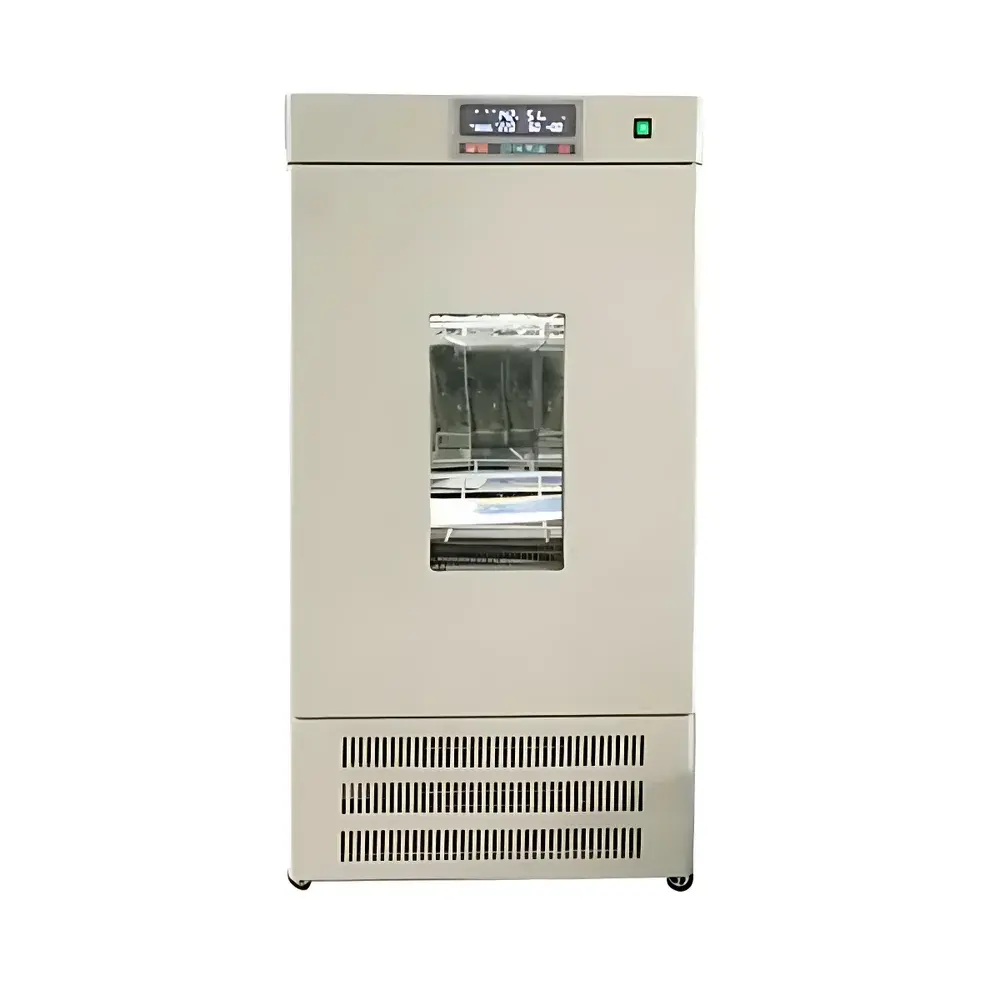
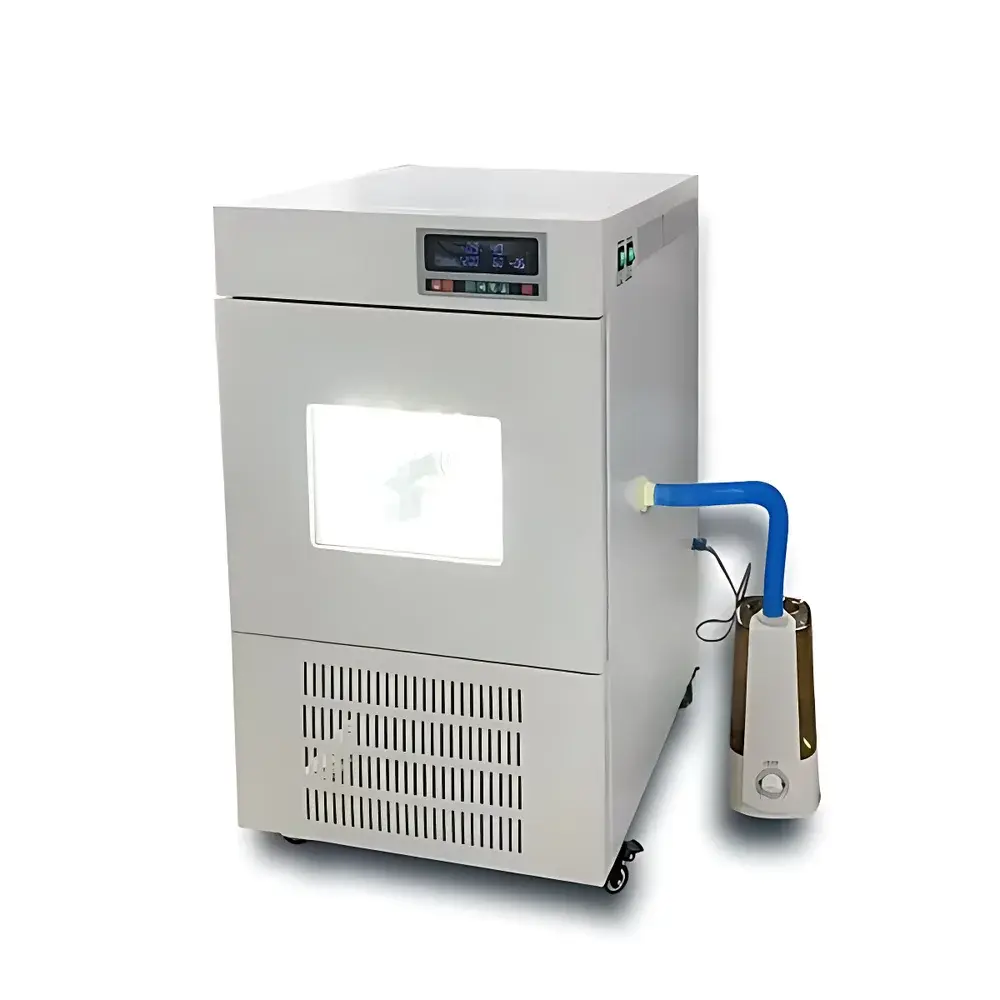
AnYuJie HWS-350B Temperature and Humidity Controlled Incubator
| Brand | AnYuJie |
|---|---|
| Origin | Zhejiang, China |
| Manufacturer Type | Authorized Distributor |
| Product Category | Domestic |
| Model | HWS-350B |
| Heating Method | Air-jacketed Heating |
| Cooling Method | Compressor-based Refrigeration |
| Humidification System | External Water Reservoir with Ultrasonic Humidifier |
| Temperature Range (with Humidification) | 5–50 °C |
| Temperature Range (without Humidification) | 5–50 °C |
| Temperature Fluctuation | ±1 °C |
| Temperature Uniformity | ±1 °C |
| Humidity Range | 40–95 %RH |
| Humidity Accuracy | ±5 %RH |
| Chamber Capacity | 350 L |
| External Dimensions (W×D×H) | 730 × 740 × 1690 mm |
Overview
The AnYuJie HWS-350B Temperature and Humidity Controlled Incubator is engineered for precision environmental simulation in life science laboratories, cell culture facilities, and quality control environments. It operates on a dual-control principle: independent regulation of air-jacketed temperature and ultrasonic-assisted humidity within a sealed, forced-air circulation chamber. The system maintains stable thermal and hygric conditions by continuously monitoring internal parameters via high-stability Pt100 temperature sensors and capacitive relative humidity (RH) sensors, feeding real-time data to a microprocessor-based PID controller. This architecture ensures consistent setpoint tracking across the full operational envelope—critical for applications such as microbial growth studies, seed germination assays, stability testing per ICH Q1 guidelines, and long-term tissue culture maintenance where diurnal or seasonal environmental drift must be eliminated.
Key Features
- Ultrasonic humidification system with external water reservoir—enables rapid RH response, uniform moisture distribution, and minimized condensation risk compared to steam-based alternatives;
- Air-jacketed heating combined with a hermetically sealed, low-vibration French Tecumseh (original import) compressor—provides stable thermal ramping, reduced thermal inertia, and enhanced energy efficiency;
- Dual-door insulation design with magnetic gasket sealing and low-emissivity inner glass—reduces heat loss and improves thermal recovery after door openings;
- Stainless steel interior chamber and reinforced airflow ductwork—supports corrosion resistance, easy decontamination (e.g., 70% ethanol or VHP-compatible protocols), and laminar air recirculation;
- Comprehensive safety architecture: over-temperature cutoff, sensor fault detection, compressor high/low pressure protection, and delayed startup sequencing to prevent power surge;
- Intuitive digital interface with dual-channel display (°C/%RH), programmable ramp-soak profiles, and real-time deviation alarms with audible/visual notification.
Sample Compatibility & Compliance
The HWS-350B accommodates standard ISO/ANSI-compliant culture vessels—including stacked Petri dishes (up to 150 mm diameter), multi-well plates, roller bottles, and flasks—within its 350 L working volume. Its stainless steel interior meets ISO 14644-1 Class 8 cleanroom compatibility requirements when operated under controlled ambient conditions. While not certified to GLP/GMP out-of-the-box, the incubator supports audit-ready operation through optional data logging (via RS485 or USB) and can be validated per ASTM E2874 (Standard Practice for Validation of Environmental Chambers) and ISO 14159 (Biotechnology—Requirements for Environmental Control Equipment). Humidity accuracy (±5 %RH) and temperature uniformity (±1 °C) are verified at nine-point mapping per ICH Q5C Annex 2 protocols.
Software & Data Management
The HWS-350B includes embedded firmware supporting time-stamped event logging (door openings, alarm triggers, setpoint changes) stored locally for ≥30 days. Optional PC connectivity enables export of CSV-formatted temperature/humidity histories compatible with LIMS integration and 21 CFR Part 11-compliant electronic records when paired with validated third-party software (e.g., LabArchives or DeltaTrak Validator Suite). All parameter modifications require password-level access, and firmware updates are performed via secure USB handshake to prevent unauthorized configuration changes. Audit trails include operator ID, timestamp, and pre/post-change values—supporting traceability in regulated QC/QA workflows.
Applications
- Long-term aerobic/anaerobic microbial cultivation (e.g., E. coli, S. aureus, fungal isolates) under defined RH conditions to assess colony morphology and metabolic activity;
- Plant tissue culture and seed viability testing requiring precise moisture gradients (e.g., 70–85 %RH at 25 °C);
- Accelerated stability studies for pharmaceutical intermediates per ICH Q1A(R3), including intermediate condition testing (30 °C/65 %RH);
- Environmental stress modeling for material biodegradability assessment (ISO 14855-1);
- Cell line passaging and cryopreservation recovery where transient humidity fluctuations compromise membrane integrity;
- Calibration verification of portable hygrometers and thermometers using NIST-traceable reference probes placed inside the chamber.
FAQ
What is the recommended maintenance schedule for the external humidification reservoir?
Drain and rinse the reservoir weekly with deionized water; inspect ultrasonic transducer surface monthly for mineral deposits and clean with 5% citric acid solution if scaling is observed.
Can the HWS-350B operate continuously at 40 °C and 95 %RH?
Yes—continuous operation is supported across the full specified range, though sustained high-RH operation requires periodic inspection of condensate drainage paths and chamber seals.
Is the incubator compatible with CO₂-enriched atmospheres?
No—this model lacks gas-tight construction and CO₂ injection ports; it is designed exclusively for ambient-air-based temperature/humidity control.
How is temperature uniformity validated during IQ/OQ?
Use nine calibrated PT100 probes arranged in a 3×3 grid at working height; record deviations from setpoint over 2 hours after thermal stabilization per ISO 14159 Annex B.
Does the unit support remote monitoring via Ethernet or Wi-Fi?
Not natively—remote access requires integration with an external industrial gateway (e.g., Siemens Desigo CC or BACnet/IP bridge) via its Modbus RTU interface.



