
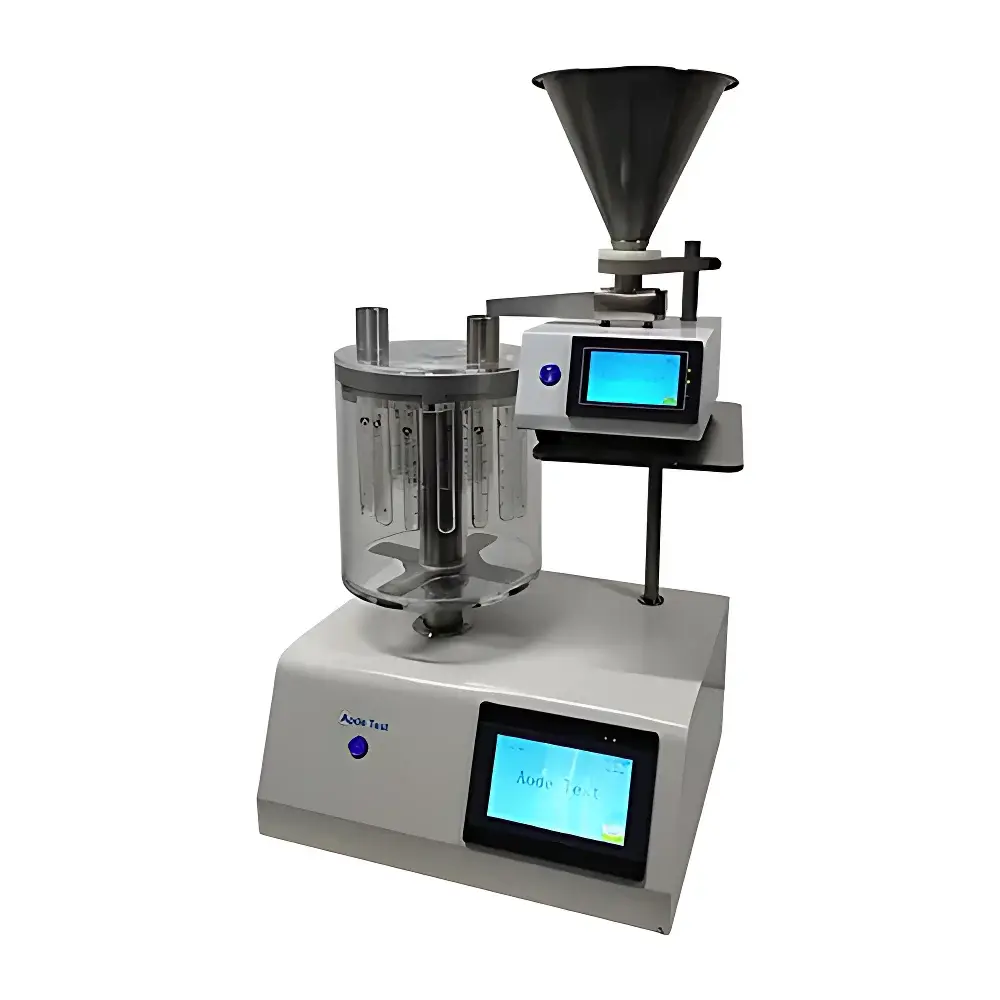
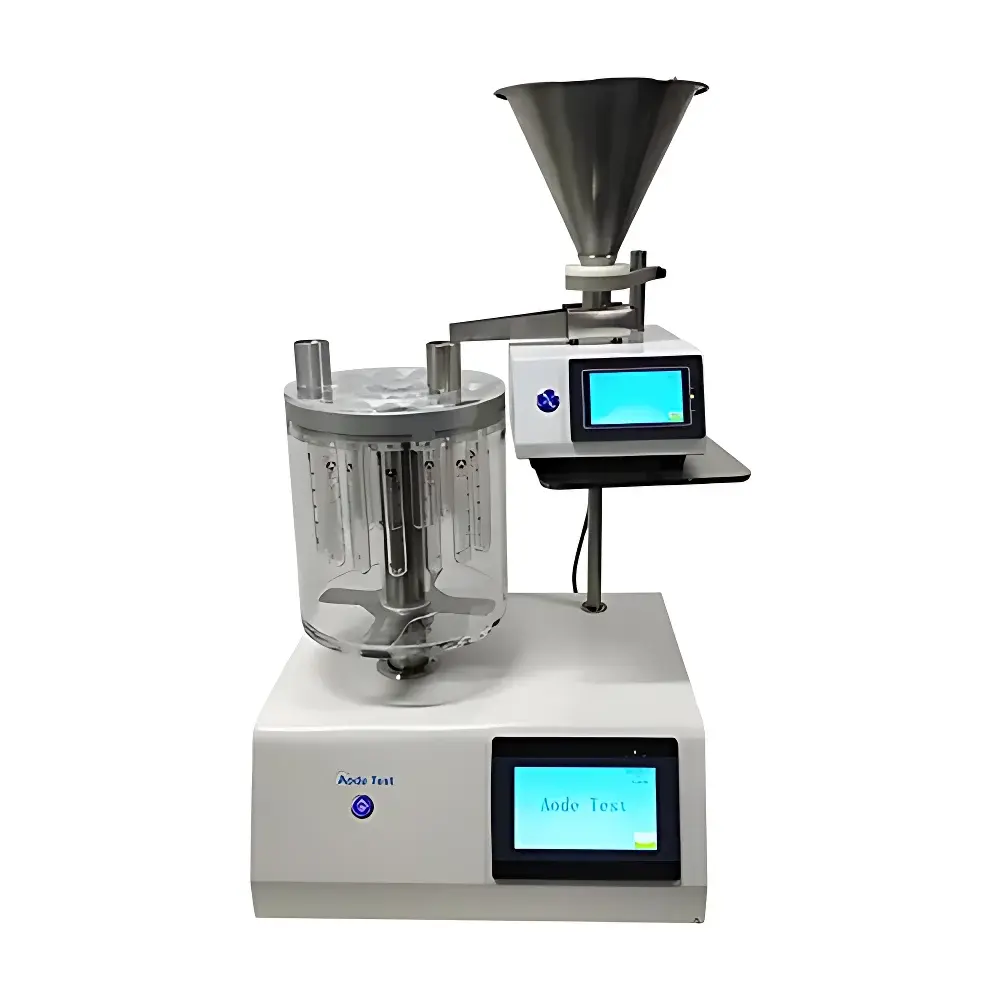
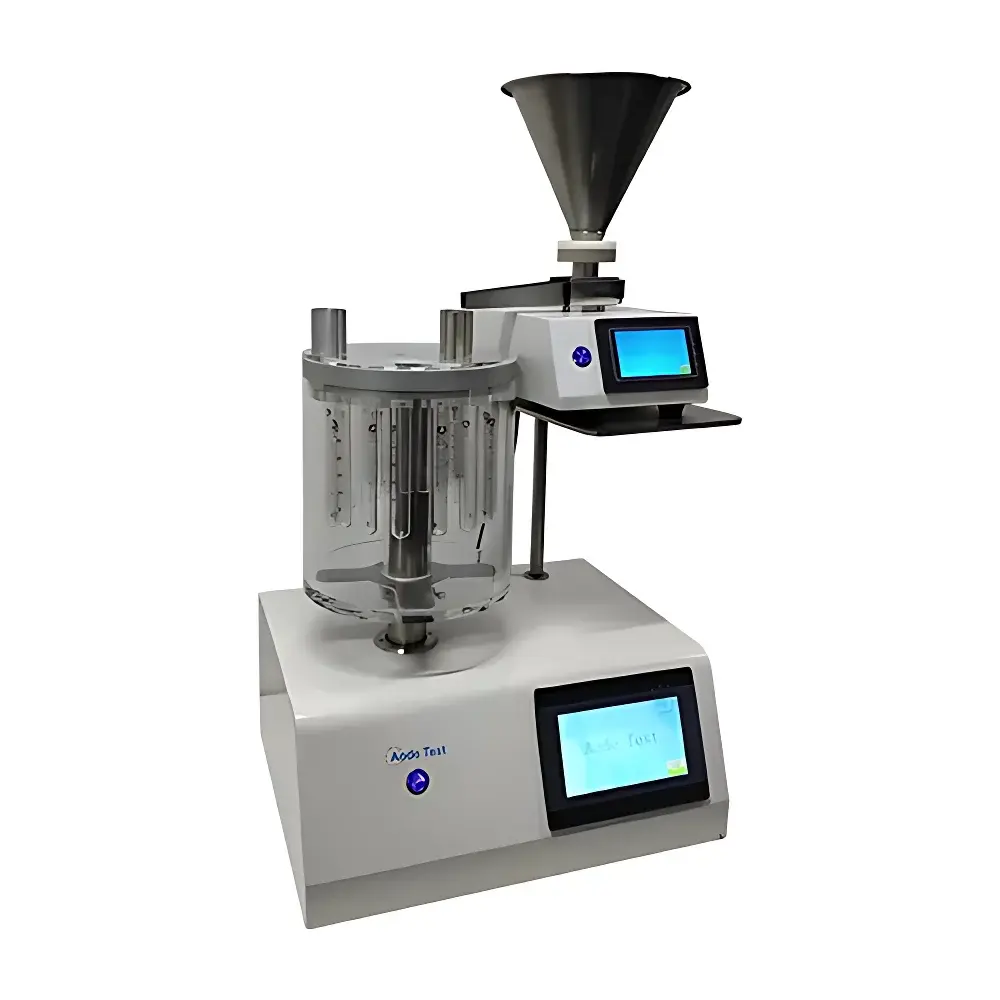
Aode Aode-102 Tube-Type Rotational Sample Divider
| Brand | Aode |
|---|---|
| Origin | Liaoning, China |
| Manufacturer Type | Direct Manufacturer |
| Region of Origin | Domestic (China) |
| Model | Aode-102 |
| Price Range | USD 7,000 – 14,000 |
| Sample Inlet Particle Size Limit | ≤10 mm |
| Max. Single Batch Volume | 1500 mL |
| Number of Subsamples per Cycle | 15 |
| Adjustable Rotation Speed | 20–50 rpm |
| Tube Capacity Options | 5–100 mL (glass vials) |
| Power Supply | 220 V, 50 Hz, 50 W |
Overview
The Aode Aode-102 Tube-Type Rotational Sample Divider is an automated, gravity-fed sample splitting instrument engineered for high-reproducibility subsampling of bulk granular, powdered, and semi-fluid (e.g., paste-like or乳状) materials. It operates on the principle of rotational symmetry and controlled gravitational flow: a vibratory feed trough delivers material at a consistent mass flow rate to a precision-machined eccentric dual-chute assembly mounted on a motor-driven rotating shaft. As the assembly rotates, material alternately discharges into either the inner (small-volume) or outer (large-volume) sampling chute—both geometrically calibrated to ensure volumetric proportionality—before gravity-directed collection into standardized glass receiving tubes. This design eliminates manual handling bias and ensures each subsample maintains compositional representativeness per ASTM D7429–22 (Standard Practice for Mechanical Splitting of Bulk Solid Samples) and ISO 13320:2020 (Particle size analysis — Laser diffraction methods), making it suitable for method validation under GLP-compliant laboratory environments.
Key Features
- Automated feed-and-split workflow enabled by integrated vibratory feeder and synchronized rotational drive module
- Two-position eccentric sampling chutes: inner chute (low-volume mode) and outer chute (high-volume mode), selectable via touchscreen interface to match analytical requirements
- 7-inch full-color capacitive touchscreen HMI with intuitive icon-based navigation, real-time status feedback, and parameter logging
- Microprocessor-controlled motor with closed-loop speed regulation (20–50 rpm ±0.5 rpm repeatability) to maintain consistent angular displacement per tube position
- Modular tube carousel accommodating standard 5–100 mL borosilicate glass vials; quick-release mechanism enables rapid batch changeover
- Low-power consumption architecture (50 W nominal) compliant with IEC 61000-3-2 harmonic emission limits
Sample Compatibility & Compliance
The Aode-102 accepts free-flowing dry powders (e.g., cement clinker, pharmaceutical excipients, ceramic precursors), cohesive granules (e.g., fertilizers, food grains), and low-viscosity suspensions (e.g., milk powder slurries, pigment dispersions), provided particle dimensions remain ≤10 mm. It is not intended for fibrous, highly adhesive, or temperature-sensitive materials requiring inert atmosphere handling. The system conforms to general safety requirements outlined in IEC 61010-1 for electrical equipment used in laboratory settings. While not certified to specific regulatory standards out-of-the-box, its deterministic mechanical splitting process supports audit-ready documentation when paired with traceable calibration protocols and electronic log export—enabling alignment with FDA 21 CFR Part 11 data integrity expectations where local IT infrastructure permits secure user authentication and audit trail generation.
Software & Data Management
Operation is fully managed through embedded firmware with no external PC dependency. All critical parameters—including rotation speed, total subsamples generated, chute selection mode, and timestamped cycle start/stop events—are stored locally in non-volatile memory. The touchscreen interface allows export of session logs via USB flash drive in CSV format, including UTC timestamps, operator ID (manually entered), and raw sensor readouts from the motor controller. No cloud connectivity or remote access capabilities are implemented, preserving data sovereignty and simplifying IT validation for regulated users. Firmware updates are performed offline via USB, ensuring version control and eliminating cybersecurity exposure vectors associated with networked instruments.
Applications
The Aode-102 serves as a primary sample reduction tool across quality control and R&D laboratories in industries where representative subsampling directly impacts analytical validity. Typical use cases include: preparation of homogenized test portions for XRF elemental analysis of construction aggregates; division of composite polymer blends prior to melt flow index testing; generation of statistically valid replicates for particle size distribution measurement by laser diffraction; pre-analytical conditioning of agricultural grain samples for mycotoxin screening; and routine subdivision of raw material lots in pharmaceutical excipient manufacturing per USP guidance on sampling plans. Its compact footprint (W×D×H: 420 × 380 × 510 mm) and quiet operation (<55 dB(A)) make it suitable for shared lab spaces without dedicated vibration isolation.
FAQ
What types of materials are compatible with the Aode-102?
Dry powders, free-flowing granules, and low-viscosity suspensions with maximum particle dimension ≤10 mm. Avoid fibrous, hygroscopic, or thermally unstable materials.
Can the instrument be integrated into an automated lab workflow?
Yes—its RS-232 serial port supports basic trigger signaling for upstream feeder activation or downstream balance tare initiation, though higher-level orchestration requires external PLC coordination.
Is calibration required before first use?
No factory calibration is needed; however, users should verify rotational speed accuracy using a handheld tachometer and confirm volumetric consistency across subsamples via gravimetric check per ISO 14488 Annex B.
What maintenance is recommended?
Monthly inspection of feed trough vibration amplitude, chute alignment, and tube carousel indexing; annual lubrication of drive shaft bearings with food-grade silicone grease.
Does the system support LIMS integration?
Not natively—data export is limited to timestamped CSV files via USB. Custom middleware development would be required for direct LIMS ingestion.



