
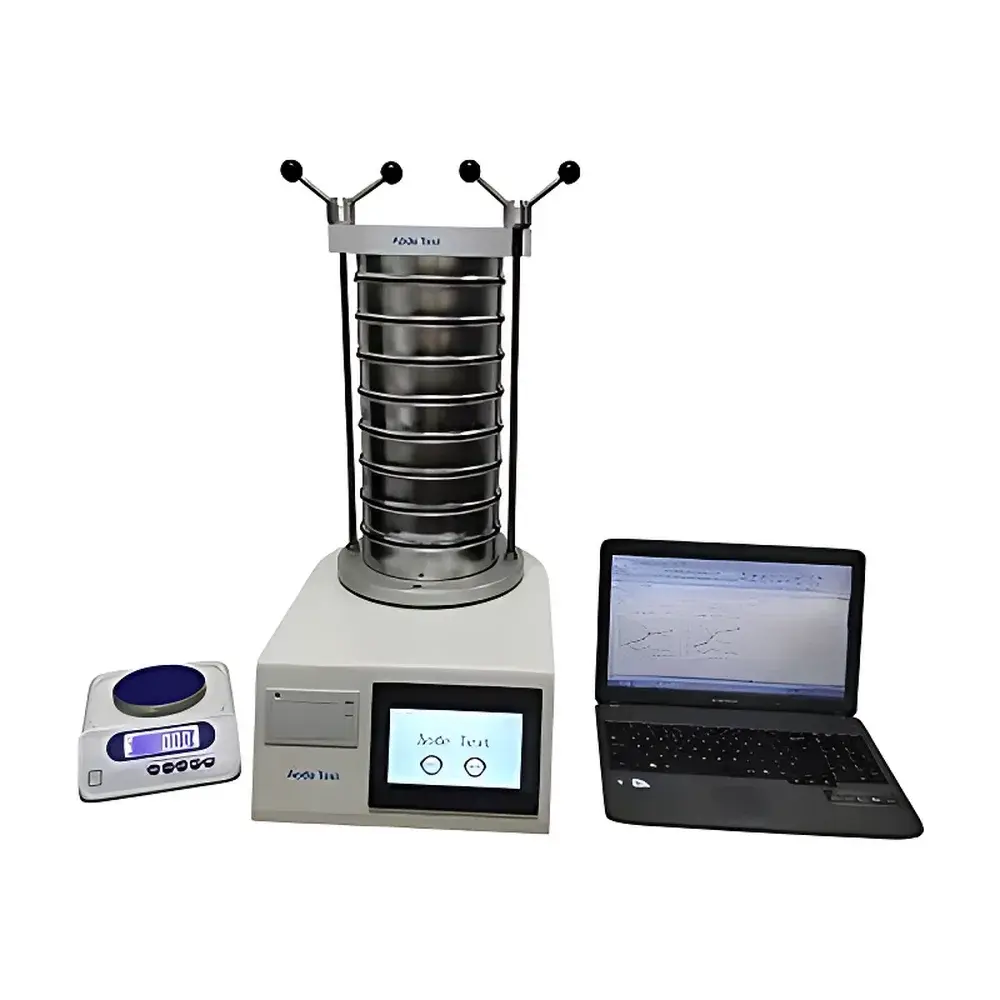
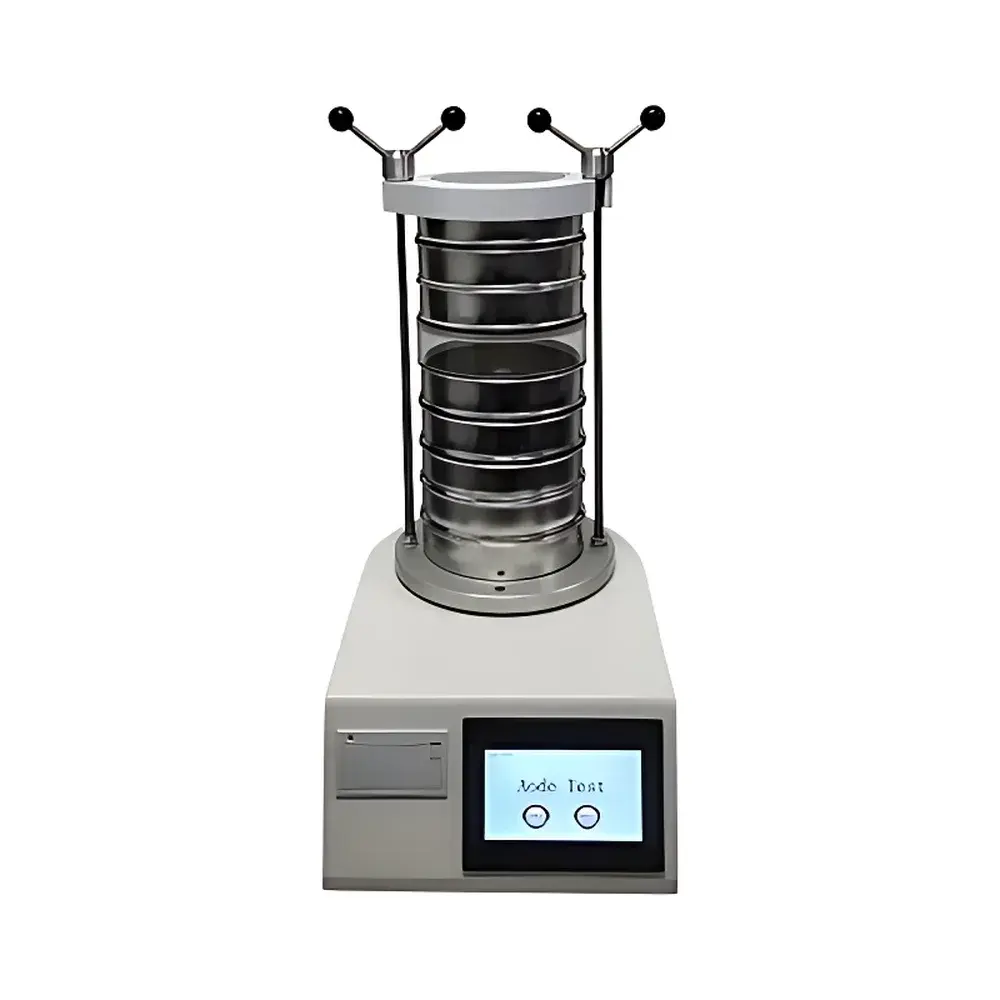
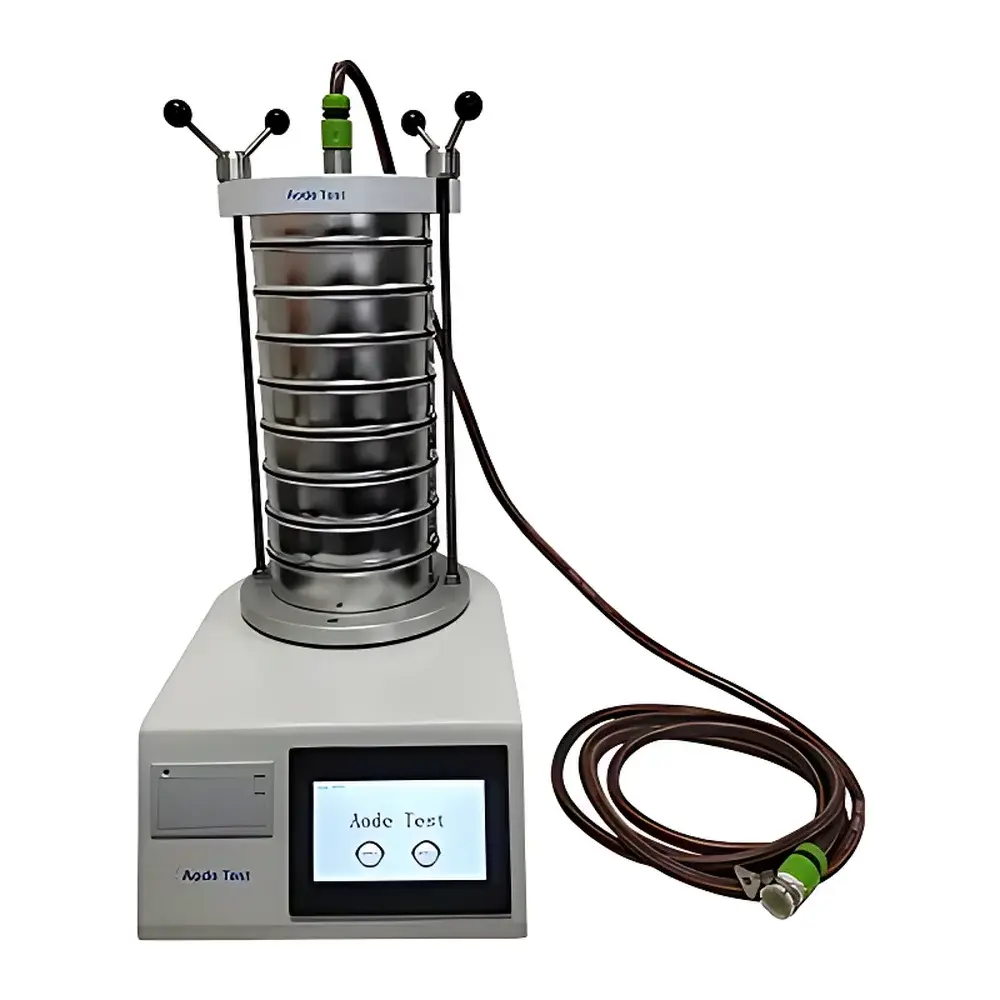
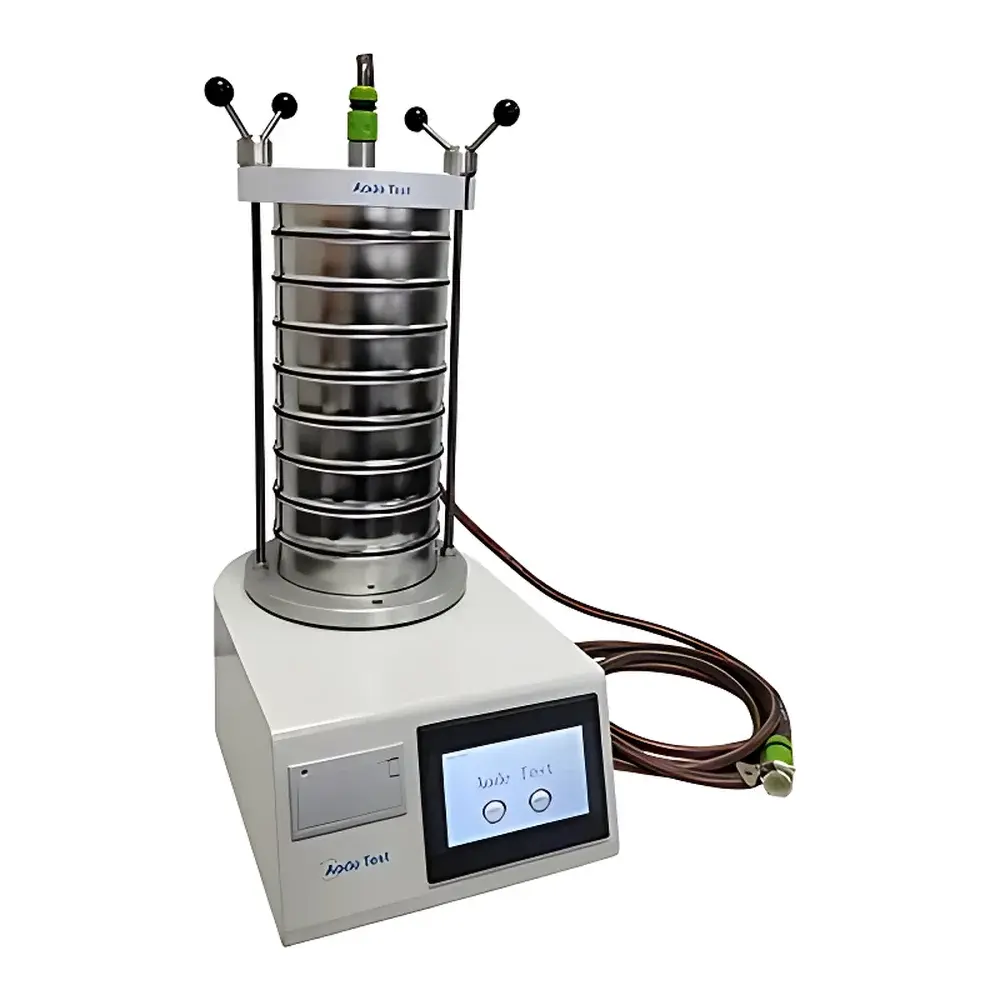
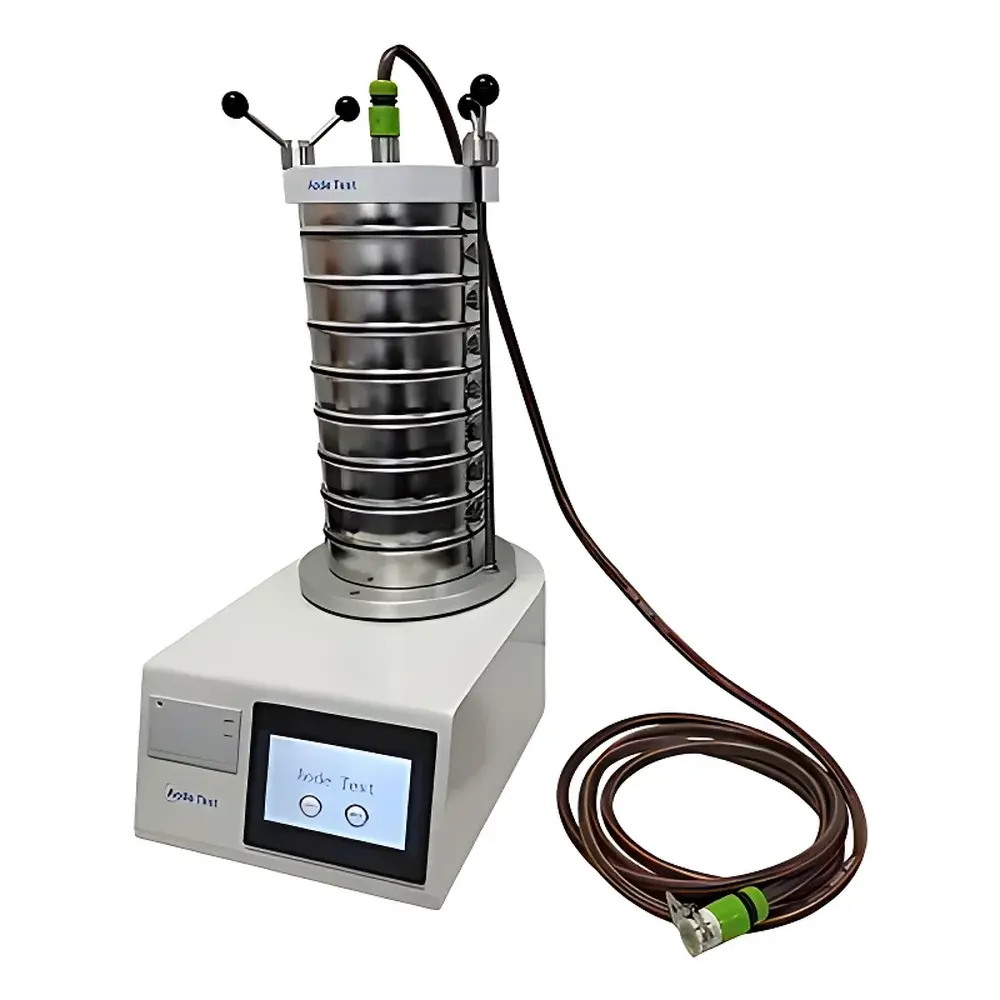
Aode Aode-200 Intelligent Electromagnetic Sieve Analyzer
| Brand | Aode |
|---|---|
| Origin | Liaoning, China |
| Manufacturer Type | Direct Manufacturer |
| Country of Origin | China |
| Model | Aode-200 |
| Price Range | USD 2,800 – 7,000 |
| Sieve Diameter Options | 75 mm, 100 mm, 150 mm, 200 mm, 203 mm |
| Particle Size Range | 20 µm – 80 mm |
| Amplitude Adjustment | 0–3 mm (adjustable) |
| Vibration Frequency | 3,000 cycles/min |
| Sieve Stages | Up to 15 levels (for 32 mm-height sieves) |
| Operating Modes | Continuous or Intermittent vibration |
| Sample Capacity | 3.5 kg max |
| Power Supply | 220 V AC, 50 Hz, 400 W, 5 A |
| Dimensions (W×H×D) | 350 × 520 × 200 mm |
| Weight | 40 kg |
| Display | 7-inch capacitive touchscreen interface |
| Data Interface | RS-232 serial port for PC connectivity |
| Software Features | Automated mass acquisition, real-time sieve residue calculation, cumulative % retained, % passing, % on each sieve, distribution curve generation (linear/logarithmic scale), user role management (admin/operator), audit trail logging, unlimited data storage and export (CSV/PDF) |
Overview
The Aode Aode-200 Intelligent Electromagnetic Sieve Analyzer is a precision laboratory instrument engineered for reliable, repeatable dry or wet particle size distribution analysis via standardized sieve fractionation. Unlike conventional mechanical shakers that rely on horizontal reciprocating motion—where particle inertia and density significantly influence separation efficiency—the Aode-200 employs high-frequency electromagnetic actuation to generate controlled three-dimensional vibratory motion. This mechanism induces vertical lift, lateral displacement, and rotational tumbling of particles across the sieve surface at 3,000 cycles per minute, effectively dislodging agglomerates and preventing mesh blinding. The resulting dynamic particle reorientation ensures consistent passage through apertures regardless of particle density, morphology, or flowability—making it particularly suitable for challenging materials such as low-density polymers, cohesive pharmaceutical powders, fine metal alloys, and irregularly shaped construction aggregates. Designed in accordance with ISO 9048, ASTM E11, and USP , the system supports regulatory-compliant granulometric testing workflows in R&D, QC, and GLP environments.
Key Features
- Electromagnetic drive system delivering stable, maintenance-free 3D vibratory motion at precisely controlled 3,000 rpm frequency
- Adjustable amplitude (0–3 mm) enabling optimization for diverse material types—from fragile granules to abrasive coarse aggregates
- Modular sieve stack compatibility with standard diameters (75 mm, 100 mm, 150 mm, 200 mm, and 203 mm) and up to 15-tier configurations for high-resolution grading
- Integrated high-precision load cell enabling automatic sample mass input prior to sieving, eliminating manual transcription errors
- 7-inch industrial-grade capacitive touchscreen with intuitive GUI supporting multilingual operation (English/Chinese)
- Programmable operational modes: continuous, intermittent, or multi-stage workgroup sequences with ramp-up/ramp-down profiles to minimize mechanical stress
- RS-232 interface for bidirectional communication with external PCs and LIMS integration
- User-access control system with configurable admin/operator roles and time-stamped audit trail for all critical actions (e.g., method edits, result exports, calibration logs)
Sample Compatibility & Compliance
The Aode-200 accommodates both dry and wet sieving protocols, with optional liquid-tight enclosures and corrosion-resistant sieve frames available for aqueous applications. It meets fundamental requirements of pharmacopoeial monographs (USP , EP 2.9.33), aggregate testing standards (ASTM C136/C136M, EN 933-1), and general powder characterization guidelines (ISO 13320, ISO 2591-1). All software calculations—including % retained, % passing, cumulative % retained, and mass balance verification—are traceable and reproducible. Audit trail functionality complies with FDA 21 CFR Part 11 principles for electronic records and signatures when deployed in regulated GMP/QbD settings. Instrument validation documentation (IQ/OQ templates) and raw data export capabilities support full compliance with internal SOPs and third-party inspection readiness.
Software & Data Management
The embedded SieveMaster™ acquisition and analysis software provides end-to-end digital workflow automation. Upon initiation, the system auto-reads tared sample mass, logs sieve sequence parameters (aperture sizes, stacking order, duration, amplitude), and captures real-time vibration status. Post-sieving, it computes mass distribution across all retained fractions, generates customizable grain size distribution curves (linear or logarithmic x-axis, % passing or % retained y-axis), and validates mass recovery (±0.5% tolerance). Reports are exportable in CSV (for statistical analysis in Excel or Minitab) and PDF (with embedded metadata, operator ID, timestamp, and instrument serial number). Historical datasets are indexed by date, batch ID, and user profile; search filters enable rapid retrieval for trend analysis or deviation investigations. All modifications to test methods or results require dual authorization and are immutably logged.
Applications
- Pharmaceutical solid dosage development: excipient grading, API particle sizing, blend uniformity assessment per USP
- Construction materials QA: gradation analysis of fine/coarse aggregates, sand equivalent testing, asphalt mix design validation
- Chemical & catalyst manufacturing: classification of supported metal catalysts, zeolite powders, and pigment dispersions
- Food & feed processing: flour particle distribution, spice grinding consistency, pet food kibble sizing
- Advanced ceramics & battery materials: anode/cathode precursor powder screening, graphite flake classification, alumina microsphere sizing
- Environmental testing: soil particle size analysis (ASTM D422), sediment sorting, landfill cover material specification
FAQ
What sieve diameters and stack heights does the Aode-200 support?
Standard configurations include 75 mm, 100 mm, 150 mm, 200 mm, and 203 mm diameter sieves. Full-height stacks accommodate up to 12 tiers; compact 32 mm-height sieves allow up to 15 tiers for enhanced resolution.
Is wet sieving possible with this instrument?
Yes—when equipped with optional splash guards, stainless-steel wet-sieving pans, and sealed electromagnetic actuator housing, the Aode-200 supports standardized wet sieving per ASTM C136 and ISO 2591-2.
How is data integrity ensured during long-term use?
All analytical sessions generate immutable digital records with cryptographic timestamps. Audit trails capture user identity, action type, parameter changes, and result modifications—fully compliant with ALCOA+ principles and FDA 21 CFR Part 11 Annex 11 expectations.
Can the instrument be integrated into a centralized laboratory network?
Via RS-232, the Aode-200 communicates with host PCs running Windows OS. Optional OPC UA or Modbus TCP gateways (sold separately) enable seamless integration into SCADA or MES platforms for automated report aggregation and SPC charting.
What maintenance is required for sustained accuracy?
No routine lubrication or belt replacement is needed due to electromagnetic actuation. Annual verification of load cell linearity, amplitude calibration using certified displacement sensors, and sieve mesh certification per ISO/IEC 17025 are recommended best practices.



