
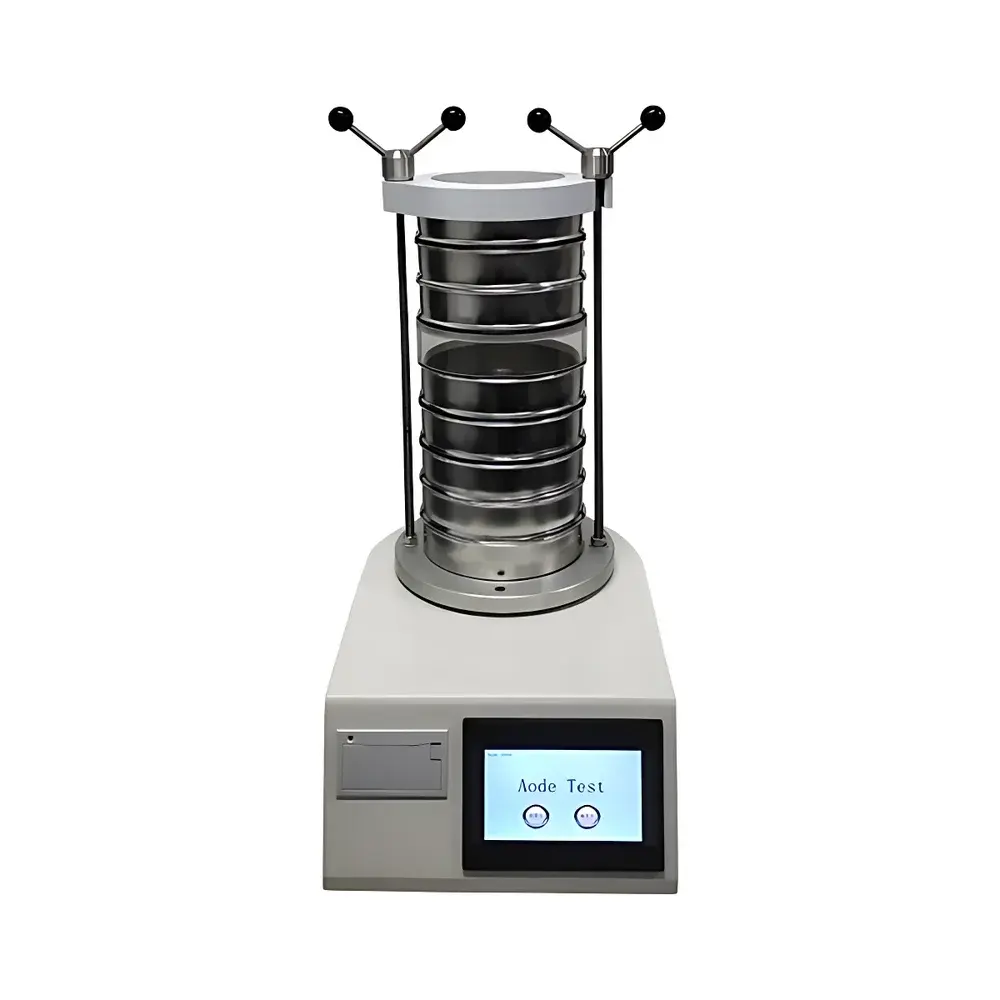
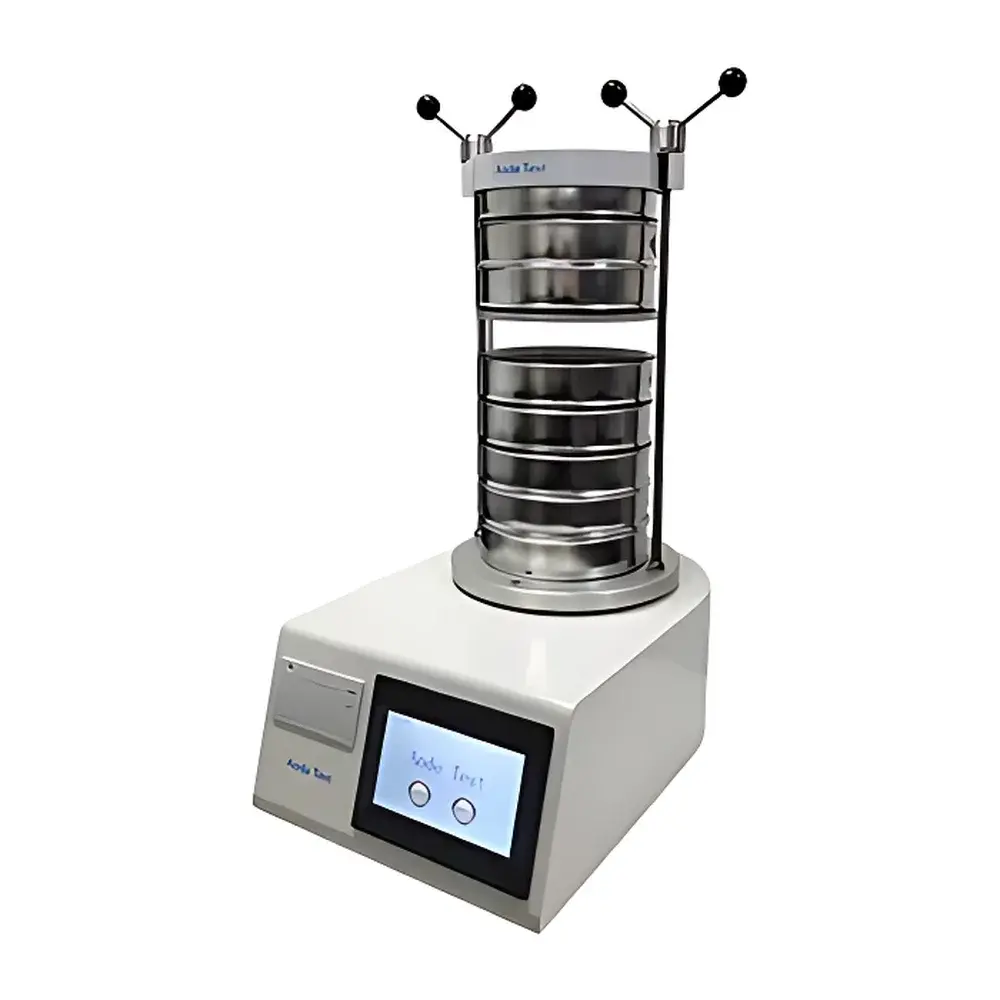
Aode Aode-200A Intelligent Electromagnetic 3D Vibratory Sieve Analyzer
| Brand | Aode |
|---|---|
| Origin | Liaoning, China |
| Manufacturer Type | Direct Manufacturer |
| Country of Origin | China |
| Model | Aode-200A (Ref. 220509) |
| Price Range | USD 2,800 – 7,000 |
| Measurement Range | Dry method: 32 µm – 25 mm |
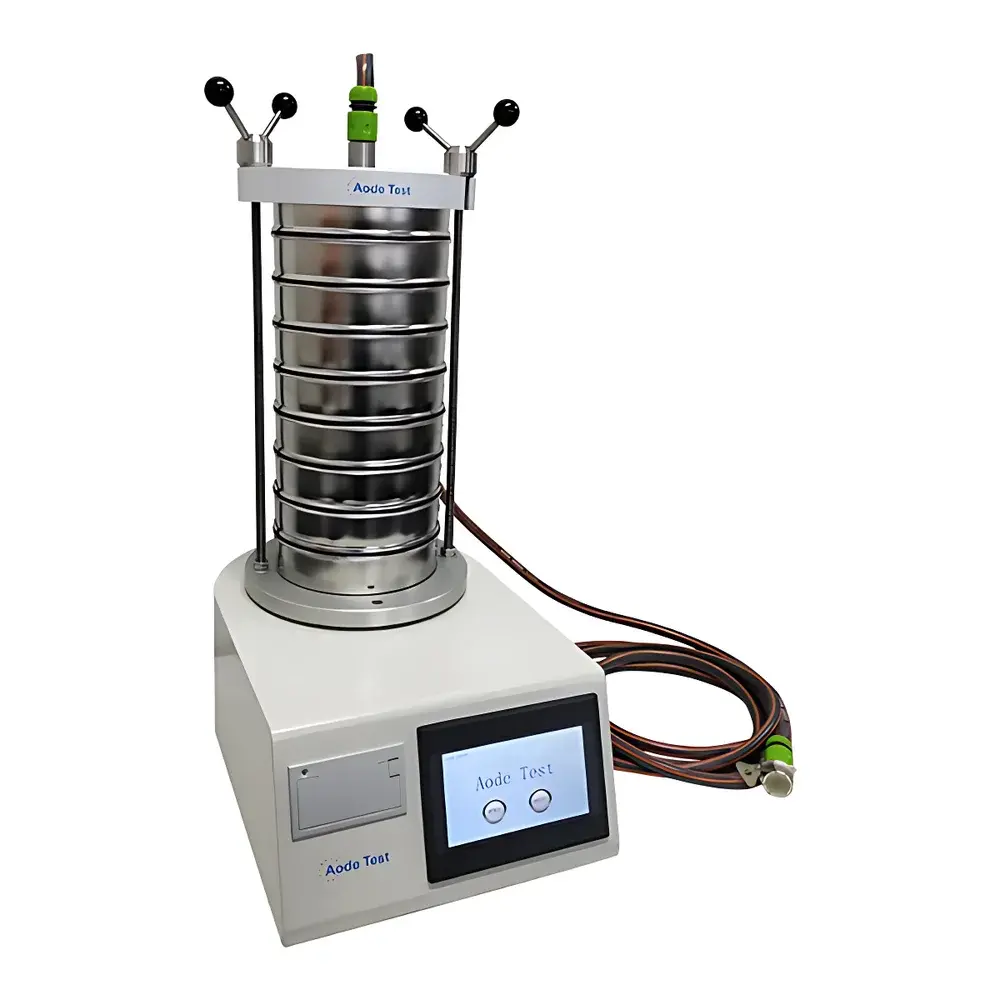
| Wet method | 20 µm – 25 mm |
| Ultrasonic precision sieving | 5 µm – 25 mm |
| Amplitude Adjustment | 0.2 – 3 mm |
| Sieve Diameter | Up to 203 mm (standard ASTM/ISO/EU-compliant sieves) |
| Stack Capacity | 10 layers for 50-mm-height sieves |
| Sample Load Capacity | 6 kg |
| Sieve Stack Height | ~560 mm |
| Dimensions (W×H×D) | 350 × 200 × 520 mm |
| Weight | 30 kg |
| Vibration Frequency | 3000 – 3600 cycles/min |
| Power Supply | 220 V / 110 V, 350 W, 50 Hz / 60 Hz |
| Control Interface | 7-inch color capacitive touchscreen |
| Vibration Mode | Electromagnetic 3D excitation |
| Sieving Motion | Triaxial抛掷 (3D tossing) motion |
| Sieving Modes | Continuous, intermittent, or time-programmed |
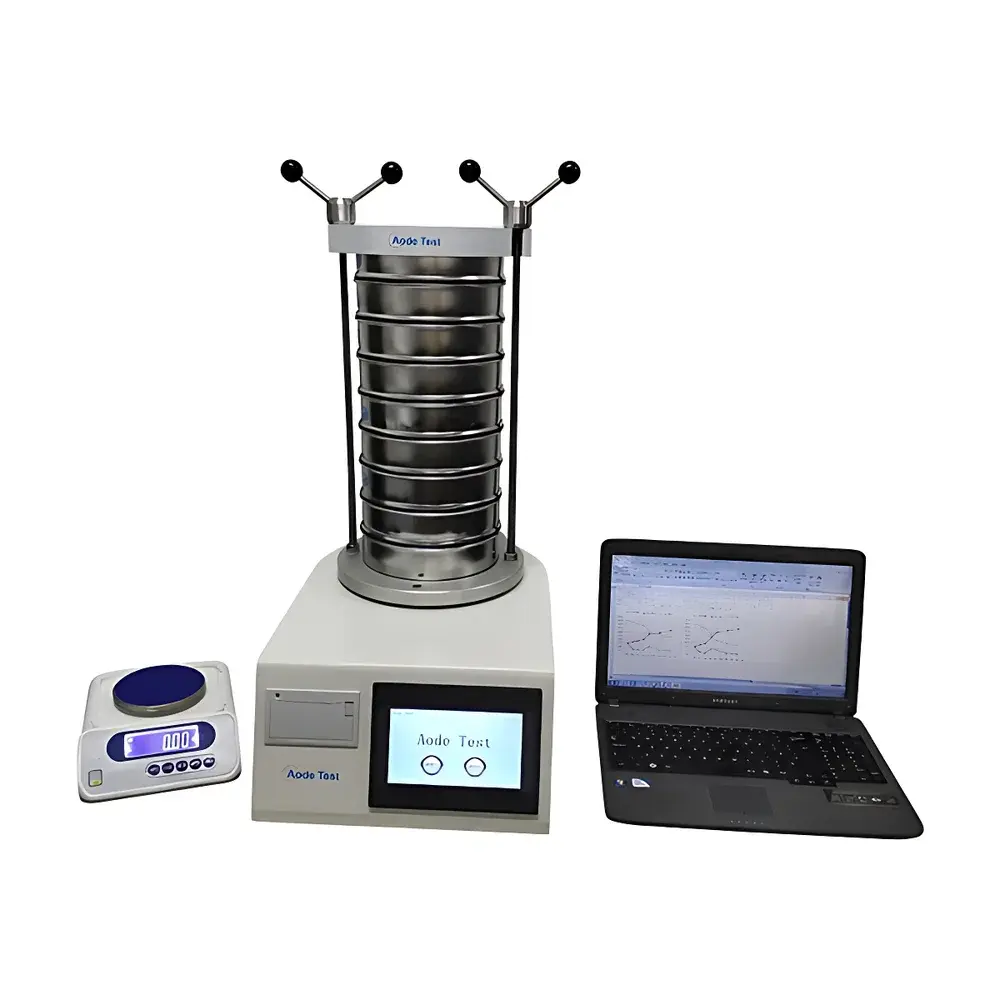
| Software | SMART Sieve Analysis Suite — auto-calculates residue per layer, cumulative residue, fractional residue, passing rate, cumulative passing rate, mass loss % |
| Compliance | GB/T 6003.1–2012, GB/T 6003.2–1997, Ph. Eur. 2.9.38, ISO 3310-1:2016, ISO 565:2022, ASTM E11–23 |
| Sieve Material | AISI 304 stainless steel |
| Data Interface | RS-232 port for bidirectional communication with balance and PC |
| User Management | Dual-role login (Administrator / Operator) with role-based permissions |
| Mechanical Design | S-shaped dual-phase locking lid + quick-release clamping system |
| Transparency | Optical-grade transparent lid and interlayer spacers for real-time process observation |
| Data Storage | Local onboard memory + external PC export (CSV, PDF, XML) |
Overview
The Aode Aode-200A Intelligent Electromagnetic 3D Vibratory Sieve Analyzer is a laboratory-grade mechanical sieve shaker engineered for high-reproducibility dry, wet, and ultrasonically assisted particle size analysis across diverse powder and granular materials. It operates on the principle of electromagnetic-driven triaxial vibration—generating controlled 3D tossing motion that ensures uniform sample dispersion across the entire sieve surface area. Unlike conventional rotary or tapping sievers, this mechanism subjects particles to simultaneous vertical lift, horizontal displacement, and rotational shear, significantly enhancing near-size particle separation efficiency and minimizing mesh blinding. The instrument is designed for compliance-critical environments including pharmaceutical QC labs (per Ph. Eur. 2.9.38 and USP <786>), materials R&D facilities, and industrial quality control departments requiring traceable, auditable, and standardized sieving protocols aligned with ISO 3310-1, ASTM E11, and GB/T 6003 series specifications.
Key Features
- Electromagnetic 3D excitation system delivering precise amplitude (0.2–3 mm) and frequency (3000–3600 rpm) control for optimized particle stratification and de-agglomeration.
- Modular sieve stack architecture supporting up to 16 layers of ISO/ASTM-standard 203 mm-diameter sieves (25 mm height) or 10 layers (50 mm height), accommodating total stack heights up to 560 mm.
- Integrated 7-inch capacitive touchscreen interface with bilingual (English/Chinese) firmware, enabling intuitive configuration of sieving mode (continuous/intermittent/timed), duration, amplitude, and data logging parameters.
- S-type dual-phase locking lid with optical-grade transparent polycarbonate cover and spacer rings allows real-time visual monitoring of particle motion, agglomeration behavior, and sieve loading dynamics without interrupting operation.
- Full stainless-steel (AISI 304) construction of all wetted and contact surfaces—including sieve frames, clamps, and collection pans—ensures corrosion resistance, cleanability, and long-term dimensional stability under repeated thermal and mechanical stress.
- Dual-role user management system with encrypted administrator/operator accounts supports GLP-compliant workflow governance, including password-protected method editing, electronic signature capture, and tamper-evident audit trail generation.
Sample Compatibility & Compliance
The Aode-200A accommodates a broad spectrum of particulate samples—from cohesive pharmaceutical actives (APIs) and excipients to abrasive metallurgical powders, friable agricultural seeds, electrostatically charged toners, and hydrated mineral slurries. Its wet-sieving capability (with optional liquid-tight seal kit) enables analysis of moisture-sensitive or hydrophilic materials per ISO 2591-1. All standard sieve sets are supplied with NIM-accredited calibration certificates conforming to ISO/IEC 17025 requirements. Instrument validation documentation includes factory-generated performance qualification (PQ) reports verifying amplitude linearity, frequency stability, load-dependent resonance consistency, and repeatability (RSD ≤ 2.1% for n = 6 replicates at 100 µm cut-point). Regulatory alignment extends to FDA 21 CFR Part 11 readiness via SMART software’s electronic record integrity controls—including timestamped operator actions, version-controlled method storage, and immutable result archives.
Software & Data Management
The embedded SMART Sieve Analysis Suite provides fully automated post-sieving quantification without manual weighing or spreadsheet entry. Upon completion, the system imports mass values directly from connected analytical balances (via RS-232) and computes: individual sieve residue (g and %), cumulative oversize/undersize fractions, mass balance error (% loss), and normalized particle size distribution (PSD) histograms. Curve outputs comply with ISO 9276-2 graphical conventions and support overlay comparison against laser diffraction (e.g., Malvern Mastersizer) or dynamic image analysis datasets. Data export formats include CSV (for statistical packages), PDF (formatted QA reports), and XML (LIMS integration). Onboard memory retains ≥10,000 test records with searchable metadata (operator ID, date/time, sieve set ID, sample ID), while optional cloud-sync enables centralized fleet monitoring and remote method deployment across multi-site laboratories.
Applications
This analyzer serves as a primary reference method for particle size specification in regulated industries: determination of granule uniformity in tablet manufacturing (per USP <786>), classification of catalyst supports in petrochemical R&D, grading of foundry sands per ASTM C778, assessment of pigment dispersion fineness in coatings, and evaluation of soil texture classes per USDA NRCS methodology. Academic users apply it for fundamental studies on particle flow rheology, segregation mechanisms in binary mixtures, and validation of computational discrete element modeling (DEM) boundary conditions. Its ultrasonic-assisted mode (5–25 mm range) extends utility to nanocomposite precursors and fumed silica where electrostatic cohesion dominates separation behavior.
FAQ
Does the Aode-200A support regulatory audit requirements for pharmaceutical testing?
Yes—it meets Ph. Eur. 2.9.38, USP <786>, and ISO 13320 Annex B for mechanical sieving validation, with full 21 CFR Part 11–compliant electronic records when used with SMART software.
Can I integrate sieve data directly into our LIMS or ERP system?
Yes—RS-232 output supports ASCII protocol handshaking; XML exports are structured for automated ingestion into LabVantage, Thermo Fisher SampleManager, or custom middleware.
What sieve standards are natively supported?
All ISO 3310-1 (R20/R40 series), ASTM E11 (E-series), and GB/T 6003.1–2012 compliant meshes up to 203 mm diameter; custom diameters available upon request.
Is wet sieving performed under sealed conditions?
Standard configuration includes splash-resistant gaskets; optional IP65-rated liquid containment kit enables full immersion sieving with recirculating fluid systems.
How is amplitude calibrated and verified?
Factory calibration uses laser vibrometry traceable to NIST standards; users may perform periodic verification using supplied reference accelerometer and SMART diagnostic module.



