
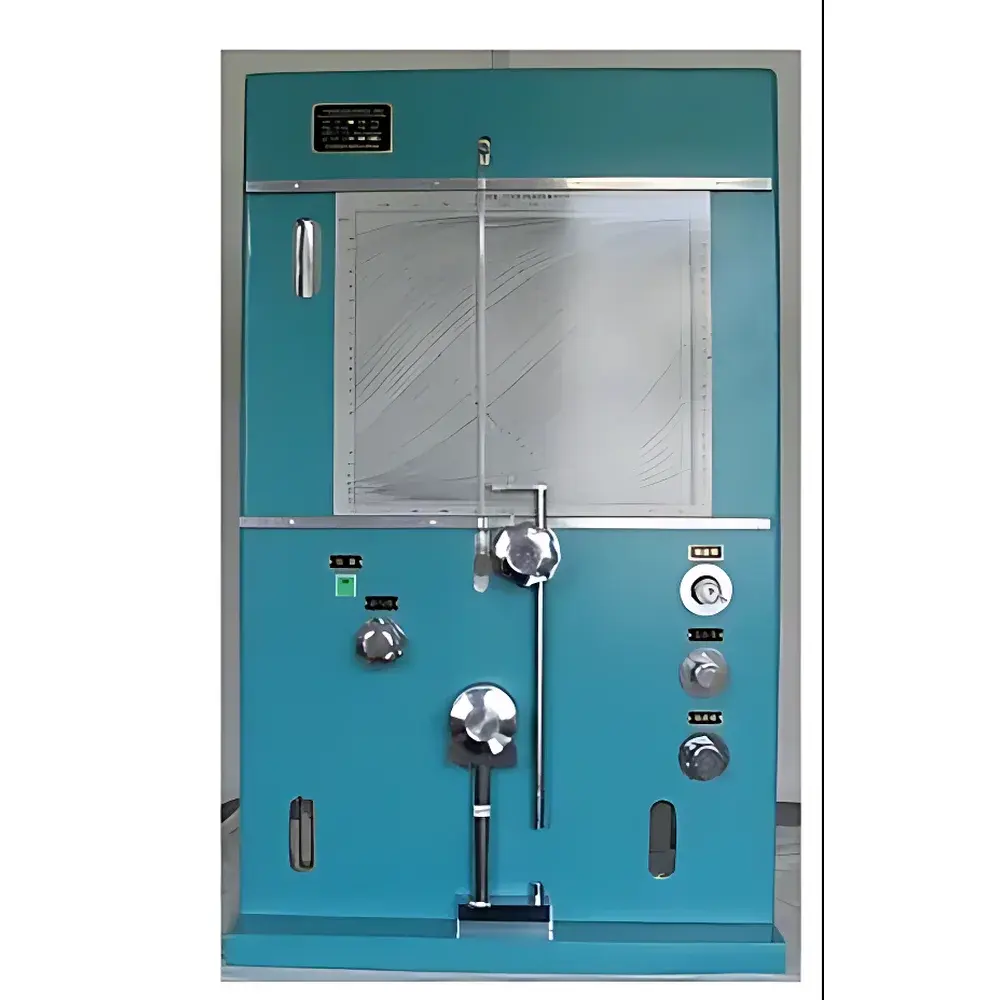
Aode AODE-305 Air Permeability Average Particle Size Analyzer
| Brand | Aode |
|---|---|
| Origin | Liaoning, China |
| Manufacturer Type | Direct Manufacturer |
| Product Type | General-Purpose |
| Display Interface | PC-Based Software |
| Measurement Range | 0.2–50 µm |
| Repeatability | ±3% |
| Porosity Range | 0.25–0.95 |
| Inlet Gas Pressure | 3 bar |
| Power Consumption | 2 W |
| Operating Temperature | 25 ± 10 °C |
| Relative Humidity | ≤80% RH |
| Dimensions | 755 × 400 × 260 mm |
| Weight | 12 kg |
Overview
The Aode AODE-305 Air Permeability Average Particle Size Analyzer is a precision instrument engineered for the rapid, non-destructive determination of average particle size and specific surface area of dry, free-flowing powders. It operates on the fundamental principle of laminar air flow through a consolidated powder bed—governed by the Carman-Kozeny equation—which relates gas permeability to particle size, bed porosity, and specific surface area. Unlike laser diffraction or dynamic light scattering methods, this analyzer delivers robust, reproducible results for industrial powders where optical opacity, agglomeration, or electrostatic charge may compromise alternative techniques. Designed for routine QC/QA laboratories in pharmaceuticals, metallurgy, ceramics, catalyst manufacturing, and additive manufacturing, the AODE-305 provides traceable, physics-based size data without requiring calibration standards or dispersion media.
Key Features
- Stable, low-noise diaphragm air pump with integrated pressure regulation (3 bar inlet), ensuring consistent volumetric flow across repeated measurements
- Dual-range porosity selection (0.25–0.40, 0.40–0.80, 0.80–0.95) via calibrated compression fixtures—enabling accurate modeling of bed structure for diverse powder morphologies
- U-tube manometer and vertical pressure gauge with vernier-calibrated scale for high-resolution differential pressure measurement
- Integrated sample compaction mechanism with force-controlled loading to maintain standardized bed density and minimize operator-induced variability
- PC-based control and analysis software (Windows-compatible) with automated calculation of mean particle diameter (dav), specific surface area (SSA), and permeability coefficient (k)
- Compact benchtop architecture (755 × 400 × 260 mm), low power draw (2 W), and ambient operating range (15–35 °C, ≤80% RH) for seamless integration into regulated lab environments
Sample Compatibility & Compliance
The AODE-305 is validated for use with non-cohesive, dry, granular materials including metal powders (e.g., Ti-6Al-4V, stainless steel 316L), ceramic precursors (Al2O3, ZrO2), pharmaceutical excipients (lactose, microcrystalline cellulose), and catalyst supports (silica gel, activated carbon). It complies with ASTM D7261–19 “Standard Test Method for Determination of Specific Surface Area of Powders by Air Permeability” and aligns with ISO 9277:2010 for BET-complementary validation. While not intrinsically compliant with FDA 21 CFR Part 11, its PC software supports user-defined audit trails, electronic signatures, and data export in CSV/Excel formats—facilitating GLP/GMP documentation workflows when deployed with institutional IT governance controls.
Software & Data Management
The included Windows application provides real-time pressure decay visualization, automatic dav computation using the Carman-Kozeny derivation, and batch reporting with statistical summaries (mean, SD, CV%). Raw pressure vs. time datasets are stored in timestamped project files (.aode), supporting retrospective reanalysis. Export functions include tab-delimited text, PDF reports with instrument ID, operator name, date/time stamp, and environmental metadata. All calculations are transparently documented in the software help system—including assumptions on tortuosity (τ = 4.5), gas viscosity (η = 18.6 µPa·s at 25 °C), and void fraction correction factors per selected porosity bracket.
Applications
- Pharmaceutical solid dosage development: Monitoring granule size distribution impact on tablet compressibility and dissolution kinetics
- AM powder qualification: Verifying batch-to-batch consistency of metal/ceramic feedstocks prior to laser sintering
- Catalyst R&D: Correlating SSA changes after thermal treatment or chemical impregnation
- Quality release testing: Final inspection of milled API batches against pharmacopeial air permeability limits (e.g., USP <1118>)
- Research labs: Cross-validation of laser diffraction data for irregular or high-aspect-ratio particles (e.g., nanofibers, platelets)
FAQ
What physical principle does the AODE-305 rely on?
It applies Darcy’s law and the Carman-Kozeny equation to quantify air permeability through a fixed-height, uniformly compacted powder bed—directly linking pressure drop, flow rate, and bed geometry to average particle diameter and specific surface area.
Can it measure nanoparticles below 0.2 µm?
No. The lower detection limit is constrained by laminar flow assumptions and manometric resolution; sub-200 nm materials require BET or TEM-based methods.
Is sample preparation standardized?
Yes—each test requires precise mass loading, controlled compaction force (via calibrated spring mechanism), and conditioning at ambient humidity to ensure inter-laboratory reproducibility.
Does it require gas calibration or certified reference materials?
No. It is a first-principles instrument: no reference standards are needed, though users may validate system integrity using NIST-traceable porosity check powders.
How is data integrity ensured in regulated environments?
While the base software lacks Part 11 features, its deterministic algorithms, full raw-data retention, and export flexibility enable integration into validated LIMS or ELN platforms with supplementary access controls and change management protocols.



