
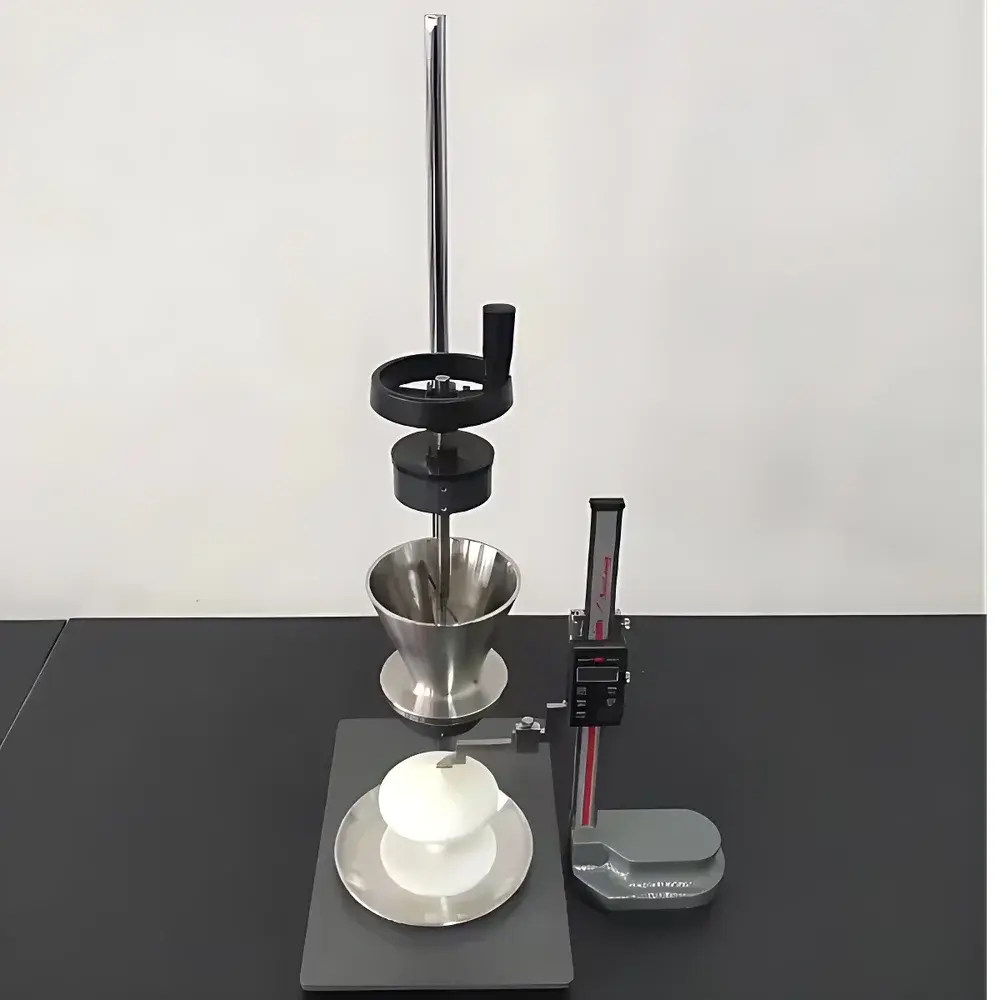
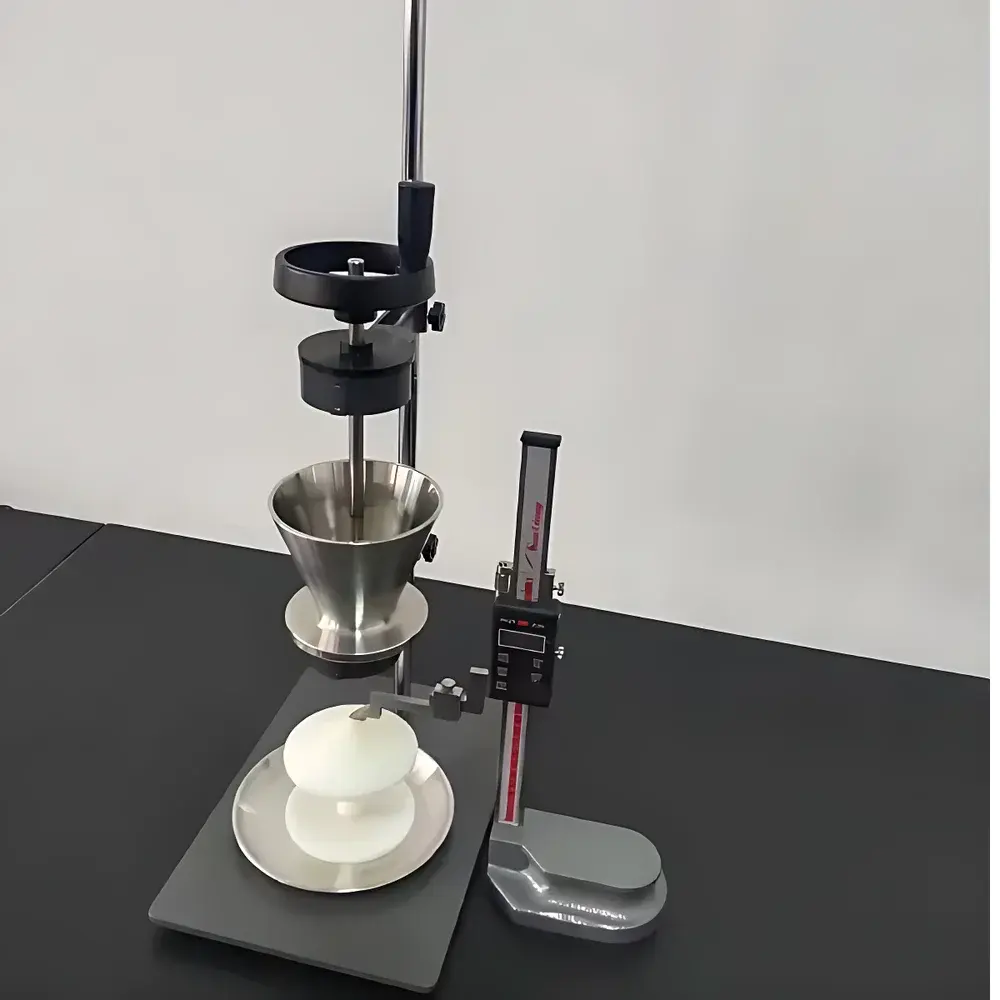
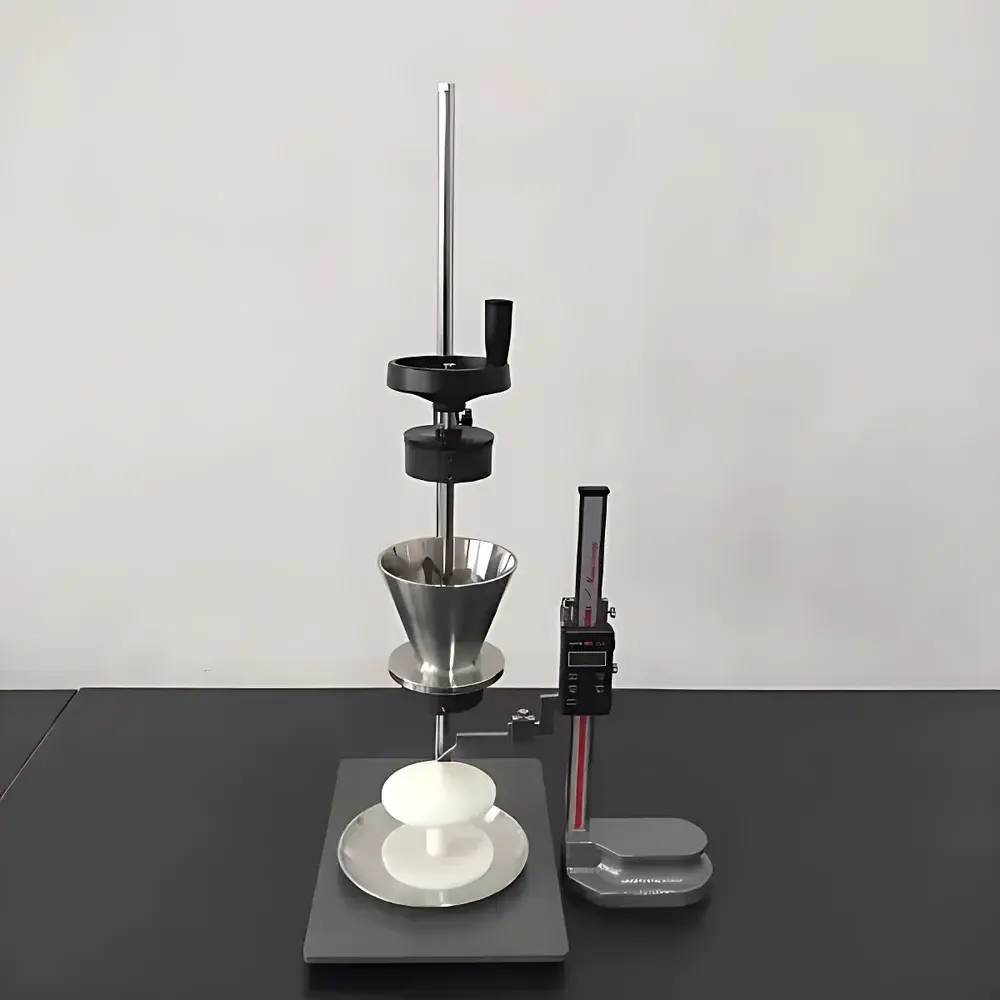
Aode Aode-307 Powder Flowability Tester
| Brand | Aode |
|---|---|
| Origin | Liaoning, China |
| Manufacturer Type | Direct Manufacturer |
| Country of Origin | China |
| Model | Aode-307-1 |
| Instrument Type | Powder Flowability Tester |
| Measurable Parameters | Angle of Repose, Flow Rate (mass/time), Discharge Mass |
| Maximum Sample Vessel Capacity | 520 mL |
| Minimum Sample Volume | 25 mL |
| Power Supply | 220 V AC |
| Dimensions (W×D×H) | 280 × 280 × 600 mm |
| Weight | 8 kg |
| Funnel Orifice Diameters | 2, 5, 8, 10, 15, 20, 25 mm (standard: 10 / 15 / 25 mm) |
| Construction Materials | 304 Stainless Steel & Aluminum Alloy |
| Compliance | ISO 4324, GB/T 21060–2007 |
Overview
The Aode Aode-307 Powder Flowability Tester is a benchtop static flow characterization instrument engineered for the quantitative assessment of bulk powder behavior under gravity-driven conditions. It operates on the fundamental principle of angle of repose (AoR) measurement—defined as the maximum stable angle formed between the free surface of a conical powder pile and the horizontal plane—providing a direct, reproducible indicator of interparticle friction and cohesion. In addition to AoR, the system supports complementary flow metrics including mass-based discharge rate (g/s) and time-resolved mass outflow (g in fixed t), enabling multi-dimensional evaluation aligned with industrial powder handling requirements. Designed for routine QC labs, R&D facilities, and formulation development teams, the Aode-307-1 delivers consistent, operator-independent results without requiring advanced rheological expertise. Its mechanical architecture eliminates reliance on complex sensors or moving actuators, favoring robustness, ease of calibration, and long-term stability across repeated use cycles.
Key Features
- ISO 4324– and GB/T 21060–2007–compliant test methodology ensures regulatory alignment for polymer, pharmaceutical, food, and ceramic powder applications
- Modular stainless-steel funnel system with seven interchangeable orifice diameters (2–25 mm) allows systematic investigation of particle size–orifice interaction effects
- Integrated digital caliper with LCD readout (0.01 mm resolution) replaces manual vernier measurements, minimizing parallax and human reading error
- Height-to-diameter ratio calculation performed automatically via embedded software upon entry of cone height and base diameter values
- 304 stainless steel construction throughout critical contact surfaces (funnel, base plate, measuring arm) guarantees corrosion resistance, cleanability, and compatibility with GMP-compliant environments
- Adjustable vertical lift platform enables precise funnel-to-base positioning; calibrated scale ensures repeatable drop height control per test protocol
- Included agitation rod facilitates controlled powder densification for low-flow materials—supporting standardized tapping or gentle stirring prior to AoR formation
Sample Compatibility & Compliance
The Aode-307-1 accommodates dry, free-flowing to marginally cohesive powders within the 25–520 mL volume range. It is suitable for granules, milled APIs, excipients, metal powders, catalysts, and food-grade particulates—provided particles are non-hygroscopic and exhibit no significant electrostatic adhesion. The instrument’s design strictly adheres to ISO 4324:2015 (“Fine ceramics — Determination of angle of repose of ceramic powders”) and Chinese national standard GB/T 21060–2007 (“Plastics — Determination of flowability of thermoplastics by the angle of repose method”). While not a dynamic rheometer, its static flow data serves as a primary screening tool for process risk assessment in hopper design, tablet compression, pneumatic conveying, and silo storage validation. No regulatory submission requires AoR alone; however, when combined with other tests (e.g., Carr Index, Hausner Ratio), it contributes to comprehensive powder flow profiling per ICH Q5C and USP .
Software & Data Management
The Aode-307-1 employs a lightweight Windows-compatible desktop application that accepts manual input of measured cone height and base diameter. The software computes angle of repose using arctangent (θ = tan⁻¹(2h/d)) and classifies flow behavior according to ASTM D6393–22 Annex A1 (Qualitative Flow Classification Table). Each test record stores timestamp, operator ID, sample ID, orifice size, and raw input values. Export options include CSV and PDF report formats—with embedded metadata fields for audit trail completeness. Though not Part 11–validated out-of-the-box, the software architecture supports integration into validated laboratory information management systems (LIMS) through standardized data export protocols. Audit log functionality can be enabled for GLP/GMP environments upon user-defined configuration.
Applications
- Pharmaceutical solid dosage form development: pre-formulation screening of API–excipient blends prior to roller compaction or direct compression
- Quality control of incoming raw materials in chemical manufacturing, particularly for catalysts and pigment dispersions
- Process troubleshooting in powder metallurgy: correlating AoR shifts with sintering atmosphere changes or milling duration
- Educational laboratories: teaching fundamental powder mechanics principles including yield locus approximation and Jenike shear testing context
- Food industry: evaluating flow consistency of milk powders, starches, and functional ingredients across batch production runs
- Research on anti-caking agent efficacy: quantifying AoR reduction following surface treatment or humidity conditioning
FAQ
What standards does the Aode-307-1 comply with?
It conforms to ISO 4324:2015 and GB/T 21060–2007. These define specimen preparation, funnel geometry, drop height, and calculation methodology for angle of repose determination.
Can this instrument measure dynamic flow properties such as shear strength or wall friction?
No. The Aode-307-1 is a static flow tester. For shear-dependent parameters, a rotational shear cell (e.g., FT4 or Schulze Ring Shear Tester) is required.
Is calibration traceable to NIST or other national metrology institutes?
The digital caliper is factory-calibrated to ±0.02 mm accuracy. Users may perform in-house verification using certified gauge blocks; full traceability documentation is available upon request.
How often should the funnel orifice be cleaned between tests?
After every test run when handling cohesive or hygroscopic powders; otherwise, cleaning is recommended after each sample type change to prevent cross-contamination.
Does the system support automated data logging or network connectivity?
Data entry is manual via PC interface. No Ethernet/WiFi module is included; however, exported CSV files integrate seamlessly with Excel-based statistical process control (SPC) workflows.



