
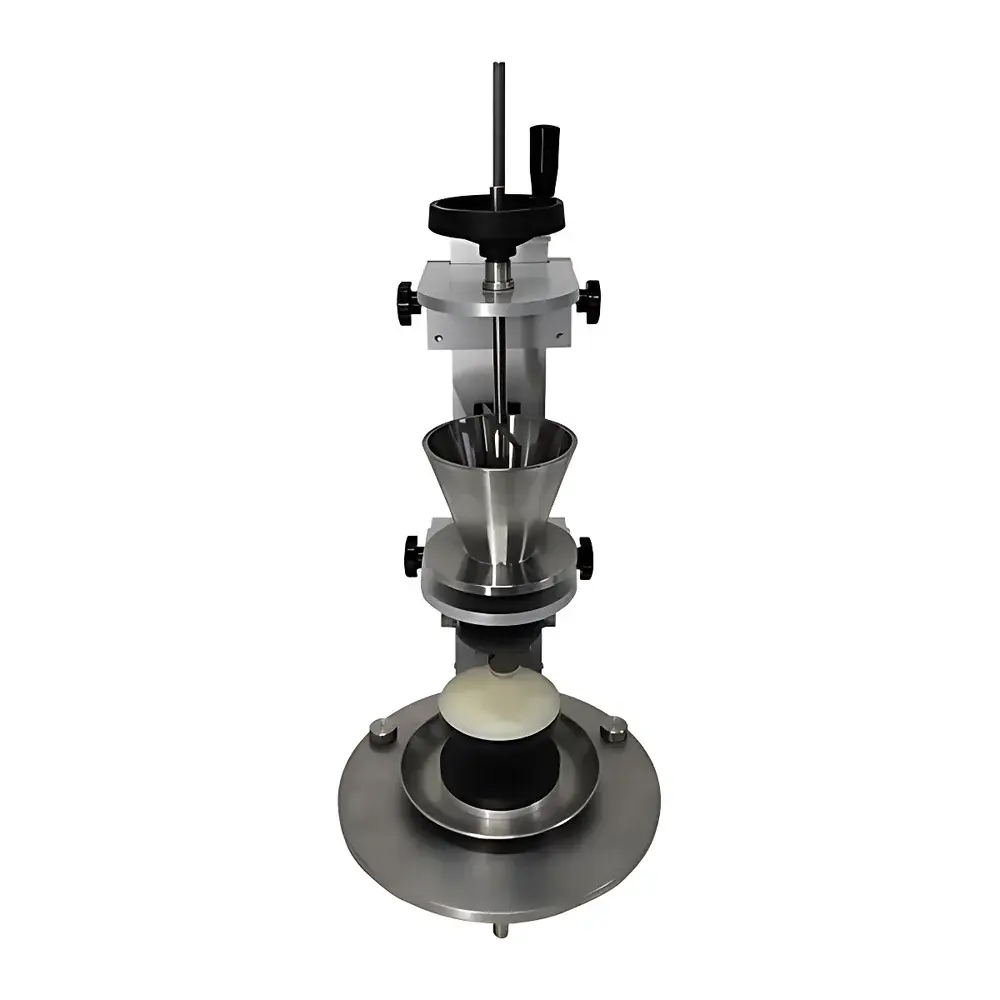
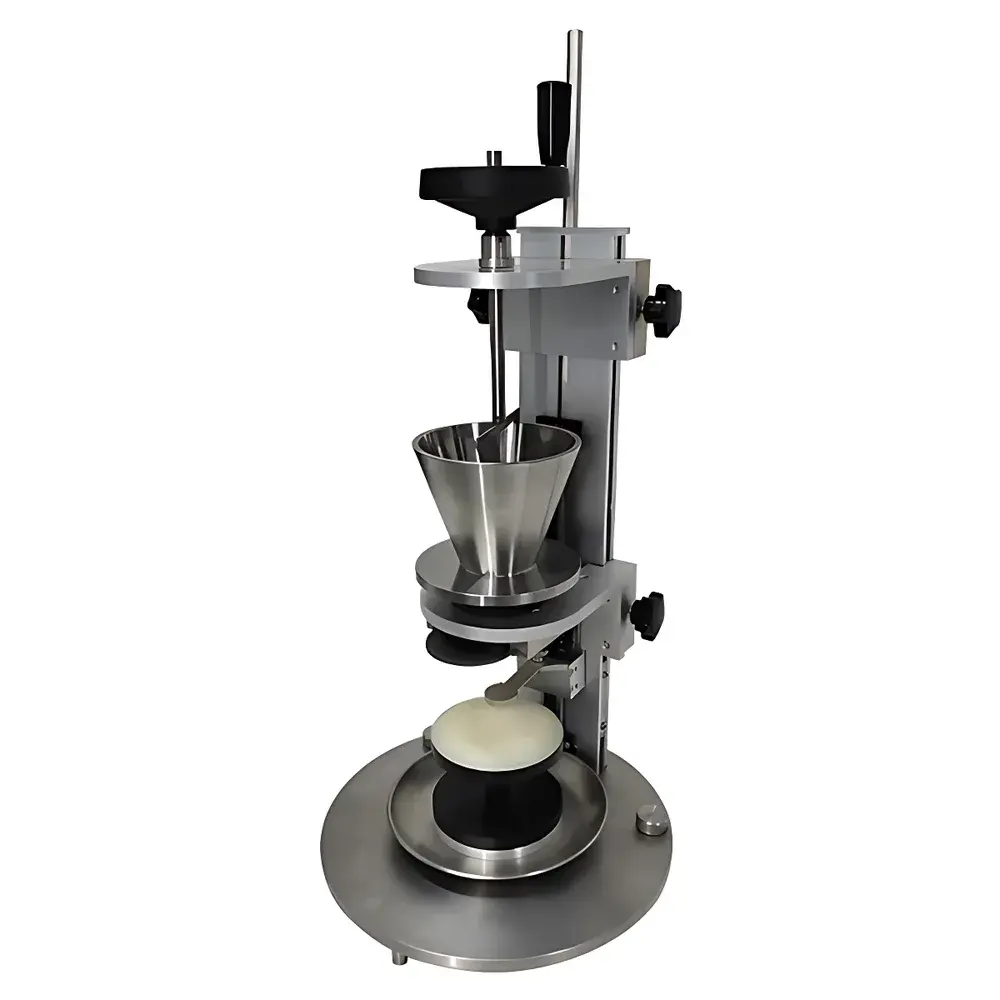
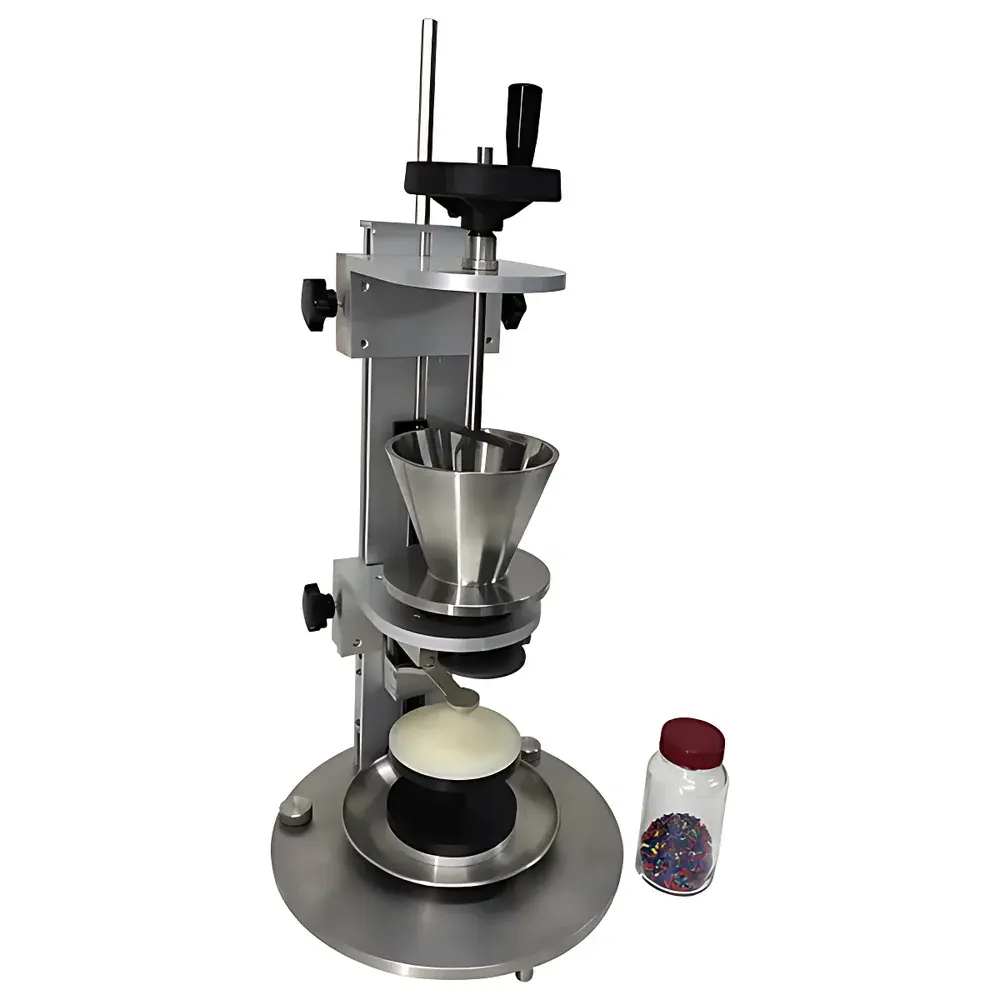
Aode Aode-310 Digital Angle of Repose Tester for Powder Flowability
| Brand | Aode |
|---|---|
| Origin | Liaoning, China |
| Manufacturer Type | Direct Manufacturer |
| Product Category | Domestic Instrument |
| Model | Aode-310 |
| Instrument Type | Powder Flowability Tester |
| Measurable Parameters | Flow Time, Discharged Mass, Angle of Repose (θ), Bulk Density, Pile Mass, Loose Bulk Density |
| Maximum Sample Vessel Capacity | 520 mL |
| Minimum Sample Requirement | 10 g |
| Funnel Orifice Diameters | 2, 5, 8, 10, 15, 20, 25 mm |
| Power Supply | 5 V DC |
| Dimensions (W×D×H) | 280 × 280 × 600 mm |
| Weight | 8 kg |
| Construction Materials | 304 Stainless Steel (funnel, base plate, measuring arm), Aluminum Alloy (elevation platform, housing) |
Overview
The Aode Aode-310 Digital Angle of Repose Tester is a precision-engineered instrument designed for the standardized determination of the angle of repose (θ) — a fundamental indicator of powder flow behavior in pharmaceutical, chemical, food, metallurgical, and additive manufacturing processes. Based on the static conical pile method defined in ISO 4324:2015 and GB/T 21060–2007, the device quantifies the maximum stable slope formed by a freely discharged powder under gravity. This parameter correlates directly with interparticle friction, cohesion, and surface energy — critical factors influencing hopper discharge, tablet compression uniformity, and powder handling efficiency. The system employs a vertically adjustable stainless steel funnel mounted above a calibrated measurement platform; powder is allowed to flow freely onto a fixed circular base, forming a symmetrical cone. A digital height gauge integrated into the articulated measuring arm captures the vertical height (h) and base diameter (d) of the resulting pile. The angle of repose is then calculated in real time using the arctangent relationship: θ = arctan(2h/d). All raw measurements are transmitted via analog-to-digital interface to companion software, eliminating manual transcription and ensuring traceable, auditable data acquisition.
Key Features
- Multi-orifice stainless steel funnel set (2, 5, 8, 10, 15, 20, 25 mm diameters) enables systematic evaluation of orifice-dependent flow sensitivity — essential for simulating different feed hoppers and die fill scenarios.
- Integrated 304 stainless steel measurement arm with high-resolution digital caliper (0.01 mm resolution) ensures repeatable geometric capture of pile dimensions without parallax error or operator interpretation.
- Motorized elevation platform allows precise vertical positioning of the funnel relative to the base plate, maintaining consistent drop height across test series — a key variable affecting consolidation state and reproducibility.
- All wetted and contact surfaces fabricated from electropolished 304 stainless steel for corrosion resistance, cleanability, and compliance with GMP cleaning validation requirements.
- Built-in auxiliary stirrer rod facilitates controlled de-agglomeration of cohesive powders prior to flow initiation — supporting standardized testing of low-flowability materials per ASTM D6393 Annex A2 guidelines.
- Compact benchtop footprint (280 × 280 × 600 mm) and low mass (8 kg) enable deployment in QC labs, R&D environments, and regulated production support areas without structural reinforcement.
Sample Compatibility & Compliance
The Aode-310 accommodates dry, free-flowing to marginally cohesive powders with particle sizes ranging from ~10 µm to 2 mm. Minimum sample requirement is 10 g; maximum vessel capacity is 520 mL, permitting statistically robust replicate testing. The instrument conforms to ISO 4324:2015 “Fine ceramics — Determination of angle of repose of ceramic powders” and Chinese national standard GB/T 21060–2007 “Soil testing methods — Determination of angle of repose”. While not intrinsically compliant with FDA 21 CFR Part 11, its digital measurement chain supports audit-trail-ready operation when deployed with validated software configured for electronic signatures, metadata logging, and user access control — aligning with GLP and GMP documentation expectations for powder characterization in regulated product development.
Software & Data Management
The included Windows-based software acquires real-time height and diameter inputs, computes angle of repose, bulk density (from measured pile mass and volume), flow time, and discharged mass. Each test session generates a timestamped report containing instrument ID, operator ID, environmental notes (optional), raw measurements, calculated parameters, and a qualitative flow classification (e.g., “Excellent”, “Fair”, “Poor”) based on established empirical thresholds. Data export is supported in CSV and PDF formats; all files include embedded metadata for version control and regulatory traceability. Software architecture permits integration into LIMS environments via configurable API endpoints, enabling automated data ingestion into enterprise quality systems.
Applications
- Pharmaceutical solid dosage form development: screening excipients for blend uniformity and die-fill consistency.
- Quality control of metal AM feedstocks: verifying batch-to-batch flow stability prior to laser powder bed fusion processing.
- Food ingredient formulation: assessing flow performance of dairy powders, starches, and functional blends under varying humidity conditions.
- Ceramic and refractory powder processing: correlating angle of repose with green strength and pressing defects.
- Regulatory submission support: generating standardized flow data for ICH Q5C, USP , and EP 2.9.33 dossiers.
FAQ
What standards does the Aode-310 comply with?
It meets ISO 4324:2015 and GB/T 21060–2007 for angle of repose determination.
Can the instrument measure cohesive or electrostatically charged powders?
Yes — the included stainless steel stirrer rod allows gentle pre-conditioning to break weak agglomerates, improving repeatability for moderately cohesive materials.
Is calibration traceable to national metrology institutes?
The digital height gauge is factory-calibrated against NIST-traceable length standards; users receive a calibration certificate with each unit.
How is data integrity ensured during reporting?
All measurements are digitally captured and stored with timestamps, operator IDs, and instrument serial numbers — supporting ALCOA+ principles (Attributable, Legible, Contemporaneous, Original, Accurate, Complete, Consistent, Enduring, Available).
What maintenance is required?
Routine cleaning of stainless steel components with ethanol or isopropanol; no scheduled recalibration is needed within the 2-year warranty period unless physical damage occurs.
Related Products



