
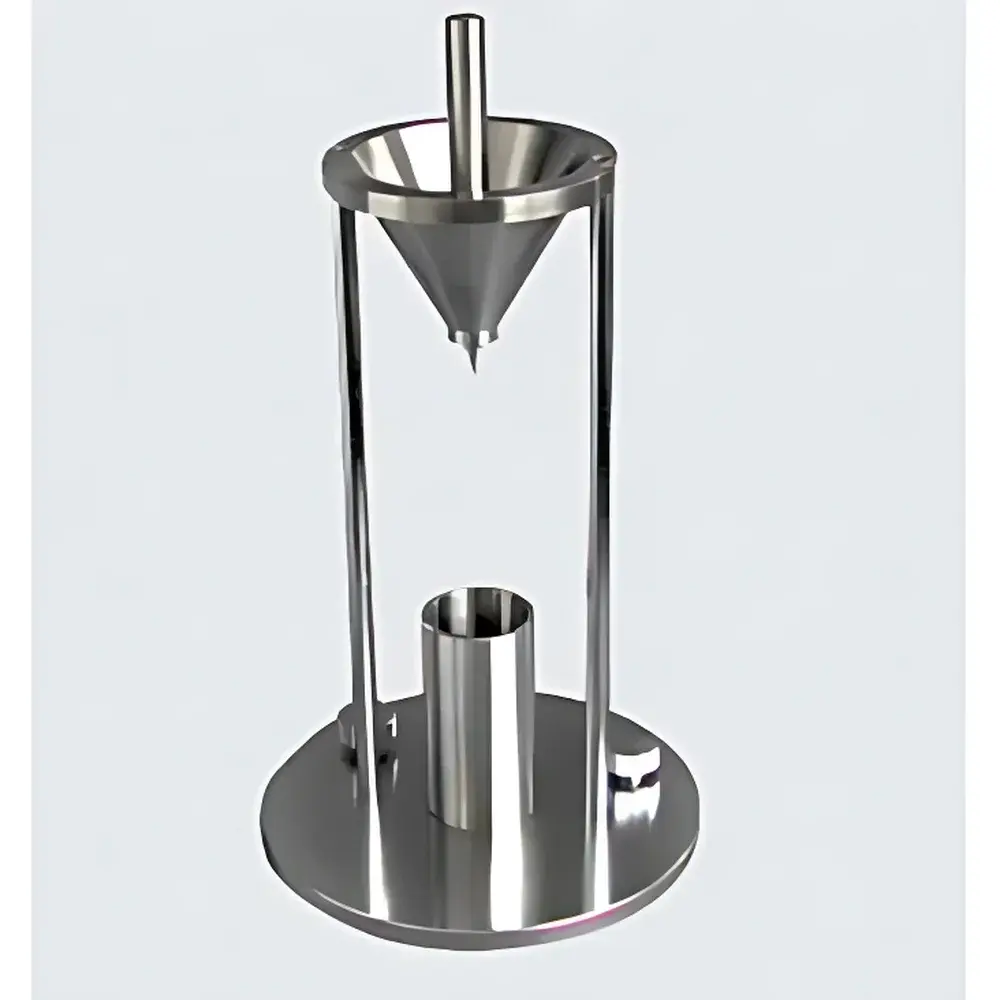
Aode AODE-311 Natural Bulk Density Tester
| Brand | Aode |
|---|---|
| Origin | Liaoning, China |
| Manufacturer Type | Direct Manufacturer |
| Region | Domestic (China) |
| Model | AODE-311 |
| Price Range | USD 700 – 1,400 (FOB) |
| Instrument Type | Powder Flowability Tester |
| Measurable Parameters | Apparent Density, Bulk Density |
| Maximum Sample Cup Capacity | 500 mL |
| Minimum Sample Requirement | 10 mL |
| Funnel Orifice Diameter | 12.7 mm |
| Funnel Cone Angle | 60° ± 0.5° |
| Cylinder Volume | 100 mL |
| Cylinder Inner Diameter | Φ39 mm |
| Material | ASTM A240 Grade 304 Stainless Steel (All Wetted Parts) |
| Required External Balance | ≤1 kg capacity, readability 0.02 g |
Overview
The Aode AODE-311 Natural Bulk Density Tester is a precision-engineered instrument designed for the standardized determination of apparent (loose) bulk density of non-metallic powders and fine particulates. It operates on the principle of gravity-fed natural packing—where powder flows freely from a fixed-height funnel into a calibrated cylindrical receiver under controlled geometric conditions. This method conforms strictly to the test protocol defined in GB/T 16913.3–2008 (equivalent in scope to ISO 697:2017 and ASTM D1895–96 Method A), which specifies the measurement of bulk density for powders that are not subject to mechanical vibration or compaction during filling. The device is widely deployed in quality control laboratories for pharmaceutical excipients, food ingredients, ceramic precursors, catalysts, agricultural chemicals, and mineral powders—where consistent bulk behavior directly impacts downstream handling, blending uniformity, and dosage accuracy.
Key Features
- Compliant stainless steel construction: All contact surfaces—including funnel, cylinder, scraper, and stopper rod—are fabricated from ASTM A240 Grade 304 stainless steel, ensuring corrosion resistance, cleanability, and long-term dimensional stability.
- Precision-machined funnel geometry: 12.7 mm orifice diameter and 60° ± 0.5° cone angle guarantee reproducible flow initiation and minimal wall adhesion per GB/T 16913.3 requirements.
- Standardized 100 mL receiving cylinder: Cylindrical receiver with nominal inner diameter of Φ39 mm and calibrated volume traceable to national metrological standards.
- Integrated manual dosing control: Spring-loaded stainless steel stopper rod enables repeatable interruption and release of powder flow, minimizing operator-induced variability.
- Modular design for rapid cleaning and validation: No internal seals or moving parts; disassembly requires no tools—supporting routine cleaning verification and GMP-aligned equipment qualification.
- Scalable sample handling: Accommodates minimum sample volumes as low as 10 mL and supports optional 500 mL auxiliary containers for heterogeneous or low-density materials requiring larger statistical sampling.
Sample Compatibility & Compliance
The AODE-311 is validated for use with free-flowing, cohesionless to moderately cohesive dry powders having particle sizes ranging from 10 µm to 2 mm. It excludes metallic powders (due to potential oxidation and static interference) and highly hygroscopic or electrostatically charged materials unless preconditioned per ISO 8503-2. Test procedures align with GB/T 16913.1–2008 for representative sampling and GB/T 16913.3–2008 for density calculation. While not intrinsically compliant with FDA 21 CFR Part 11, its operation supports ALCOA+ data integrity principles when paired with an audit-trail-capable balance and documented SOPs. The instrument meets general laboratory safety standards per IEC 61010-1 and is suitable for ISO/IEC 17025-accredited testing environments when operated within validated procedural limits.
Software & Data Management
The AODE-311 is a manually operated, hardware-only system with no embedded electronics or firmware. Density calculations are performed externally using standard laboratory spreadsheets or LIMS-integrated templates. Users record mass (g) measured on a Class II balance (0.02 g resolution) and apply the formula ρb = m/V, where V = 100 mL. To support GLP/GMP workflows, laboratories commonly integrate the tester into electronic batch records via digital balance interfaces (RS-232 or USB HID), enabling automatic mass capture and timestamped result logging. Raw data—mass, ambient temperature/humidity, operator ID, and lot number—is retained per retention policies aligned with ISO 17025 clause 7.5.2.
Applications
- Pharmaceutical manufacturing: Verification of excipient bulk density prior to direct compression tableting or high-shear wet granulation.
- Food processing: Characterization of starches, milk powders, and spice blends for volumetric dosing system calibration.
- Ceramics & refractories: Batch-to-batch consistency monitoring of alumina, zirconia, and silica powders used in slip casting or dry pressing.
- Environmental testing labs: Analysis of airborne dust simulants and soil particulates per occupational hygiene protocols.
- Research & development: Screening of surface-modified nanoparticles or spray-dried formulations for process scalability assessment.
FAQ
Is the AODE-311 suitable for metallic powders?
No. Metallic powders are excluded per GB/T 16913.3 due to oxidation risk, static charge accumulation, and inconsistent flow dynamics under gravity-only conditions.
Can the instrument be used with powders exhibiting high moisture content?
Not without pre-conditioning. Hygroscopic samples must be dried to constant mass at specified temperature/humidity per GB/T 16913.1 before testing to avoid density artifact.
What balance specifications are required for compliant operation?
A Class II analytical balance with ≥1 kg capacity and ≤0.02 g readability is mandatory; calibration must be verified daily using certified weights traceable to NIM (China) or NIST (USA).
Does the device include automated data recording?
No. The AODE-311 is a mechanical-only system. Data capture and calculation are performed externally using user-supplied instrumentation and documentation systems.
How often should the funnel orifice be inspected for wear?
Visual inspection and orifice diameter verification with pin gauges are recommended after every 200 test cycles or quarterly—whichever occurs first—to maintain conformance with the 12.7 mm tolerance requirement.



