
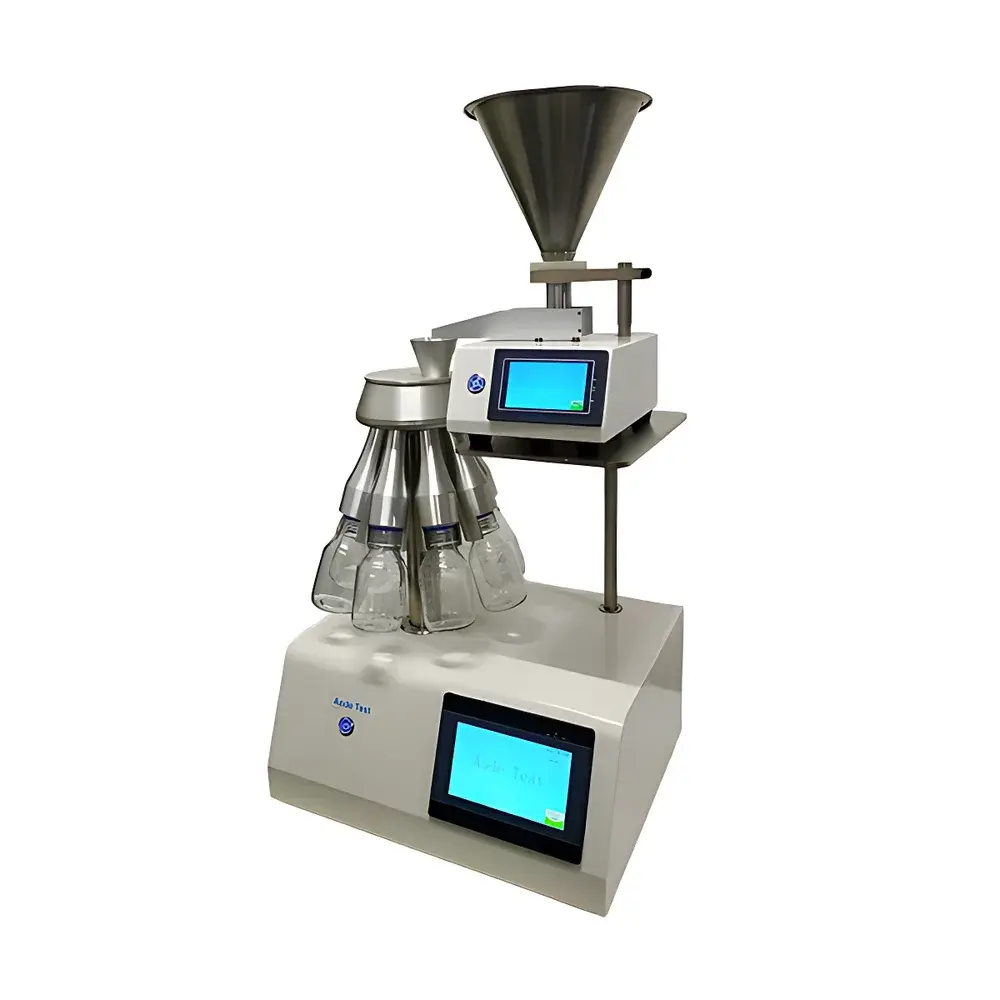
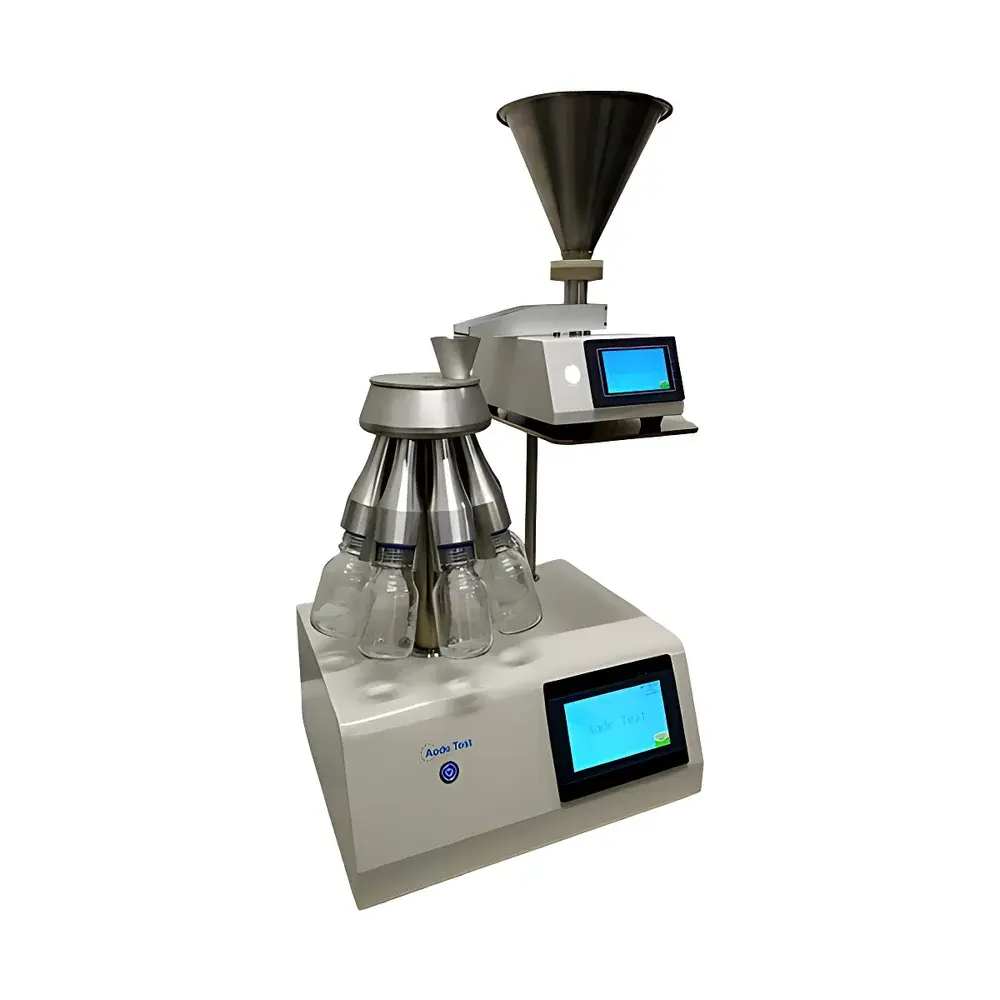
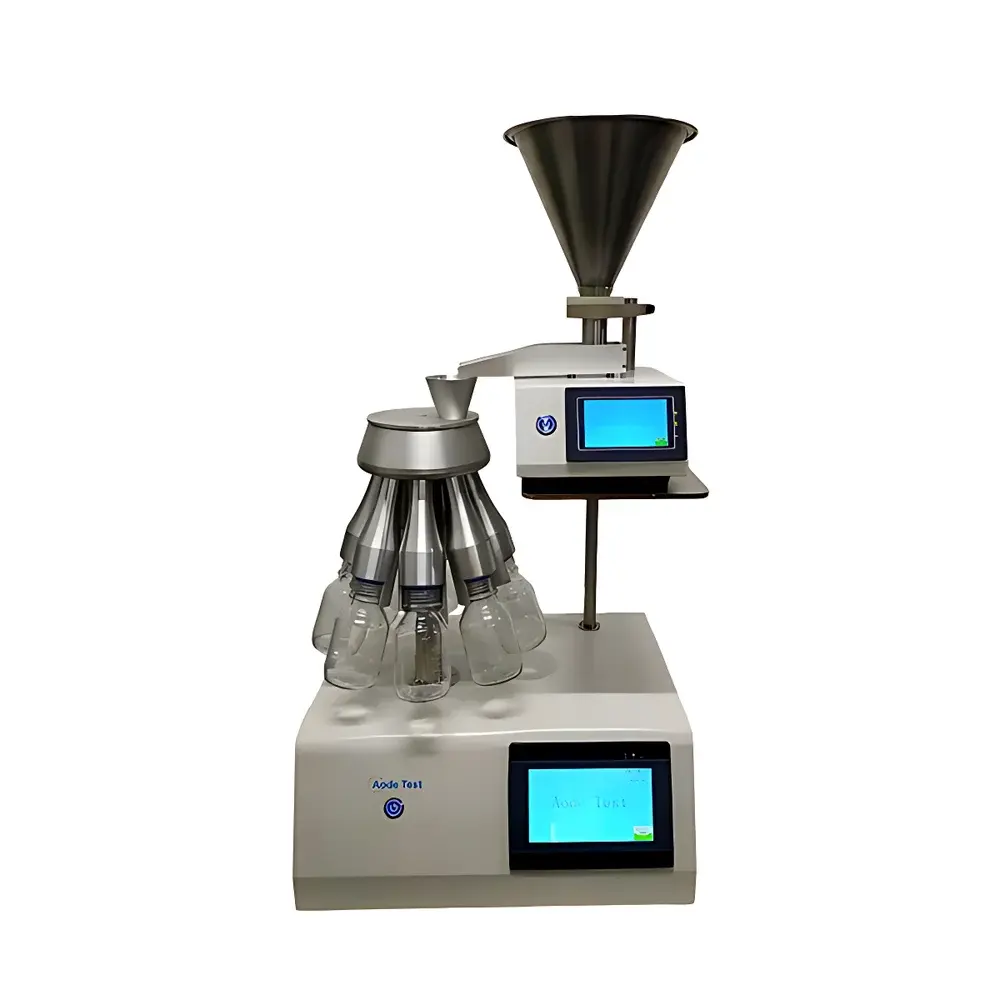
Aode Aode100 Automated Rotary Sample Divider
| Brand | Aode |
|---|---|
| Origin | Liaoning, China |
| Manufacturer Type | Direct Manufacturer |
| Model | Aode100211227 |
| Sample Bottle Volumes | 30 / 100 / 250 / 500 mL |
| Dividing Speed | 80–120 rpm (adjustable) |
| Sample Throughput | 5–5000 mL |
| Maximum Particle Diameter | 15 mm |
| Sample Volume per Port | 1–500 mL |
| Power Supply | 220 V, 50 Hz, 60 W |
| Dimensions | 50 × 40 × 69 cm |
| Weight | 35 kg |
| Material | 6061 Aluminum Alloy (rotor assembly) |
| Sample Types | Dry powders, granules, and stable emulsions |
| Dividing Configurations | Standard 8-port |
| Compliance | Designed for GLP-compliant sample preparation workflows |
Overview
The Aode Aode100 Automated Rotary Sample Divider is an engineered solution for high-fidelity, statistically representative subsampling of bulk particulate materials in laboratory and quality control environments. Based on the principle of rotary centrifugal division—where a rotating multi-orifice distributor couples gravitational feed with controlled angular momentum—the Aode100 ensures mass-proportional splitting across all output ports. Unlike static splitter designs or manual scooping methods, this system eliminates operator-induced bias and minimizes segregation effects during handling. Its core architecture integrates a vibration-fed linear feeder with a precision-engineered eccentric hopper and a dynamically balanced 6061 aluminum alloy rotor. This configuration maintains consistent mass flow rate and angular velocity regardless of load variation or minor voltage fluctuations, supporting ISO 13320-compliant sampling protocols for particle size analysis, chemical assay validation, and homogeneity testing.
Key Features
- Integrated vibration feeder and rotary divider subsystems operate synchronously under closed-loop speed control, ensuring temporal and volumetric synchronization across all split fractions.
- 6061 aluminum alloy rotor construction resists adhesion, facilitates rapid cleaning, and eliminates cross-contamination between sequential samples—critical for trace-level analytical workflows.
- Modular bottle interface with standardized lab-grade borosilicate glass or polypropylene vials (30 / 100 / 250 / 500 mL options) ensures compatibility with downstream instrumentation including ICP-OES, XRD, and laser diffraction analyzers.
- Adjustable operational parameters—including rotation speed (80–120 rpm), feed duration, and vibratory amplitude—are programmable via front-panel controller with non-volatile memory retention.
- Eight standard outlet ports support parallel sample distribution; custom configurations (6- or 10-port) are available to align with specific QA/QC batch documentation requirements or regulatory audit trails.
- Low-noise (<62 dB(A)) operation enables integration into shared analytical laboratories without acoustic interference to adjacent instrumentation such as FTIR spectrometers or microbalances.
Sample Compatibility & Compliance
The Aode100 accommodates dry, free-flowing powders and stable emulsions with maximum particle diameters up to 15 mm and total sample volumes ranging from 5 mL to 5 L. It is validated for use with pharmaceutical excipients, mineral ores, catalyst pellets, food-grade starches, and battery cathode precursors. All wetted surfaces meet USP Class VI biocompatibility standards when configured with certified PP or glass vessels. The system supports audit-ready documentation through optional time-stamped log export (CSV format) and complies with fundamental principles of ISO/IEC 17025:2017 Clause 7.7 (sampling) and ASTM D6938–22 (standard practice for sampling bulk solids). While not intrinsically 21 CFR Part 11 compliant, its parameter-locking capability and manual logbook functionality facilitate GMP-aligned implementation when paired with laboratory information management systems (LIMS).
Software & Data Management
The Aode100 operates via an embedded microcontroller interface with real-time monitoring of motor RPM, feed cycle duration, and actuation count. Though it does not include proprietary PC software, all operational settings—including preset programs for common material classes (e.g., “Fine Pharma Powder”, “Coarse Aggregate”)—are stored locally with password-protected access. Optional RS-232 or USB-to-serial adapters enable integration with external data acquisition platforms for automated recordkeeping. Audit trail generation requires external logging; however, the device’s deterministic mechanical behavior—verified via NIST-traceable rotational calibration—ensures reproducible performance across shifts and operators without software dependency.
Applications
- Preparation of representative subsamples for BET surface area measurement, where heterogeneity in coarse catalyst batches can skew nitrogen adsorption isotherms.
- Reduction of large-volume geological core samples prior to XRF fusion bead preparation, maintaining stoichiometric fidelity across replicate splits.
- Division of polymer masterbatch lots for melt flow index (MFI) testing, minimizing shear-induced degradation during manual handling.
- Homogenization and splitting of blended active pharmaceutical ingredients (APIs) and excipients prior to content uniformity assays per USP <905>.
- Supporting ISO 14687 hydrogen fuel purity certification by enabling repeatable sub-sampling of metal hydride storage media for residual impurity screening.
FAQ
What particle size distributions is the Aode100 validated for?
The system is optimized for particles ≤15 mm in maximum dimension and performs best with D50 values between 10 µm and 5 mm. For ultrafine aerosols or cohesive nanomaterials, pre-conditioning (e.g., dry sieving or antistatic treatment) is recommended.
Can the Aode100 handle moisture-sensitive samples?
Yes—when equipped with sealed sample bottles and operated in controlled ambient humidity (<40% RH), it maintains sample integrity for hygroscopic materials such as lithium iron phosphate or ammonium nitrate formulations.
Is calibration required before first use?
No routine calibration is needed due to its mechanical speed regulation and fixed-geometry rotor. However, users should verify rotational consistency using a handheld tachometer during initial commissioning and after major maintenance.
How often does the vibration feeder require maintenance?
Under normal operation (≤8 hrs/day), the electromagnetic vibrator requires no scheduled servicing beyond periodic inspection of mounting fasteners and coil insulation resistance every 12 months.
Does the Aode100 support integration with LIMS or ELN platforms?
Direct API integration is not supported, but timestamped CSV logs (via optional serial adapter) can be parsed by most LIMS vendors for electronic record linkage and metadata enrichment.



