
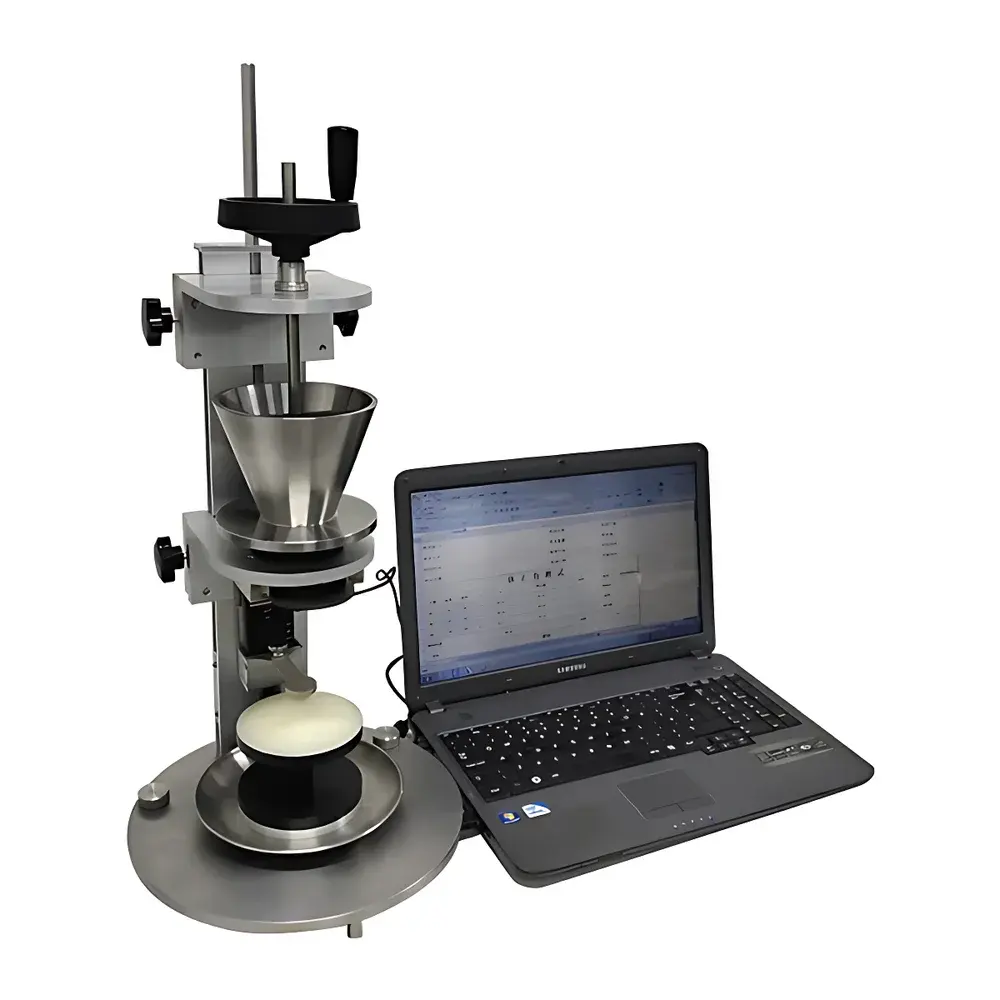
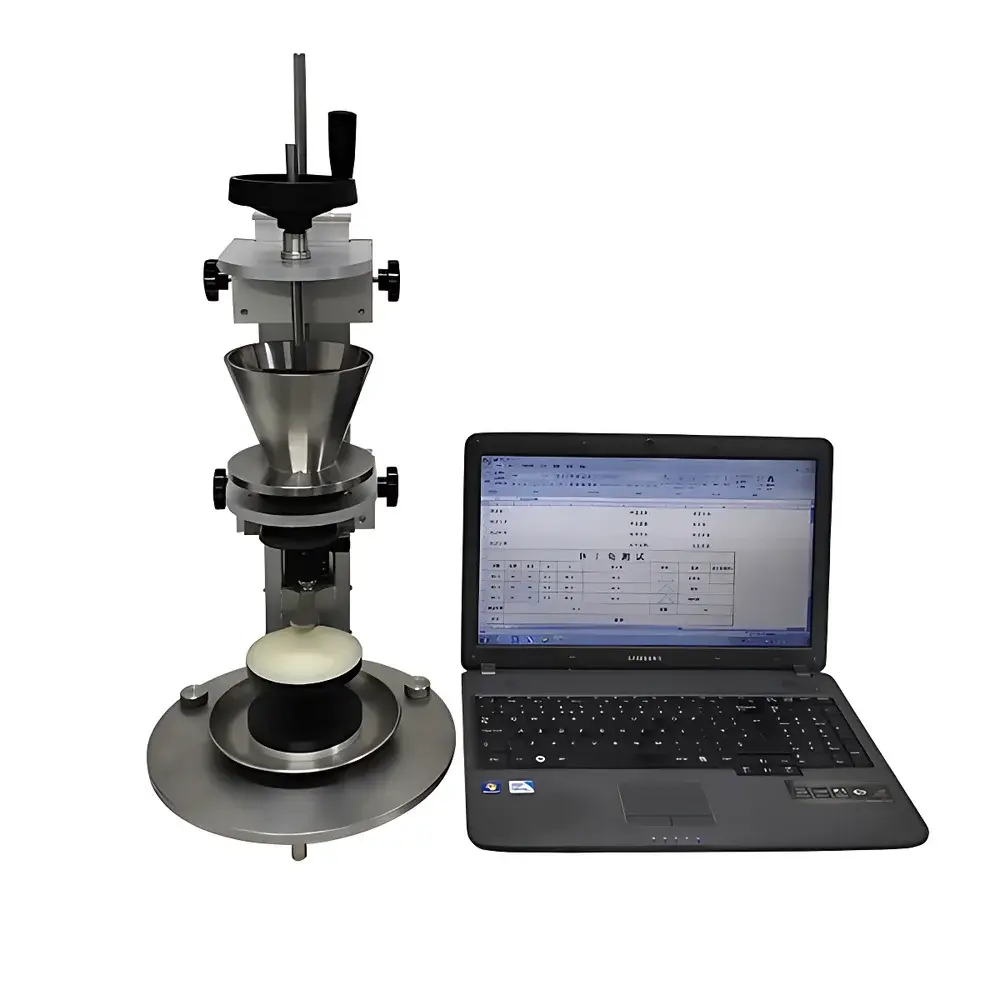
Aode Aode309 Advanced Powder Flowability Tester with Automated Angle of Repose Measurement
| Brand | Aode |
|---|---|
| Origin | Liaoning, China |
| Manufacturer Type | Direct Manufacturer |
| Country of Origin | China |
| Model | Aode309 (211224) |
| Instrument Category | Powder Flowability Tester |
| Measurable Parameters | Flow Time, Discharged Mass, Angle of Repose (θ), Bulk Density, Heap Mass, Loose Bulk Density |
| Maximum Sample Vessel Capacity | 520 mL |
| Minimum Sample Requirement | 10 g |
| Power Supply | 5 V DC |
| Dimensions | 280 × 280 × 600 mm |
| Weight | 8 kg |
| Funnel Outlet Diameters | 4, 6, 8, 10, 13, 15, 18, 20 mm |
| Construction Materials | 304 Stainless Steel & Aluminum Alloy |
| Compliance | GB/T 21060–2007, ISO 4324 |
Overview
The Aode Aode309 Advanced Powder Flowability Tester is an engineered instrument designed for the standardized determination of the angle of repose — a fundamental parameter in powder flow characterization. Based on the gravitational heap formation principle, the device measures the natural inclination angle formed when a cohesive or free-flowing powder is discharged through a calibrated funnel onto a horizontal base plate. This angle directly correlates with interparticle forces, including friction, cohesion, surface energy, particle morphology, size distribution, and bulk density. As a primary indicator of powder handling behavior, the angle of repose informs critical process decisions in formulation development, scale-up, and quality control across pharmaceutical, chemical, additive manufacturing, and food industries. The Aode309 implements a fully automated optical height-sensing and geometric calculation protocol to eliminate operator-dependent variability, ensuring high reproducibility under controlled ambient conditions.
Key Features
- Automated angle-of-repose calculation via integrated optical height detection and real-time geometric analysis — no manual protractor measurement required.
- Multi-orifice stainless steel funnel set (4–20 mm diameters) enables method flexibility per ISO 4324 and GB/T 21060–2007, supporting comparative testing across particle size ranges and flow regimes.
- Dual-mode operation: gravity-fed discharge for free-flowing powders; optional mechanical agitation rod for low-flow or cohesive materials to ensure consistent heap formation without compaction artifacts.
- 304 stainless steel sample chamber and aluminum alloy structural frame ensure corrosion resistance, cleanability, and long-term dimensional stability — essential for GMP-compliant environments.
- Embedded microcontroller with USB interface enables direct data streaming to Windows-based software for traceable acquisition, audit-ready reporting, and GLP-aligned metadata tagging (operator ID, timestamp, test ID, environmental notes).
Sample Compatibility & Compliance
The Aode309 accommodates dry, non-hygroscopic powders and granules with particle sizes ranging from ~10 µm to 2 mm. It supports minimum sample masses as low as 10 g — ideal for early-stage R&D where material is limited. The system complies with national and international standards governing powder flow assessment: GB/T 21060–2007 (China National Standard for Determination of Angle of Repose of Powders) and ISO 4324:2015 (Fine Ceramics — Determination of Angle of Repose of Ceramic Powders). While not a regulated medical device, its design principles align with FDA-recognized methodologies for excipient evaluation and support documentation requirements under ICH Q5C and USP <1174> Powder Flow. All hardware components are non-porous and sterilizable, facilitating reuse across batches with validated cleaning procedures.
Software & Data Management
The proprietary AodeFlow Analysis Suite (v3.2+) runs on Windows 10/11 and provides full lifecycle data management. Each test session records raw height measurements, calculated θ (in degrees ±0.1°), bulk density (g/cm³), flow time (s), discharged mass (g), and derived flow classification indices (e.g., Carr Index equivalent tiers). Reports are exportable in PDF, CSV, and XML formats with embedded digital signatures. Audit trail functionality logs user actions, parameter changes, and calibration events — satisfying 21 CFR Part 11 requirements for electronic records when deployed with appropriate IT governance controls. Historical datasets can be queried by batch number, date range, or material ID, enabling trend analysis across supplier lots or process modifications.
Applications
- Pharmaceutical solid dosage development: screening excipients (e.g., microcrystalline cellulose, lactose monohydrate) for tablet compression suitability.
- Quality assurance in polymer pellet production: detecting moisture-induced agglomeration or static-related bridging prior to extrusion.
- Process validation for metal AM feedstocks: verifying consistency of spherical Ti-6Al-4V or Inconel 718 powders between supplier deliveries.
- R&D labs evaluating novel battery cathode materials (e.g., NMC, LFP) where flow uniformity impacts electrode coating homogeneity.
- Food ingredient blending operations: assessing starch, sugar, or dairy powder flow response to humidity variations during packaging line trials.
FAQ
What standards does the Aode309 comply with?
It conforms to GB/T 21060–2007 and ISO 4324:2015 for angle-of-repose measurement methodology and reporting.
Can the instrument handle cohesive or electrostatically charged powders?
Yes — the included mechanical agitation rod assists in initiating flow for low-mobility materials without altering intrinsic properties.
Is the software compliant with 21 CFR Part 11?
The AodeFlow Analysis Suite supports electronic signatures, audit trails, and role-based access control — meeting technical prerequisites when implemented within a validated IT infrastructure.
What is the smallest sample quantity required for reliable measurement?
The minimum recommended mass is 10 g, verified across multiple powder types under ISO-defined funnel geometry conditions.
How is calibration performed and documented?
Calibration uses certified reference angles and geometric verification templates; all calibrations are logged with date, technician ID, and deviation metrics in the software audit trail.



