
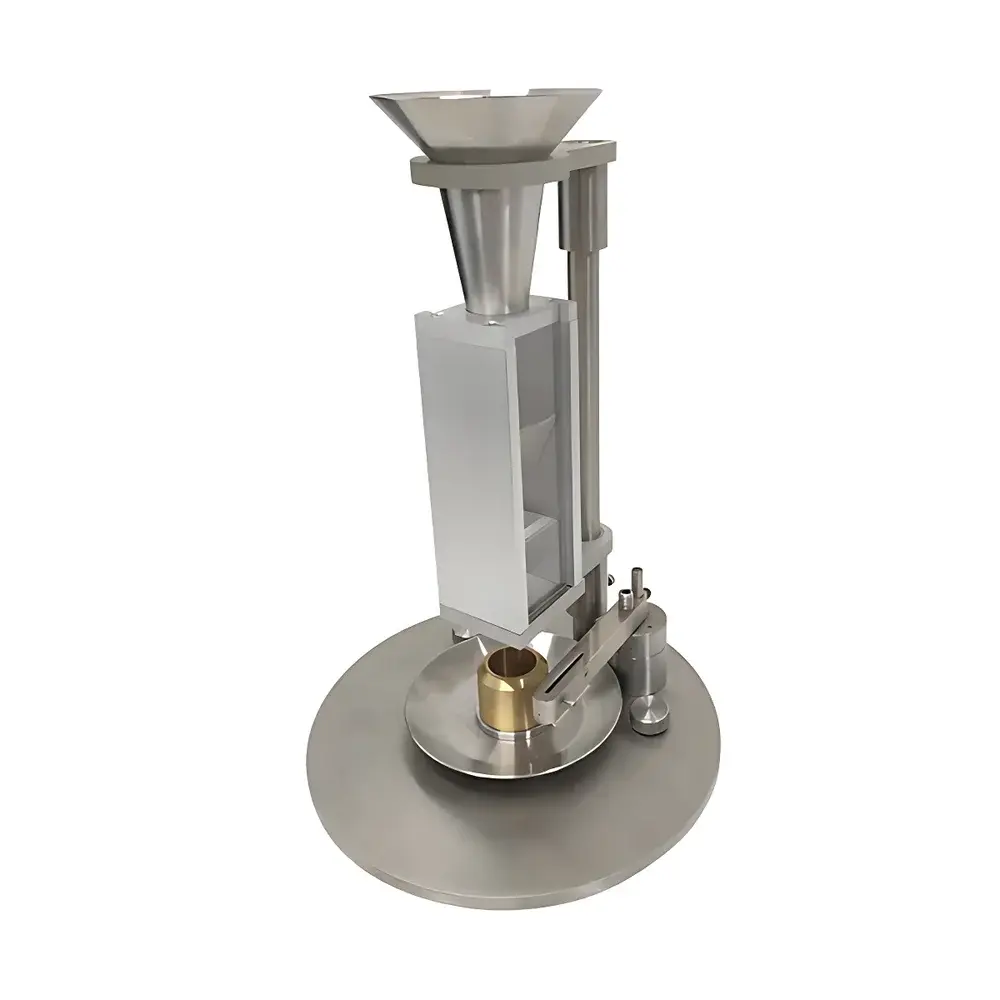
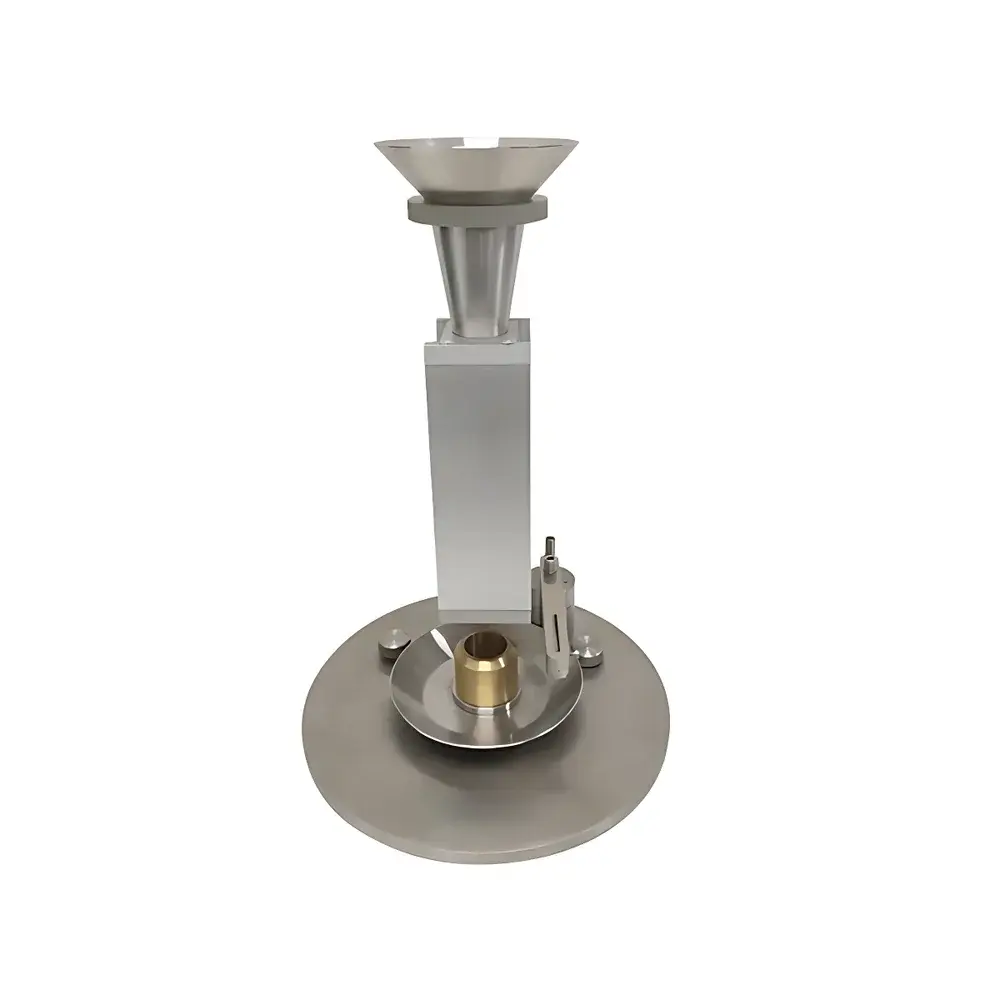
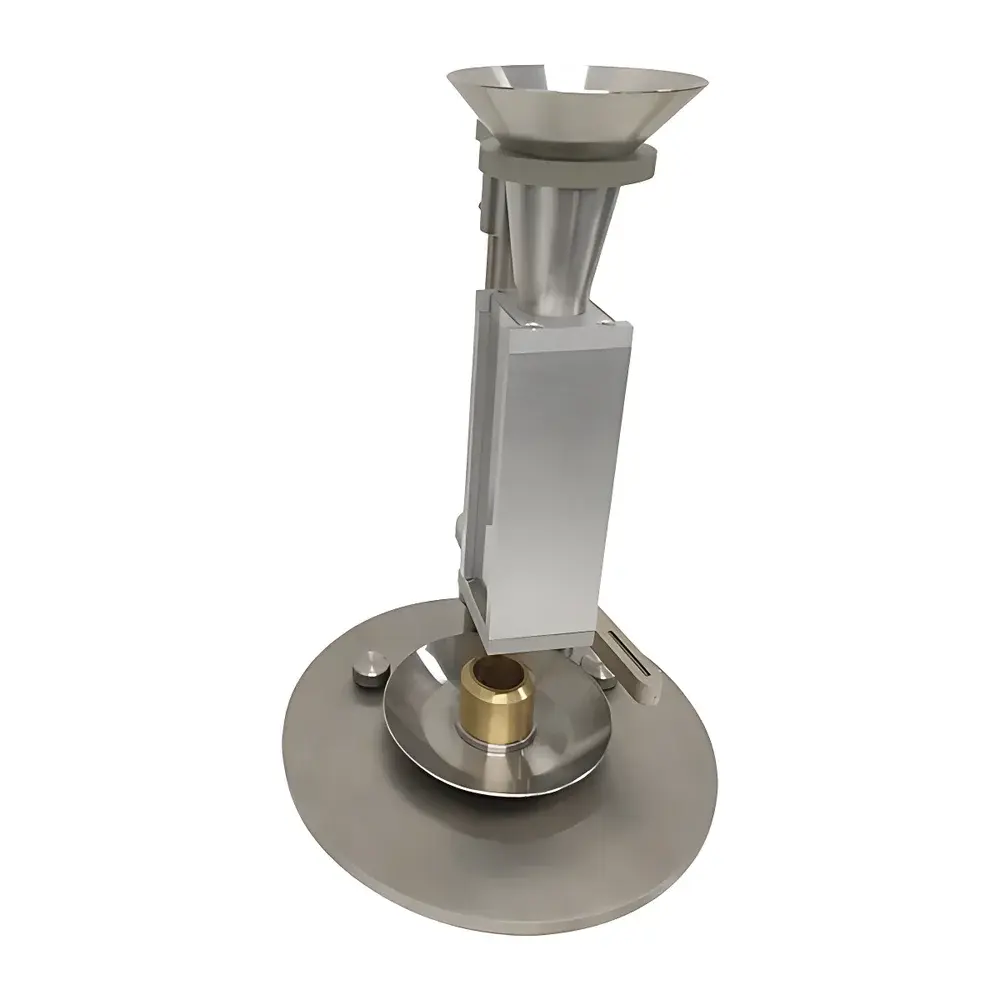
Aode Scott Volumeter Aode-502-1 Powder Flowability Tester
| Brand | Aode |
|---|---|
| Origin | Liaoning, China |
| Manufacturer Type | Direct Manufacturer |
| Country of Origin | China |
| Model | Aode-502-1 |
| Instrument Type | Flowability Tester |
| Measurable Parameters | Apparent Density, Bulk Density |
| Maximum Sample Cup Capacity | 500 mL |
| Minimum Sample Requirement | 10 mL |
Overview
The Aode Scott Volumeter Aode-502-1 is a precision-engineered bulk and apparent density tester designed in strict accordance with standardized gravity-fed powder flow methodology. It implements the Scott Volumeter principle — a well-established gravimetric technique for determining the apparent (loose) density of free-flowing and marginally cohesive powders that cannot be reliably characterized using funnel-based or vibratory methods. Unlike tap density testers or shear cell analyzers, the Scott method relies on controlled gravitational descent through a defined geometry: powder passes through a 1.18 mm stainless steel sieve, then traverses a baffle-equipped feed box with four interleaved stainless steel plates inclined at 25°, before entering a calibrated receiving cup. This configuration ensures uniform, non-compacted powder deposition, minimizing particle rearrangement and enabling reproducible measurement of the powder’s natural packing state under zero external vibration or pressure. The instrument complies with GB/T 5060.2–1985 (equivalent to ISO 3953:1993, *Metallic Powders — Determination of Apparent Density — Scott Volumeter Method*) and is suitable for quality control in metallurgy, pharmaceutical excipient evaluation, additive manufacturing feedstock qualification, and ceramic raw material screening.
Key Features
- Modular 304 stainless steel construction throughout — including dual-stage conical hopper (top diameter 112 mm, bottom outlet 30 mm), 1.18 mm precision-woven sieve, feed box with removable 25°-inclined baffles, 60° square discharge funnel (12.5 mm × 12.5 mm outlet), and volumetric cup (25 mL capacity, ASTM E1077-compliant geometry)
- Enclosed feed box design minimizes air currents and operator-induced disturbances, ensuring measurement stability and operator safety by suppressing dust dispersion
- Removable, tool-free baffle plates allow rapid cleaning and verification of geometric integrity — critical for GLP-compliant routine operation
- Circular corrosion-resistant base provides mechanical rigidity and alignment stability during repeated cup placement and weighing cycles
- No moving parts or electronic actuators — eliminates calibration drift and maintenance dependency inherent in motorized or pneumatic systems
Sample Compatibility & Compliance
The Aode-502-1 is optimized for powders exhibiting low to moderate flowability — particularly those that bridge or channel in standard funnel tests (e.g., fine metal powders, agglomerated oxides, hygroscopic pharmaceutical actives, or coated battery cathode materials). It excludes highly cohesive, fibrous, or moisture-sensitive samples requiring humidity-controlled enclosures. Compliance extends beyond GB/T 5060.2 and ISO 3953 to support audit readiness under ICH Q5C, USP , and ASTM B527–18 (Standard Test Methods for Apparent Density of Metal Powders). While not intrinsically 21 CFR Part 11 compliant (as it generates no electronic records), its manual workflow integrates seamlessly into paper-based or LIMS-linked SOPs where raw mass/volume data are entered post-measurement with full analyst traceability.
Software & Data Management
The Aode-502-1 operates as a standalone mechanical instrument with no embedded firmware or proprietary software. Density calculation follows the formula: ρ = m / V, where m is the net mass (g) measured on an external analytical balance (recommended readability ≤ 0.001 g) and V is the certified cup volume (25.00 ± 0.05 mL). Users may document results via laboratory notebooks, Excel templates, or validated LIMS interfaces. Optional digital workflows include integration with METTLER TOLEDO or SARTORIUS balance APIs for automated mass capture, provided the balance supports RS232/USB HID output and the host system enforces audit trails per ALCOA+ principles.
Applications
- Quality release testing of atomized stainless steel, titanium, and nickel alloy powders for laser powder bed fusion (LPBF) processes
- Batch-to-batch consistency assessment of lactose, microcrystalline cellulose, and mannitol in oral solid dosage formulation development
- Raw material acceptance testing for catalyst supports, pigment dispersions, and abrasive grain blends
- Pre-screening of granule fluidization behavior prior to fluid bed dryer or coater qualification
- Correlation studies between Scott density, Hausner ratio, and Carr index in powder flow classification frameworks (e.g., Jenike shear test correlation)
FAQ
What is the difference between apparent density and bulk density in this context?
Apparent density (measured by the Scott Volumeter) reflects the mass per unit volume of a powder in its freely settled, non-tapped state — distinct from bulk density determined after standardized tapping (e.g., ASTM D1464). The Scott method intentionally avoids compaction, yielding values typically 5–15% lower than tapped bulk density.
Can the 25 mL cup be replaced with a larger one?
No. The 25 mL cup is integral to the ISO 3953-defined geometry and calibration. Substitution invalidates compliance; however, multiple sequential measurements may be performed to improve statistical confidence for low-density powders.
Is calibration certification included?
The volumetric cup is supplied with a factory-verified calibration certificate traceable to NIM (China National Institute of Metrology). Annual recalibration is recommended per ISO/IEC 17025 requirements when used in accredited labs.
Does the instrument require electrical power or compressed air?
No. It is entirely passive and gravity-driven — requiring only a calibrated balance and stable lab bench.
How is operator variability minimized?
Standardized SOPs govern powder loading height, sieve tapping count (if applied), and cup positioning. Training videos and documented procedures reduce inter-operator RSD to ≤ 2.5% for homogeneous powders (n=6).
Related Products



