
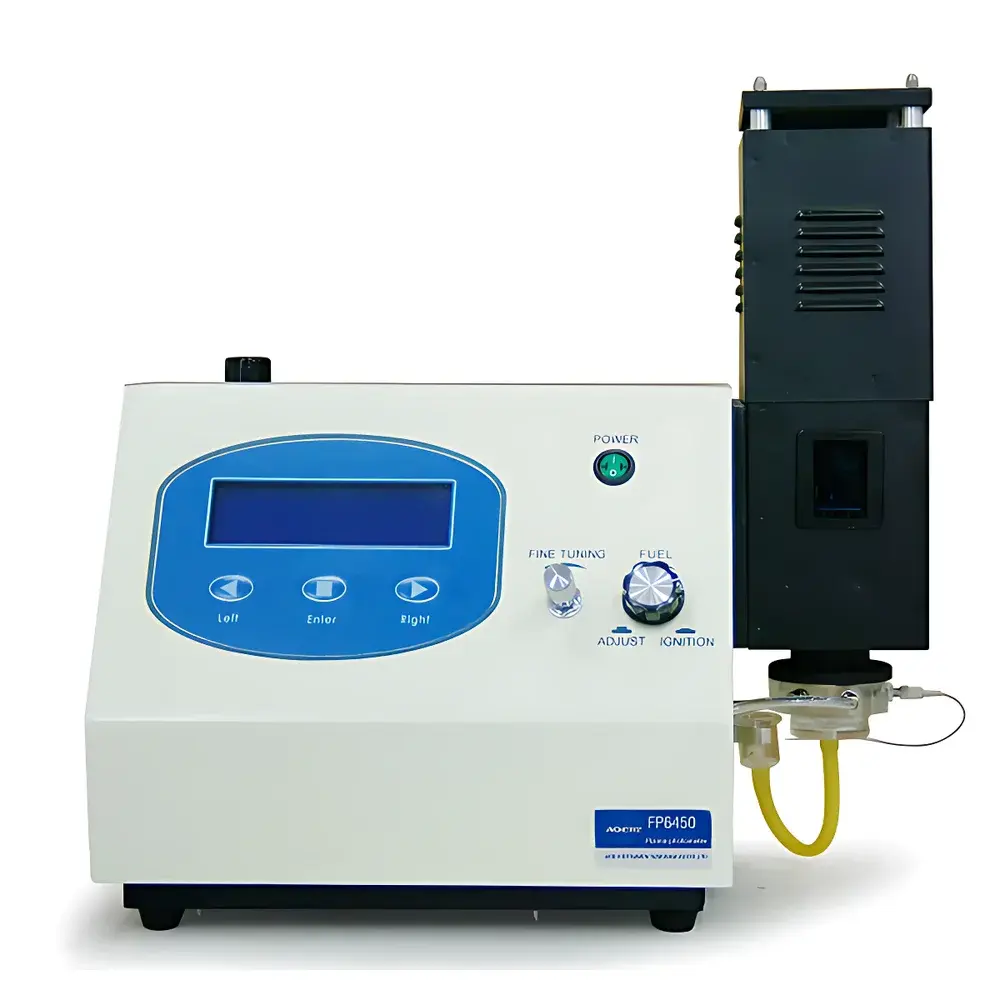
AOE 6400A Flame Photometer
| Brand | AOE |
|---|---|
| Model | 6400A |
| Origin | Shanghai, China |
| Type | Benchtop Flame Emission Spectrometer |
| Detection Elements | K, Na, Li, Ca, Ba |
| Optical System | Interference Filter-Based Monochromator |
| Detector | Silicon Photocell |
| Display | LCD |
| Sample Uptake Rate | <6 mL/min |
| Response Time | <8 s |
| Stability (15 s) | ≤3% RSD |
| Stability (6 min, 6 readings) | ≤15% RSD |
| Repeatability | ≤3% RSD |
| Linearity Error | K: ≤0.005 mmol/L (0.0100–0.0800 mmol/L) |
| Na | ≤0.03 mmol/L (0.0500–0.400 mmol/L) |
| Detection Limit | K: ≤0.004 mmol/L |
| Na | ≤0.008 mmol/L |
| Potassium Filter | Peak Wavelength Tolerance ≤±7 nm, FWHM ≤15 nm, Background Transmittance ≤0.5% |
| Sodium Filter | Peak Wavelength Tolerance ≤±5 nm, FWHM ≤15 nm, Background Transmittance ≤0.5% |
| Measurement Range | K: 0–100 µg/mL |
| Na | 0–160 µg/mL |
| Li | 0–100 µg/mL |
| Ca | 0–100 µg/mL |
| Ba | 0–3000 µg/mL |
Overview
The AOE 6400A Flame Photometer is a benchtop atomic emission spectrometer engineered for quantitative analysis of alkali and alkaline earth metals—including potassium (K), sodium (Na), lithium (Li), calcium (Ca), and barium (Ba)—in aqueous solutions. It operates on the principle of flame emission spectroscopy: liquid samples are nebulized into a stable air-propane or air-butane flame, where analyte atoms are thermally excited and emit characteristic wavelengths upon relaxation. Interference filters isolate element-specific emission lines—e.g., 766.5 nm for K and 589.0 nm for Na—while a silicon photocell converts radiant intensity into proportional electrical signals. The instrument delivers high reproducibility in routine clinical, agricultural, environmental, and industrial quality control laboratories where rapid, cost-effective multi-element screening is required without the complexity or capital cost of ICP-OES.
Key Features
- Built-in interference filter set with certified spectral performance: potassium filter peak wavelength tolerance ≤±7 nm, sodium filter ≤±5 nm; full width at half maximum (FWHM) ≤15 nm for both; background transmittance ≤0.5% ensures minimal spectral overlap and high selectivity.
- Optimized pneumatic nebulization system delivering consistent sample uptake <6 mL/min, supporting stable flame conditions and minimizing drift during sequential measurements.
- Fast response time <8 seconds from aspiration to stabilized reading, enabling high-throughput batch analysis of calibration standards and unknowns.
- LCD display with intuitive menu navigation supports direct concentration readout in µg/mL or mmol/L, with manual or auto-zero functionality and linear/non-linear calibration curve options.
- Robust mechanical architecture with flame shield, adjustable burner head, and integrated gas flow regulators designed for long-term operational stability under variable ambient conditions.
- Verified short-term stability ≤3% RSD over 15 seconds and ≤15% RSD across six consecutive 1-minute readings—meeting ASTM D2237-20 and ISO 9297:2000 requirements for flame photometric repeatability in water and soil extract analysis.
Sample Compatibility & Compliance
The AOE 6400A accepts clarified aqueous samples with total dissolved solids (TDS) <0.5%, including serum, urine, plant tissue digests, fertilizer extracts, boiler water, and soil leachates. Samples must be free of suspended particulates and organic solvents to prevent clogging or flame instability. For regulatory environments, the instrument supports GLP-compliant documentation when paired with external data loggers or LIMS interfaces. While not 21 CFR Part 11–certified out-of-the-box, its analog signal output and deterministic calibration logic allow integration into validated workflows under ISO/IEC 17025-accredited laboratories. Performance specifications align with USP for sodium and potassium assays in pharmaceutical excipients and ASTM D511–22 for water-soluble cations in drinking water.
Software & Data Management
The 6400A operates as a standalone instrument with embedded firmware—no PC dependency required for basic operation. Calibration curves (up to 6-point linear or quadratic) are stored internally and recalled per element. Raw absorbance/emission intensity values and calculated concentrations are displayed in real time and can be manually recorded. For traceability, users may connect optional RS-232 or USB-to-serial adapters to export measurement logs to spreadsheet-compatible CSV files. Though no proprietary software suite is bundled, the ASCII-based output protocol enables seamless ingestion into laboratory information management systems (LIMS) or statistical process control (SPC) platforms. Audit trail capability is maintained via operator-defined session notes and timestamped calibration verification records.
Applications
- Clinical chemistry: Quantification of serum K⁺ and Na⁺ for electrolyte panel validation and point-of-care reference method cross-checking.
- Agricultural testing: Rapid determination of exchangeable K and Na in soil extracts (e.g., ammonium acetate or Mehlich-3 methods) per AOAC 975.03 and USDA-NRCS protocols.
- Food & beverage QA: Monitoring salt content (NaCl) in processed foods, dairy products, and brewing wort; verifying K levels in fruit juices and sports drinks.
- Environmental monitoring: Analysis of cation concentrations in surface water, wastewater effluents, and acid mine drainage per EPA Method 200.7 (modified for flame photometry).
- Industrial process control: In-line verification of brine composition in chlor-alkali plants, coolant formulations in metalworking fluids, and desalination pre-treatment streams.
FAQ
What gases are compatible with the AOE 6400A flame system?
The instrument is configured for air-propane or air-butane premixed flames. Acetylene is not recommended due to excessive temperature and risk of filter degradation.
Can the 6400A measure magnesium or iron?
No. It is optimized for elements with strong, low-excitation-energy emission lines in the visible range (K, Na, Li, Ca, Ba). Mg and Fe require higher flame temperatures and UV-capable optics not supported by this platform.
Is routine maintenance required beyond cleaning the nebulizer capillary?
Yes. Weekly inspection of the burner slit for carbon buildup, monthly alignment check of optical path using alignment tool (included), and quarterly verification of filter transmission using NIST-traceable reference lamps are recommended per ISO 17025 clause 6.4.3.
How does the instrument handle matrix interferences from high-Ca or high-Sr samples?
Ionization suppressors (e.g., 2% LaCl₃ or CsCl) should be added to both standards and samples to mitigate electron-capture effects. The 6400A’s fixed-wavelength design does not support internal standard correction, so chemical correction remains essential for complex matrices.
Does the 6400A comply with FDA or CLIA requirements for clinical use?
It meets analytical performance criteria outlined in CLIA ’88 for waived testing categories when operated within specified linearity and precision limits—but final compliance depends on lab-specific validation per CAP/CLSI EP15-A3 guidelines and documented QC procedures.







