
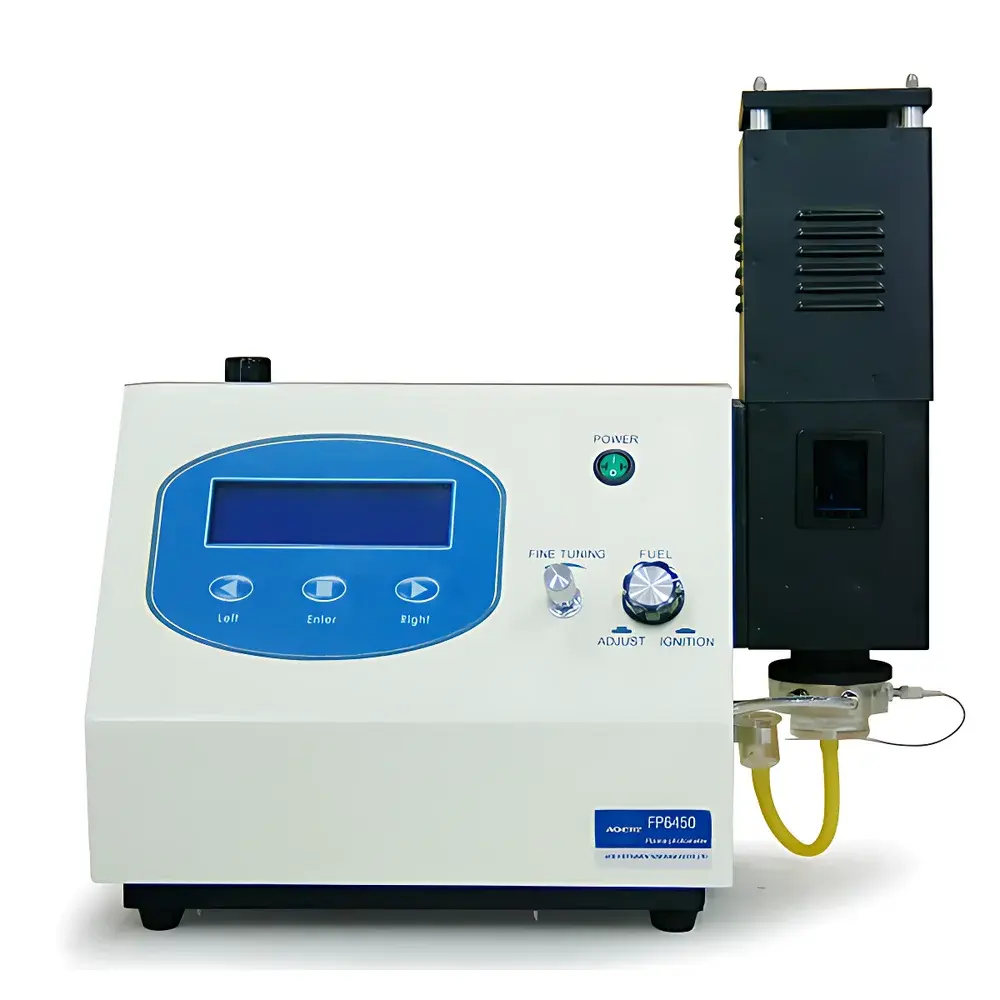
AOE FP640 Flame Photometer
| Brand | AOE |
|---|---|
| Origin | Shanghai, China |
| Manufacturer Type | Authorized Distributor |
| Country of Origin | China |
| Model | FP640 |
| Price Range | USD 720–1,430 (FOB Shanghai) |
| Stability (15 s) | ≤3% RSD |
| Stability (6 min, 1-min interval) | ≤15% RSD |
| Repeatability | ≤3% RSD |
| Linearity Error | K: ≤0.005 mmol/L (0.0100–0.0800 mmol/L) |
| Na | ≤0.03 mmol/L (0.0500–0.400 mmol/L) |
| Detection Limit | K: ≤0.004 mmol/L |
| Na | ≤0.008 mmol/L |
| K Interference Filter | Peak Wavelength Tolerance ≤±7 nm |
| Na Interference Filter | Peak Wavelength Tolerance ≤±5 nm |
| Filter Bandwidth (FWHM) | ≤15 nm for both K and Na filters |
| Background Transmittance | ≤0.5% |
| Response Time | <8 s |
| Sample Aspiration Rate | <6 mL/min |
| Display | LCD with integrated parameter readout |
| Optical System | Fixed-wavelength interference filters |
| Detector | Silicon photodiode |
| Measurement Range (as elemental concentration) | K: 0–100 µg/mL |
| Na | 0–160 µg/mL |
| Li | 0–100 µg/mL |
| Ca | 0–100 µg/mL |
| Ba | 0–3000 µg/mL |
Overview
The AOE FP640 Flame Photometer is a benchtop atomic emission spectrometer designed for quantitative determination of alkali and alkaline earth metals—including potassium (K), sodium (Na), lithium (Li), calcium (Ca), and barium (Ba)—in aqueous solutions. It operates on the principle of flame atomic emission spectroscopy (FAES): liquid samples are nebulized into a premixed air-propane flame, where thermal energy excites valence electrons of metal atoms. Upon relaxation, these atoms emit characteristic wavelengths—primarily 766.5 nm for K and 589.0 nm for Na—which are isolated by narrowband interference filters and quantified via silicon photodiode detection. The FP640 delivers trace-level sensitivity and robust performance for routine analysis in environmental testing labs, clinical chemistry departments, fertilizer quality control, and food & beverage QA/QC workflows. Its fixed-filter optical architecture eliminates moving parts and wavelength calibration drift, ensuring long-term measurement stability without routine recalibration.
Key Features
- High-stability air-propane combustion system with adjustable flame height and optimized nebulizer geometry for consistent aerosol generation and minimal matrix-induced signal suppression
- Dual-channel interference filter set (K and Na) certified to peak wavelength tolerances ≤±7 nm (K) and ≤±5 nm (Na), with full width at half maximum (FWHM) ≤15 nm and background transmittance ≤0.5%, minimizing spectral overlap and inter-element interference
- Silicon photodiode detector with linear response across five decades of signal intensity, coupled to low-noise analog signal conditioning and 16-bit ADC resolution
- LCD display with real-time concentration readout (µg/mL or mmol/L), built-in calibration curve storage (up to 10 multi-point curves), and automatic zero/baseline correction
- Aspiration rate controlled at <6 mL/min to ensure stable flame conditions and reduce sample consumption—compatible with standard 10–50 mL volumetric flasks and polypropylene sample vials
- Compliance-ready design: supports manual audit trail logging; firmware architecture enables future integration with LIMS via RS-232 serial interface (optional USB-to-serial adapter)
Sample Compatibility & Compliance
The FP640 accepts clarified, low-viscosity aqueous samples with total dissolved solids (TDS) <0.5% w/v. Acidified samples (e.g., 1% HNO₃) are recommended for improved cation solubility and reduced precipitation risk. Matrix-matched standards and internal standardization (e.g., using Li as internal reference for K/Na dual analysis) mitigate ionization suppression in high-salt matrices such as seawater extracts or soil leachates. While not 21 CFR Part 11–certified out-of-the-box, the instrument’s deterministic signal processing, non-volatile calibration storage, and timestamped manual result recording support GLP-compliant documentation practices. Method validation parameters—including detection limits (K: ≤0.004 mmol/L; Na: ≤0.008 mmol/L), linearity (r² ≥0.999 over specified ranges), repeatability (≤3% RSD), and short-term stability (≤3% RSD over 15 s)—align with ASTM D1293 (electrical conductivity and ion analysis in water) and ISO 11885 (determination of selected elements by FAES).
Software & Data Management
The FP640 operates independently without PC dependency. All calibration and measurement functions are executed onboard via embedded firmware. Calibration curves are generated using up to six standard concentrations per element; polynomial (linear or quadratic) fitting is applied automatically. Raw absorbance/emission intensities and final concentration values are displayed in real time and retained in volatile memory until power-off. For regulated environments, users may manually record results—including date/time, operator ID, standard lot numbers, and instrument serial number—in laboratory notebooks or Excel-based templates. Optional RS-232 output enables automated data capture into third-party software (e.g., LabArchives, Empower, or custom Python scripts) for traceable electronic records.
Applications
- Environmental monitoring: Quantification of K⁺ and Na⁺ in surface water, groundwater, and wastewater per EPA Method 200.7 (ICP-OES alternative for dedicated cation screening)
- Agricultural testing: Rapid analysis of exchangeable K and Na in soil extracts (Ammonium acetate or Mehlich-3 methods)
- Clinical chemistry: Serum/plasma Na and K profiling in resource-constrained settings where ICP-MS or ion-selective electrodes are unavailable
- Food & beverage: Salt content verification in dairy products, beverages, and processed foods; Ca and Ba monitoring in mineral water compliance testing
- Fertilizer quality control: Batch verification of K₂O and Na₂O content in potash and mixed NPK formulations
FAQ
What sample preparation is required prior to analysis?
Samples must be filtered (0.45 µm membrane), acidified to pH <2 with ultrapure HNO₃, and diluted to fall within the linear range of the target element. High-TDS or organic-rich matrices require digestion (e.g., hotplate HNO₃/H₂O₂) followed by dilution.
Can the FP640 measure multiple elements simultaneously?
No—it performs sequential single-element analysis. Users manually switch between K, Na, Li, Ca, and Ba channels using the front-panel mode selector; each requires separate calibration and measurement.
Is propane gas supply included with the instrument?
No. The FP640 requires external propane (≥95% purity) delivered via pressure-regulated cylinder (recommended outlet pressure: 0.5–1.0 bar) and flashback-arrested tubing. Air is supplied by integral compressor or external oil-free air source.
How often does the nebulizer require cleaning or replacement?
Nebulizer capillaries should be inspected weekly and soaked in 10% HNO₃ for 15 minutes if clogging is observed. Under normal use with filtered samples, replacement is typically needed every 6–12 months.
Does the FP640 support regulatory compliance for pharmaceutical manufacturing?
It is suitable for in-process testing and raw material screening per USP and Ph. Eur. 2.2.24, but lacks electronic signature and audit trail capabilities required for GMP release testing; supplemental procedural controls are necessary.




