
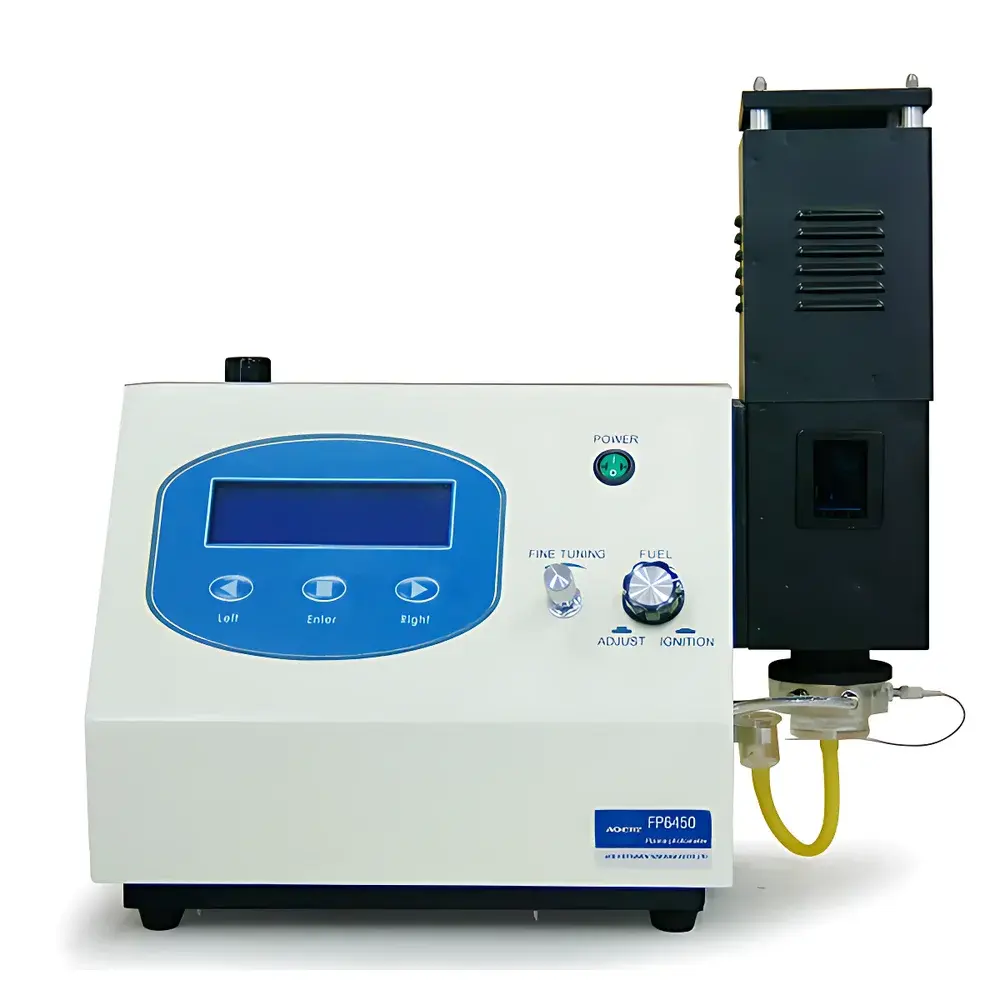
AOE FP6410 Flame Photometer
| Brand | AOE |
|---|---|
| Origin | Shanghai, China |
| Manufacturer Type | Authorized Distributor |
| Country of Origin | China |
| Model | FP6410 |
| Price Range | USD 1,400–2,800 |
| Stability (15 s) | ≤3% RSD |
| Stability (6 min, 1-min interval) | ≤15% RSD |
| Repeatability | ≤3% RSD |
| Linearity Error | K ≤0.005 mmol/L (0.0100–0.0800 mmol/L) |
| Detection Limit | K ≤0.004 mmol/L |
| Filter Peak Wavelength Tolerance | K ≤7 nm |
| Filter Bandwidth (FWHM) | ≤15 nm (K & Na) |
| Filter Background Transmittance | ≤0.5% |
| Response Time | <8 s |
| Sample Aspiration Rate | <6 mL/min |
| Display | LCD |
| Optical Filtering | Interference Filters |
| Photodetector | Silicon Photocell |
| Measurement Range | K: 0–100 µg/mL |
| Na | 0–160 µg/mL |
| Li | 0–100 µg/mL |
| Ca | 0–100 µg/mL |
| Ba | 0–3000 µg/mL |
Overview
The AOE FP6410 Flame Photometer is a benchtop atomic emission spectrometer designed for quantitative determination of alkali and alkaline earth metals—including potassium (K), sodium (Na), lithium (Li), calcium (Ca), and barium (Ba)—in aqueous solutions. It operates on the principle of flame atomic emission spectroscopy (FAES): liquid samples are nebulized into a stable air-propane or air-butane flame, where thermal energy excites valence electrons of metal atoms. Upon relaxation, these atoms emit characteristic wavelengths of visible light—primarily at 766.5 nm (K) and 589.0 nm (Na)—which are isolated by high-selectivity interference filters and quantified via silicon photocell detection. Engineered for routine laboratory environments, the FP6410 delivers reliable, cost-effective elemental analysis without requiring complex optics or vacuum systems typical of ICP-OES instruments. Its robust architecture supports daily QC/QA workflows in environmental testing labs, fertilizer quality control, clinical serum analysis, and food & beverage mineral profiling.
Key Features
- High-stability air-propane burner system with optimized gas flow regulation to minimize flame flicker and thermal drift
- Interference filter-based optical path featuring dual-bandpass filters for K and Na, each with FWHM ≤15 nm and background transmittance ≤0.5%, ensuring spectral selectivity and low inter-element interference
- Silicon photocell detector with linear response across full dynamic range and integrated temperature compensation circuitry
- LCD display with real-time analog bar graph and digital concentration readout in µg/mL or mmol/L units
- Pre-calibrated single-point and multi-point calibration modes with automatic curve fitting (linear regression)
- Response time <8 seconds from sample aspiration onset to stabilized signal output, enabling throughput of ≥6 samples per minute
- Aspiration rate controlled at <6 mL/min to ensure consistent nebulization efficiency and reduce aerosol droplet size variability
Sample Compatibility & Compliance
The FP6410 accepts clarified, low-viscosity aqueous samples—including digested plant tissues, soil extracts, serum dilutions, brine solutions, and nutrient media—with minimal pretreatment. Samples must be free of suspended solids (>0.45 µm filtration recommended) and organic solvents (e.g., ethanol >5% v/v may destabilize flame). The instrument complies with fundamental performance criteria outlined in ISO 6955:2007 (Flame photometric determination of alkali metals) and aligns with method validation expectations under CLIA and ISO/IEC 17025 for routine testing laboratories. While not FDA 21 CFR Part 11–certified out-of-the-box, its manual data recording workflow supports GLP-compliant documentation when paired with controlled lab notebooks and audit-trail procedures.
Software & Data Management
The FP6410 operates as a standalone instrument with embedded firmware—no external PC required for basic operation. All calibration coefficients, blank values, and sample results are stored in non-volatile memory (retains data for ≥10 years without power). Optional RS-232 serial interface enables connection to LIMS or spreadsheet software for automated data export (ASCII format, tab-delimited). Firmware supports user-defined report headers, date/time stamping, and up to 99 sample ID entries per session. For regulated environments, laboratories may implement supplementary electronic record controls—including secure user login protocols and change logs—to satisfy internal QA requirements aligned with GMP Annex 11 principles.
Applications
- Soil and irrigation water analysis for K⁺/Na⁺ ratio assessment in agronomy and salinity studies
- Quality control of potassium chloride and sodium nitrate fertilizers per ASTM D512 and ISO 11261
- Clinical measurement of serum potassium and sodium in point-of-care and reference labs (per CLSI C30-A3 guidelines)
- Determination of ash content minerals in dairy powders, infant formula, and fortified cereals
- Monitoring of boiler feedwater and cooling tower chemistry for corrosion risk mitigation
- Research-scale quantification of Li⁺ in battery electrolyte formulations and Ca²⁺ in bone mineralization studies
FAQ
What flame gases are compatible with the FP6410?
The instrument is configured for air-propane combustion. Air-butane may be substituted with minor flame adjustment; acetylene and hydrogen are not supported due to excessive flame temperature and safety constraints.
Can the FP6410 measure multiple elements simultaneously?
No—it performs sequential single-element analysis. Users manually switch between K, Na, Li, Ca, and Ba filter positions; no simultaneous multi-channel detection capability is provided.
Is matrix matching required for accurate results?
Yes. High ionic strength or elevated concentrations of interfering cations (e.g., NH₄⁺, Mg²⁺) may suppress or enhance emission intensity. Standard addition or matched calibration standards are recommended for complex matrices such as seawater or biological fluids.
How often should the nebulizer capillary be cleaned?
Daily cleaning with 5% HNO₃ followed by deionized water rinse is advised when analyzing high-salt or viscous samples. Clogging frequency increases significantly above 1000 µS/cm conductivity.
Does the FP6410 support regulatory audit trails?
Not natively. Full electronic audit trail functionality (user actions, parameter changes, result modifications) requires integration with validated third-party data management software compliant with 21 CFR Part 11.





