
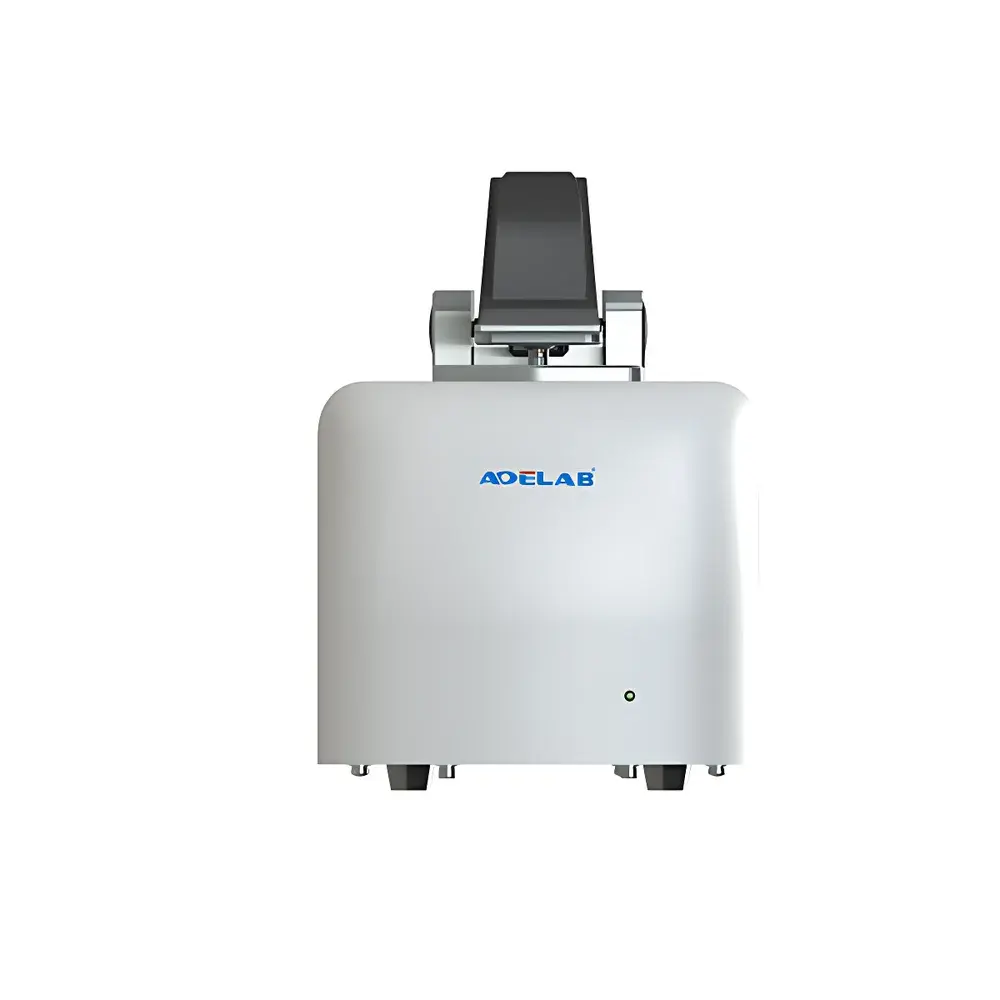
AOE ND300 Ultra-Micro Volume UV-Vis Spectrophotometer
| Brand | AOE |
|---|---|
| Origin | Shanghai, China |
| Model | ND300 |
| Optical Design | Single-Beam |
| Detector | 2048-Pixel Linear CCD Array |
| Wavelength Range | 185–910 nm |
| Spectral Bandwidth | 1.8 nm (FWHM at Hg 253.7 nm) |
| Wavelength Accuracy | ±1 nm |
| Stray Light | ≤0.1% (at 220 nm & 360 nm) |
| Minimum Sample Volume | 0.5 µL |
| dsDNA Detection Range | 2–15,000 ng/µL |
| Absorbance Accuracy | ±0.002 Abs (1 mm pathlength) |
| Measurement Time | <0.5 s |
| Connectivity | USB 2.0, Wi-Fi, USB Flash Drive Firmware Update |
Overview
The AOE ND300 Ultra-Micro Volume UV-Vis Spectrophotometer is a compact, high-performance benchtop instrument engineered for rapid, precise nucleic acid, protein, and small-molecule quantification using microvolume absorbance spectroscopy. Based on the principle of fixed-pathlength (1.0 mm effective) absorbance measurement via surface tension–based sample retention on a quartz optical pedestal, the ND300 eliminates the need for cuvettes or capillaries—enabling direct analysis of 0.5 µL native samples without dilution. Its xenon flash lamp source provides stable, broad-spectrum output from deep UV (185 nm) through visible (910 nm), supporting critical applications such as dsDNA quantification at 260 nm, protein A280/A260 ratio assessment, and aromatic compound characterization. The integrated 2048-pixel linear CCD array detector delivers high signal-to-noise ratio and sub-nanometer wavelength sampling resolution, ensuring reproducible spectral acquisition across routine QC and research workflows.
Key Features
- Ultra-low sample consumption: Accurate measurements from just 0.5 µL of undiluted sample—ideal for precious or limited-yield biological extracts.
- High-fidelity optical architecture: Single-beam design with thermally stabilized xenon flash lamp and precision-aligned quartz pedestal ensures long-term photometric stability and minimal drift.
- Real-time spectral acquisition: Full 185–910 nm spectrum captured in under 0.5 seconds, enabling high-throughput screening in core facilities and production labs.
- Robust calibration and traceability: Factory-calibrated against NIST-traceable standards; wavelength accuracy verified per ISO 8579-1 and absorbance linearity validated per ASTM E275.
- Integrated environmental compensation: Onboard temperature and humidity sensors correct for refractive index variations during ambient lab operation.
- Secure data handling: Firmware supports audit-trail logging and user-access levels compliant with GLP and FDA 21 CFR Part 11 requirements when used with optional networked software deployment.
Sample Compatibility & Compliance
The ND300 accommodates a wide range of liquid-phase samples—including purified dsDNA, ssDNA, RNA, oligonucleotides, proteins (BSA, IgG), peptides, dyes (e.g., Coomassie, Bradford reagents), and small organic molecules—without requiring dilution or specialized consumables. Its pedestal surface is chemically resistant to common buffers (Tris-HCl, EDTA, TE), mild detergents, and ethanol-based solutions. Instrument compliance includes adherence to IEC 61010-1 (safety), IEC 61326-1 (EMC), and ISO/IEC 17025–aligned performance verification protocols. For regulated environments, method validation packages are available to support IQ/OQ/PQ documentation aligned with USP , EP 2.2.25, and CLSI EP10-A3 guidelines.
Software & Data Management
The ND300 operates via embedded Linux-based firmware with intuitive touchscreen interface and optional PC-based AOE SpectraSuite™ software (Windows/macOS). SpectraSuite enables advanced spectral processing—including baseline correction, peak integration, multi-curve overlay, and custom extinction coefficient application—as well as automated nucleic acid purity reporting (A260/A280, A260/A230). All measurement data are stored with timestamp, operator ID, instrument serial number, and full spectral metadata in .csv and .spc formats. Wi-Fi connectivity allows remote instrument status monitoring, batch export to LIMS, and over-the-air firmware updates via secure HTTPS protocol. Audit trails record all parameter changes, file deletions, and user logins—retained for ≥180 days and exportable for regulatory review.
Applications
- Quantitative QC of next-generation sequencing (NGS) library preparations and CRISPR guide RNA synthesis.
- Routine assessment of protein expression yields in bacterial and mammalian cell lysates.
- Verification of oligonucleotide coupling efficiency and desalting completeness post-synthesis.
- High-sensitivity detection of contaminants (e.g., phenol, guanidine, carbohydrates) in nucleic acid preps via A230 deviation analysis.
- Stability studies of therapeutic antibodies under accelerated stress conditions (pH, temperature).
- Educational use in undergraduate biochemistry labs for hands-on spectrophotometric fundamentals and Beer–Lambert law validation.
FAQ
What is the effective pathlength used for concentration calculations?
The ND300 uses a fixed 1.0 mm effective pathlength determined by optical geometry and surface tension physics—not adjustable or user-defined.
Can the instrument measure turbid or viscous samples?
Samples with OD > 2.5 at 260 nm or viscosity > 10 cP may exhibit reduced accuracy due to light scattering; dilution or alternative methods (e.g., fluorometry) are recommended.
Is calibration required before each use?
No routine recalibration is needed; however, daily performance verification using a supplied quartz reference standard is recommended per ISO/IEC 17025 quality management practices.
Does the ND300 support 21 CFR Part 11 compliance out-of-the-box?
The base firmware provides foundational controls (user authentication, audit trail); full Part 11 compliance requires deployment of AOE SpectraSuite™ Enterprise Edition with electronic signature and role-based access modules.
How often should the optical pedestal be cleaned?
Cleaning with spectroscopic-grade water followed by lint-free wipe is advised after every 10–15 samples or immediately following viscous or dye-laden samples to prevent residue buildup and cross-contamination.






