
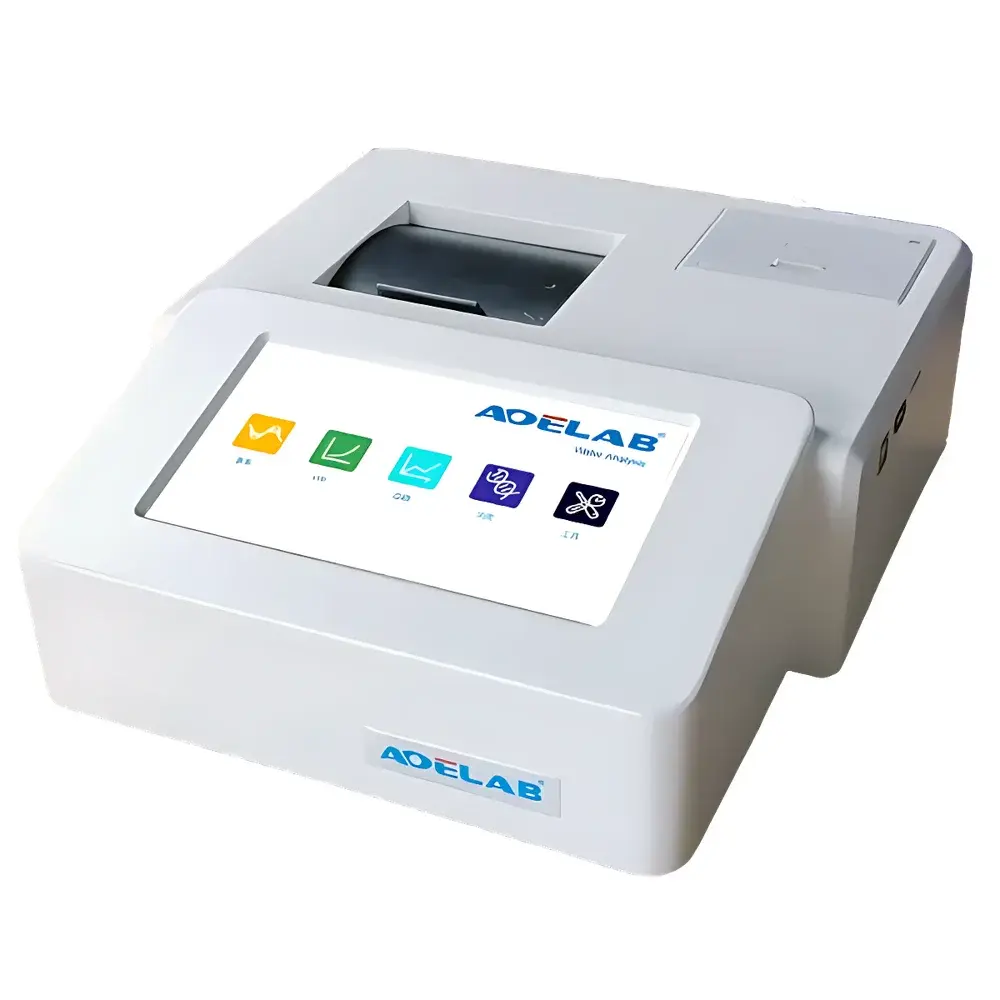
AOE OD600 Microbial Optical Density Analyzer
| Brand | AOE |
|---|---|
| Model | OD600 |
| Instrument Type | Benchtop Microbial Turbidimeter |
| Detection Wavelength | 600 nm ± 1 nm |
| Bandwidth | 10 nm |
| Absorbance Range | −0.3 to 3.0 Abs |
| Absorbance Accuracy | ±0.005 Abs (0–0.5 Abs), ±0.01 Abs (0.5–1.0 Abs) |
| Absorbance Repeatability | ≤0.002 Abs |
| Light Source | High-Stability Solid-State LED (20,000 h lifetime) |
| Detector | Silicon Photodiode |
| Sample Volume | 200–3000 µL |
| Display | 8-inch HD Color TFT LCD (1024 × 600) |
| Data Storage | 128 MB internal memory |
| Data Export | USB flash drive & microSD card support |
| Built-in Thermal Printer | Yes (auto/batch print) |
| Power Supply | AC 100–240 V, 50/60 Hz or DC 12 V / 3 A |
| Dimensions (W × D × H) | 290 × 260 × 100 mm |
| Weight | 2.15 kg |
Overview
The AOE OD600 Microbial Optical Density Analyzer is a benchtop turbidimetric instrument engineered for rapid, reproducible quantification of microbial cell density in liquid culture media via optical absorbance measurement at 600 nm (OD600). It operates on the principle of Beer–Lambert law-based light attenuation, where scattered and absorbed light intensity correlates with suspended biomass concentration—primarily applied for Escherichia coli, Bacillus subtilis, Saccharomyces cerevisiae, and other common laboratory strains. Unlike spectrophotometers requiring wavelength scanning, the OD600 is purpose-built for single-wavelength turbidity assessment with optimized optical path geometry, fixed cuvette positioning, and temperature-stable LED illumination. Its design prioritizes assay robustness in high-throughput microbiology workflows—including strain growth monitoring, induction timing, bioreactor inoculation calibration, and QC release testing—where consistent OD600 values serve as validated surrogates for viable cell count under controlled conditions.
Key Features
- Long-life solid-state LED light source (rated ≥20,000 h) ensures minimal photometric drift and eliminates lamp replacement maintenance.
- Modular optical architecture isolates detector, light path, and sample chamber to minimize thermal and mechanical interference—enhancing measurement stability across extended operation.
- Intuitive 8-inch HD color touchscreen (1024 × 600 resolution) delivers guided workflow navigation, real-time graphing of kinetic runs, and on-device data annotation without external software dependency.
- Built-in thermal printer enables GLP-compliant hardcopy output with timestamp, sample ID, OD value, and operator tag—supporting audit-ready documentation for ISO 17025 or FDA-regulated environments.
- Dual data export pathways: direct transfer via USB 2.0 interface or microSD card slot (up to 32 GB), exporting CSV-formatted datasets with metadata (date, time, user ID, calibration status).
- Extended dynamic range from −0.3 to 3.0 Abs accommodates both low-density starter cultures and highly concentrated fermentation broths—reducing manual dilution steps and associated pipetting error.
Sample Compatibility & Compliance
The OD600 accepts standard 1-cm pathlength semi-micro cuvettes (1.5–3.5 mL volume) and compatible micro-volume adapters (200–500 µL). It supports aqueous bacterial, yeast, and algal suspensions; viscous or particulate-laden samples require centrifugation or filtration prior to analysis to prevent scattering artifacts. The instrument complies with IEC 61010-1:2010 safety standards for laboratory electrical equipment and meets electromagnetic compatibility requirements per EN 61326-1. While not certified for clinical diagnostics, its performance aligns with ASTM E275–22 (Standard Practices for Describing and Measuring Performance of UV-Visible Spectrophotometers) and supports adherence to USP <1225> validation principles when integrated into laboratory SOPs. Routine verification using NIST-traceable neutral density filters is recommended per GLP/GMP quality system requirements.
Software & Data Management
No proprietary PC software is required for core operation; all functions are embedded within the device firmware. However, exported CSV files are natively compatible with Excel, GraphPad Prism, Python (pandas), and MATLAB for downstream statistical modeling or growth curve fitting (e.g., Gompertz or Logistic regression). Audit trail functionality logs every measurement event—including user login (via optional PIN), calibration timestamp, and firmware version—enabling traceability in regulated settings. Data encryption during SD card export is not implemented; users deploying in HIPAA- or GDPR-sensitive contexts must apply institutional-level file access controls.
Applications
- Monitoring E. coli DH5α or BL21(DE3) growth phases during plasmid transformation and protein expression optimization.
- Standardizing inoculum density prior to anaerobic digestion assays or antibiotic susceptibility testing (AST) per CLSI M07-A11 guidelines.
- Validating consistency of yeast starter cultures in industrial fermentation process development.
- Supporting undergraduate and graduate teaching labs in molecular microbiology courses through repeatable, low-barrier OD600 training modules.
- Enabling QC release of commercial probiotic suspensions where OD600 correlates with CFU/mL via lab-specific correlation curves.
FAQ
What is the minimum detectable sample volume?
The instrument supports measurements down to 200 µL using optional micro-volume cuvettes with calibrated pathlength correction.
Does the OD600 support multi-point calibration or user-defined curves?
No—it performs absolute absorbance measurement only. Quantitative cell concentration requires external correlation (e.g., CFU/mL vs. OD600) established per strain and medium.
Can the thermal printer generate reports compliant with 21 CFR Part 11?
The printer produces non-electronic records; full Part 11 compliance requires integration with a validated LIMS or ELN system managing electronic signatures and audit trails.
Is the LED source field-replaceable?
Yes—the optical module is serviceable by authorized AOE technical personnel; replacement does not require recalibration.
How frequently should photometric verification be performed?
Daily verification with a stable reference standard (e.g., 1.0 Abs filter) is recommended before critical experiments; full calibration against NIST-traceable standards every 6 months or per lab quality policy.





