
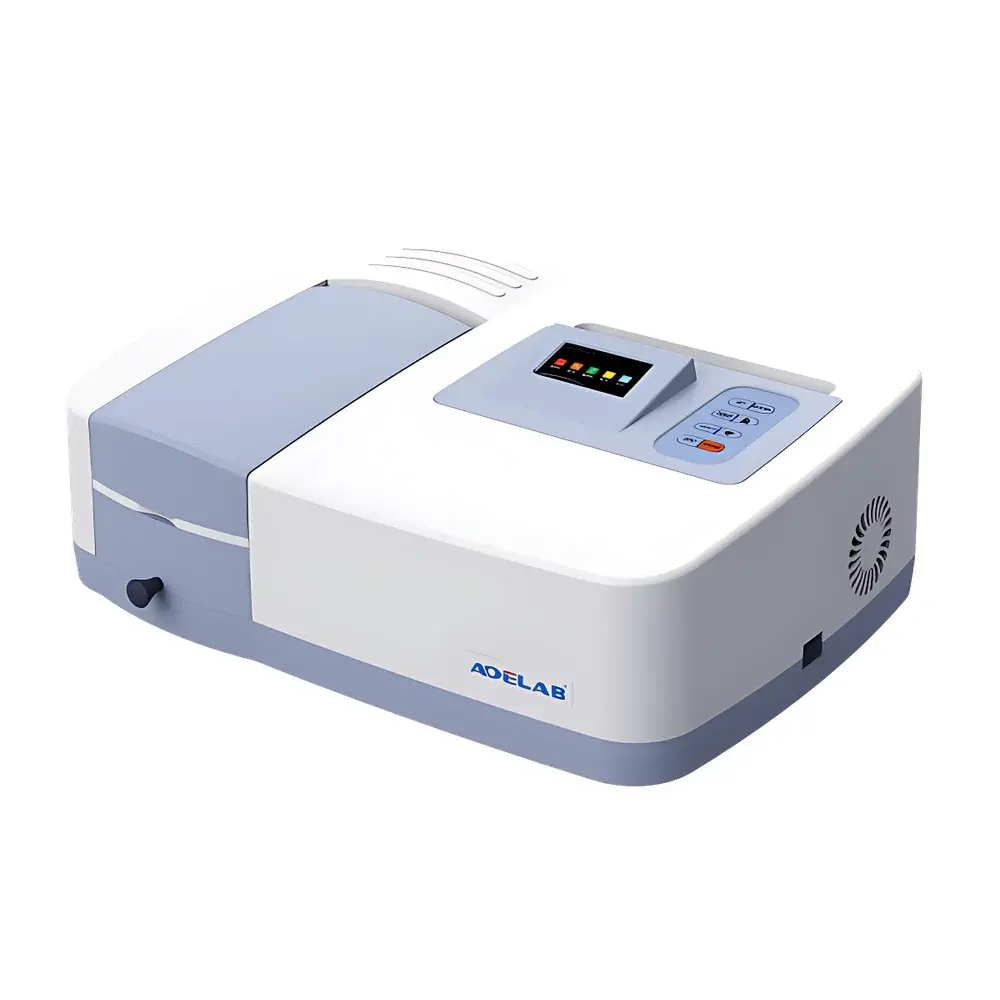
AOE T1 Smart UV-Vis Spectrophotometer
| Brand | AOE |
|---|---|
| Origin | Shanghai, China |
| Manufacturer Type | Authorized Distributor |
| Product Origin | Domestic (China) |
| Model | T1 |
| Instrument Architecture | Single-beam |
| Detector Type | Silicon Photocell |
| Wavelength Range | 200–1020 nm |
| Wavelength Scanning | Motorized Auto-Scanning |
| Spectral Bandwidth | 4.0 nm |
| Wavelength Accuracy | ±1.5 nm |
| Wavelength Repeatability | ≤0.2 nm |
| Stray Light | ≤0.1% T (at 220 nm and 360 nm) |
| Absorbance Noise | ±0.001 Abs |
| Display | 7-inch TFT LCD Touchscreen (480 × 272 pixels) |
| Data Export | USB flash drive interface |
| Software Features | Audit Trail, GMP/GLP-compliant data logging, lifetime free firmware & software updates |
| Sample Holder Compatibility | Adjustable cuvette holder for 1–5 cm pathlength cells |
| Optical System | Holographic grating (1200 lines/mm) |
Overview
The AOE T1 Smart UV-Vis Spectrophotometer is a single-beam, microprocessor-controlled analytical instrument engineered for routine quantitative and qualitative analysis in pharmaceutical QC labs, academic research settings, and industrial quality control environments. It operates on the fundamental principle of Beer–Lambert law-based absorbance measurement, utilizing a high-efficiency holographic grating (1200 lines/mm) to disperse polychromatic light across a broad spectral range of 200–1020 nm. The system employs a silicon photocell detector for stable photometric response and integrates motorized wavelength scanning to ensure precise, repeatable spectral acquisition without manual intervention. Designed with robust mechanical integrity—reinforced sheet-metal chassis and fully sealed optical compartment—the T1 maintains long-term alignment stability during transit and daily operation, minimizing drift and enhancing measurement reproducibility over extended service life.
Key Features
- Single-beam optical architecture optimized for cost-effective, high-stability routine analysis with minimal maintenance requirements.
- 7-inch high-resolution TFT color touchscreen (480 × 272 pixels) enabling intuitive local operation—menu navigation, method setup, real-time spectrum viewing, and result review—all without external PC dependency.
- Sealed optical chamber design prevents dust ingress and moisture-induced degradation of grating or detector performance, ensuring consistent photometric accuracy across humid or variable-lab environments.
- Adjustable cuvette holder accommodating standard pathlengths from 1 cm to 5 cm, supporting diverse sample matrices including highly diluted solutions and concentrated suspensions requiring extended optical paths.
- Integrated USB port for direct export of spectra, calibration logs, and measurement reports to FAT32-formatted flash drives—enabling secure offline data transfer compliant with internal IT policies.
- Lifetime free firmware and application software updates, delivered via encrypted download portal—ensuring continued regulatory alignment and functional enhancement without subscription fees or hardware retrofits.
Sample Compatibility & Compliance
The T1 accommodates standard rectangular quartz, glass, or plastic cuvettes (10 mm to 50 mm pathlength), with optional accessories available for microvolume or flow-cell configurations. Its photometric linearity (0–3.0 Abs) and low stray light (≤0.1% T at 220 nm and 360 nm) meet minimum performance criteria outlined in USP <857>, EP 2.2.25, and ISO 6059 for UV-Vis instrumentation used in pharmacopoeial testing. The embedded audit trail functionality records user ID, timestamp, parameter changes, and data modifications in immutable chronological order—fully satisfying FDA 21 CFR Part 11 requirements for electronic records and signatures when deployed in regulated GMP environments.
Software & Data Management
The bundled PC software provides full remote control, kinetic assay scheduling, multi-wavelength quantitation, and spectral overlay comparison. All data files are saved in vendor-neutral CSV and XML formats, facilitating integration with LIMS platforms and statistical process control (SPC) tools. Each session generates a digitally signed metadata log—including instrument ID, calibration status, lamp hours, and environmental sensor readings (where enabled)—supporting GLP audit readiness. Software validation documentation (IQ/OQ templates) and change-control records are provided upon request for regulated installations.
Applications
- Pharmaceutical assay development and release testing per USP monographs (e.g., assay of paracetamol, vitamin B12, or rifampicin).
- Enzyme kinetics monitoring (e.g., NADH/NADPH oxidation at 340 nm) under controlled temperature conditions using external Peltier accessories.
- Water quality analysis (nitrate, phosphate, COD estimation) in environmental and municipal labs.
- Polymer characterization via carbonyl index calculation (A1710/A1470) in FTIR-preprocessed samples.
- Educational use in undergraduate chemistry laboratories for Beer’s law verification, equilibrium constant determination, and spectral deconvolution exercises.
FAQ
Does the T1 support GLP-compliant electronic signatures?
Yes—the embedded audit trail captures operator identity, action timestamps, and all parameter edits; signature enforcement is configurable per user role in the PC software.
Is the instrument compatible with third-party LIMS systems?
Yes—CSV/XML export and optional OPC UA connectivity enable seamless bidirectional data exchange with major LIMS vendors (e.g., LabWare, STARLIMS, Thermo Fisher SampleManager).
What is the expected lifetime of the deuterium and tungsten lamps?
Typical rated lifetimes are ≥2,000 hours for the deuterium lamp and ≥5,000 hours for the tungsten-halogen lamp; automatic lamp usage tracking is logged in system diagnostics.
Can the T1 perform time-scan or multi-component analysis?
Yes—the PC software supports kinetic time-scan mode (up to 999 points) and simultaneous multi-wavelength regression for up to five analytes using stored calibration curves.
Is calibration verification traceable to NIST standards?
Yes—certified holmium oxide and neutral density filters (NIST-traceable) are recommended for periodic wavelength and photometric accuracy verification; procedures align with ASTM E275 and ISO/IEC 17025 guidelines.




