
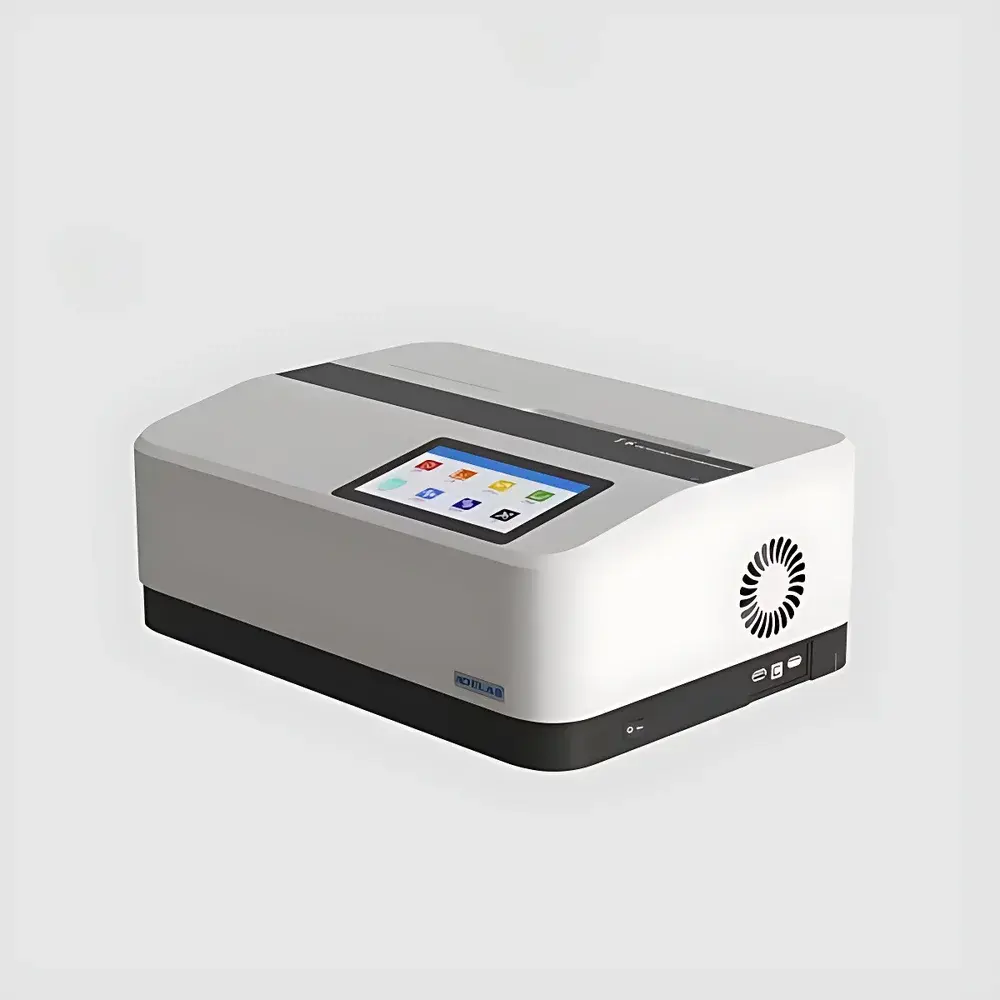
AOE T5 Ultraviolet-Visible Spectrophotometer
| Brand | AOE |
|---|---|
| Origin | Shanghai, China |
| Manufacturer Type | Authorized Distributor |
| Origin Category | Domestic (China) |
| Model | T5 |
| Price Range | USD 1,400–2,800 |
| Optical Design | Pseudo-Double-Beam |
| Detector Type | Silicon Photocell |
| Wavelength Range | 190–1100 nm |
| Wavelength Scanning | Motorized Automatic |
| Spectral Bandwidth | 4.0 nm (±3.8 nm) |
| Wavelength Accuracy | ±0.4 nm (±0.3 nm at 546.1 nm) |
| Stray Light | ≤0.04% T (at 220 nm and 360 nm) |
| Wavelength Repeatability | ≤0.2 nm |
| Photometric Noise | ±0.0005 Abs (0–0.5 Abs), ±0.0004 Abs (0.5–1.0 Abs) |
| Display | 7-inch TFT LCD Touchscreen (1024 × 800 resolution) |
| Data Export | USB flash drive interface |
| Connectivity | USB 2.0, Wi-Fi 802.11 b/g/n, Bluetooth 4.2 |
| Sample Handling | Standard 6-position automatic cuvette changer (1–5 cm pathlength support) |
| Software Compliance | Audit trail enabled, 21 CFR Part 11–ready configuration options |
| Maintenance | Lifetime free firmware and software updates |
Overview
The AOE T5 Ultraviolet-Visible Spectrophotometer is a precision optical instrument engineered for quantitative and qualitative analysis across research laboratories, quality control environments, and regulated pharmaceutical manufacturing facilities. Based on the fundamental principle of Beer–Lambert law absorption spectroscopy, the T5 employs a pseudo-double-beam optical architecture with a high-efficiency 1200-lines/mm holographic grating to deliver stable, reproducible absorbance, transmittance, concentration, and energy measurements. Its 190–1100 nm spectral coverage spans deep UV through near-infrared, enabling routine analysis of organic compounds, nucleic acids, proteins, dyes, catalysts, and dissolved solids. The instrument’s robust mechanical design—featuring reinforced sheet-metal chassis and fully sealed optical compartment—ensures long-term wavelength stability and resistance to environmental dust or vibration-induced misalignment during transport or daily operation.
Key Features
- Sealed optical bench with anti-contamination housing, minimizing photometric drift from ambient particulates or humidity.
- Pseudo-double-beam system with real-time reference beam monitoring for enhanced baseline stability and reduced lamp intensity fluctuation effects.
- 7-inch high-resolution TFT touchscreen (1024 × 800) supporting intuitive gesture-based navigation, direct method setup, and real-time spectral visualization without external PC dependency.
- Integrated 6-position automated cuvette changer accommodating standard 1 cm, 2 cm, 3 cm, 4 cm, and 5 cm pathlength cells—enabling rapid multi-concentration or multi-sample kinetic workflows.
- Multi-interface connectivity: native USB 2.0 port for peripheral devices and data export; IEEE 802.11 b/g/n Wi-Fi module for secure LAN integration; Bluetooth 4.2 for wireless printer pairing (A4 thermal or inkjet).
- Lifetime firmware and application software updates provided at no additional cost, ensuring continued compatibility with evolving OS platforms and regulatory documentation requirements.
Sample Compatibility & Compliance
The T5 accommodates standard rectangular quartz, glass, or plastic cuvettes (10 × 10 mm to 12.5 × 12.5 mm cross-section) with pathlengths from 1 mm to 50 mm. Its low stray light performance (≤0.04% T at 220 nm and 360 nm) meets ASTM E275 and ISO 9001 calibration verification criteria for UV-Vis instrumentation. The embedded PC software supports full audit trail logging—including user ID, timestamp, parameter changes, and result modifications—as required under USP , EP 2.2.25, and FDA 21 CFR Part 11 for electronic records in GMP/GLP-regulated environments. All factory calibrations are traceable to NIST-standard holmium oxide and didymium filters.
Software & Data Management
The T5 operates with AOE SpectraSuite™ v4.x—a Windows-compatible desktop application offering method templates for DNA/RNA quantification (260/280 nm ratio), protein assay (Bradford, BCA), enzyme kinetics (time-scan mode), and multicomponent analysis (linear regression, derivative spectra). Raw absorbance/time/wavelength datasets export in CSV, TXT, and XML formats. Built-in validation tools include wavelength accuracy verification, photometric linearity checks (0–3.0 Abs), and stray light assessment protocols. Data integrity safeguards include password-protected user roles (Operator, Supervisor, Administrator), electronic signatures, and immutable log archives stored locally or on network drives.
Applications
- Pharmaceutical QC: Active pharmaceutical ingredient (API) assay, excipient purity screening, dissolution testing, and cleaning validation swab analysis.
- Academic & Industrial Research: Ligand binding studies, redox reaction monitoring, nanoparticle size estimation via plasmon resonance, and polymer degradation kinetics.
- Environmental Testing: Nitrate, phosphate, and heavy metal ion quantification (e.g., Cr(VI) at 350 nm) in wastewater per EPA Method 353.2 and ISO 15681-1.
- Food & Beverage: Colorimetric determination of anthocyanins, chlorophyll, sulfites, and preservatives using AOAC-approved spectrophotometric endpoints.
- Clinical Diagnostics Support: Calibration verification of hematology analyzers and reagent stability assessment in IVD development labs.
FAQ
Does the T5 comply with 21 CFR Part 11 requirements for electronic records?
Yes—the optional SpectraSuite™ software package includes configurable audit trail, electronic signature, and role-based access control modules validated for Part 11 compliance in regulated settings.
What cuvette materials are supported across the full 190–1100 nm range?
Quartz cuvettes are required below 340 nm; optical-grade fused silica extends usable range to 190 nm. Glass and polystyrene cells are suitable for visible-range applications only (≥340 nm).
Is external PC hardware mandatory for operation?
No—the integrated touchscreen enables standalone operation for basic scans, calibration, and report generation. A PC is required only for advanced data processing, LIMS integration, or full audit trail management.
How often does the instrument require wavelength calibration verification?
Per ISO/IEC 17025 guidelines, verification should occur before each analytical session when traceability is critical; annual recalibration by an accredited service provider is recommended.
Can the T5 perform kinetic measurements over extended time periods?
Yes—time-scan mode supports up to 9,999 data points with user-defined intervals from 0.1 s to 600 s, enabling enzyme activity assays and photochemical reaction monitoring.





