
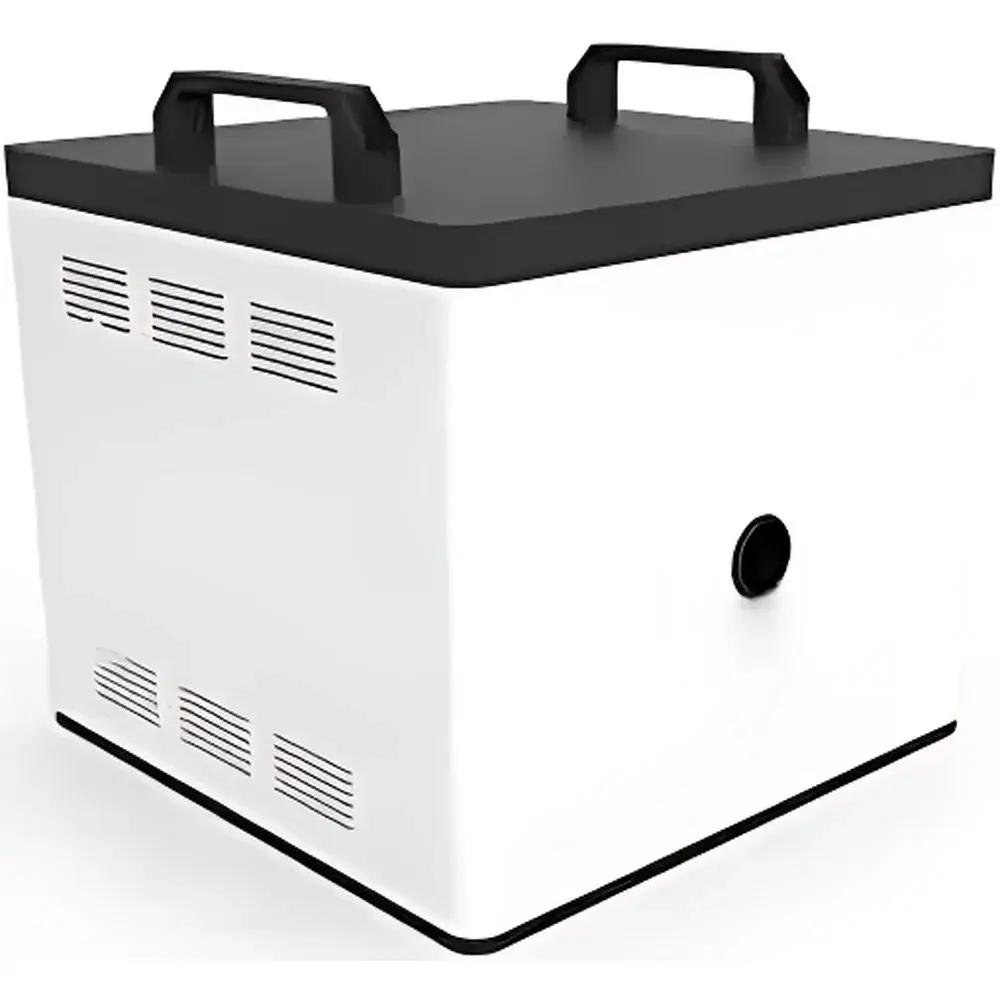
AOE Tech HT-Series High-Temperature Blackbody Radiation Source
| Brand | AOE Tech |
|---|---|
| Model | HT-Series |
| Cavity Material | High-Purity Alumina Ceramic (Corundum) |
| Temperature Range | 300–1700 °C |
| Emissivity | ≥0.99 |
| Temperature Uniformity | ≤±0.5 °C across cavity aperture |
| Temperature Stability | ≤±0.1 °C / 30 min (at setpoint ≥1000 °C) |
| Temperature Resolution | 0.1 °C (≤1000 °C), 1 °C (>1000 °C) |
| Temperature Accuracy | ±(0.15 °C + 0.003× |
| Aperture Diameters | 24 mm, 30 mm, 40 mm |
| Standard Configurations | HT-H1200-040, HT-H1450-024, HT-H1450-030, HT-H1450-040, HT-H1700-040 |
| Housing Type | Integrated or Split-Body (Split: 550 × 584 × 913 mm |
| Integrated | 451 × 446 × 442 mm) |
| Power Supply | 220 V ±1%, 50/60 Hz, 35 A |
| Optional | Precision Aperture Diaphragms (ISO 11554 compliant) |
Overview
The AOE Tech HT-Series High-Temperature Blackbody Radiation Source is a precision-calibrated thermal reference standard engineered for radiometric calibration, infrared sensor characterization, and high-temperature emissivity validation in metrology laboratories, aerospace R&D facilities, and national standards institutes. Operating on the fundamental principle of Planckian radiation, the HT-Series generates spectrally stable, spatially uniform thermal emission traceable to ITS-90 via integrated platinum resistance thermometers (PRTs) and multi-point cavity temperature mapping. Its high-purity alumina (corundum) cavity—chemically inert up to 1700 °C—features a geometrically optimized conical or spherical internal profile to maximize effective emissivity (≥0.99) while minimizing non-uniformity-induced spectral deviation. Unlike graphite- or metal-cavity blackbodies, the ceramic architecture eliminates outgassing, oxidation, and thermal drift at elevated temperatures, ensuring long-term reproducibility under continuous operation.
Key Features
- High-stability alumina ceramic cavity with surface-engineered microstructure for enhanced radiative equivalence and reduced specular reflection
- Multi-zone resistive heating system with closed-loop PID control and real-time thermal gradient compensation
- Traceable temperature calibration with dual PRT sensors (Class A IEC 60751) embedded at cavity base and mid-height
- Configurable aperture geometry (24 mm, 30 mm, 40 mm) supporting ISO 11554-compliant beam collimation and field-of-view matching
- Integrated thermal shielding and vacuum-compatible flange options (CF-40, KF-40) for integration into environmental test chambers
- Split-body configuration available for modular installation in constrained optical benches or furnace-integrated systems
Sample Compatibility & Compliance
The HT-Series accommodates calibration of uncooled microbolometers, cooled InSb/MCT detectors, FTIR spectrometers, and pyrometers across spectral bands from 0.3 µm to 20 µm. All models comply with ISO/IEC 17025:2017 requirements for calibration laboratories, and support documentation packages meeting NIST SP 250-93 and EURAMET cg-18 guidelines. Cavity emissivity is validated per ASTM E1597–22 (Standard Test Method for Determining Effective Emissivity of Blackbody Cavities) using calibrated transfer standard radiometers. The system meets electromagnetic compatibility (EMC) requirements per EN 61326-1:2013 and safety standards per IEC 61010-1:2010 for laboratory equipment.
Software & Data Management
Control and monitoring are performed via AOE Tech’s RadiantCal™ v3.2 software suite, compatible with Windows 10/11 and supporting IEEE 488.2 (GPIB), USB-TMC, and Ethernet (LXI Class C) interfaces. The software provides automated temperature ramping profiles, real-time thermal map visualization, uncertainty budget generation per GUM (JCGM 100:2008), and audit-trail logging compliant with FDA 21 CFR Part 11 for regulated environments. Calibration certificates include full uncertainty analysis, cavity temperature homogeneity maps, and spectral radiance tables (every 10 °C from 300–1700 °C) referenced to NPL and PTB spectral irradiance models.
Applications
- Radiometric calibration of infrared imaging systems (MWIR/LWIR) used in defense targeting and thermal surveillance
- Validation of contactless thermometry algorithms in industrial process control (e.g., steel, glass, semiconductor manufacturing)
- Reference source for validating atmospheric transmission models in remote sensing satellite ground-truthing
- Emissivity benchmarking of high-temperature coatings and refractory materials (e.g., SiC, ZrO₂, MoSi₂)
- Inter-laboratory comparison studies organized by BIPM CCT-WG3 and APMP TCPR
- Development and verification of non-contact temperature measurement standards per ISO 18434-1 and IEC 62906-5-2
FAQ
What is the maximum recommended continuous operating temperature for the HT-H1700-040 model?
Continuous operation at 1700 °C is rated for ≤2 hours per cycle, with mandatory 30-minute cooldown intervals between cycles to preserve cavity integrity and sensor longevity.
Can the HT-Series be operated under vacuum or inert gas purge?
Yes—standard models include CF-40 or KF-40 vacuum flanges; optional quartz viewport and gas purge ports (N₂, Ar) are available for controlled-atmosphere applications.
Is emissivity validation data provided with each unit?
Each shipment includes a NIST-traceable calibration certificate with cavity emissivity measured at three wavelengths (3.9 µm, 4.26 µm, 10.6 µm) using a cryogenically cooled FTIR radiometer.
How is temperature uniformity verified across the aperture?
Uniformity is mapped using a 5-point PRT array during factory acceptance testing; results are documented in the certificate showing radial and axial gradients ≤±0.3 °C at 1200 °C and ≤±0.5 °C at 1700 °C.
Are custom aperture shapes or spectral filters supported?
Yes—custom conical, hemispherical, and truncated-pyramid cavities are available under non-standard engineering (NSE) service; bandpass interference filters (3–5 µm, 8–12 µm) can be integrated as OEM options.





