
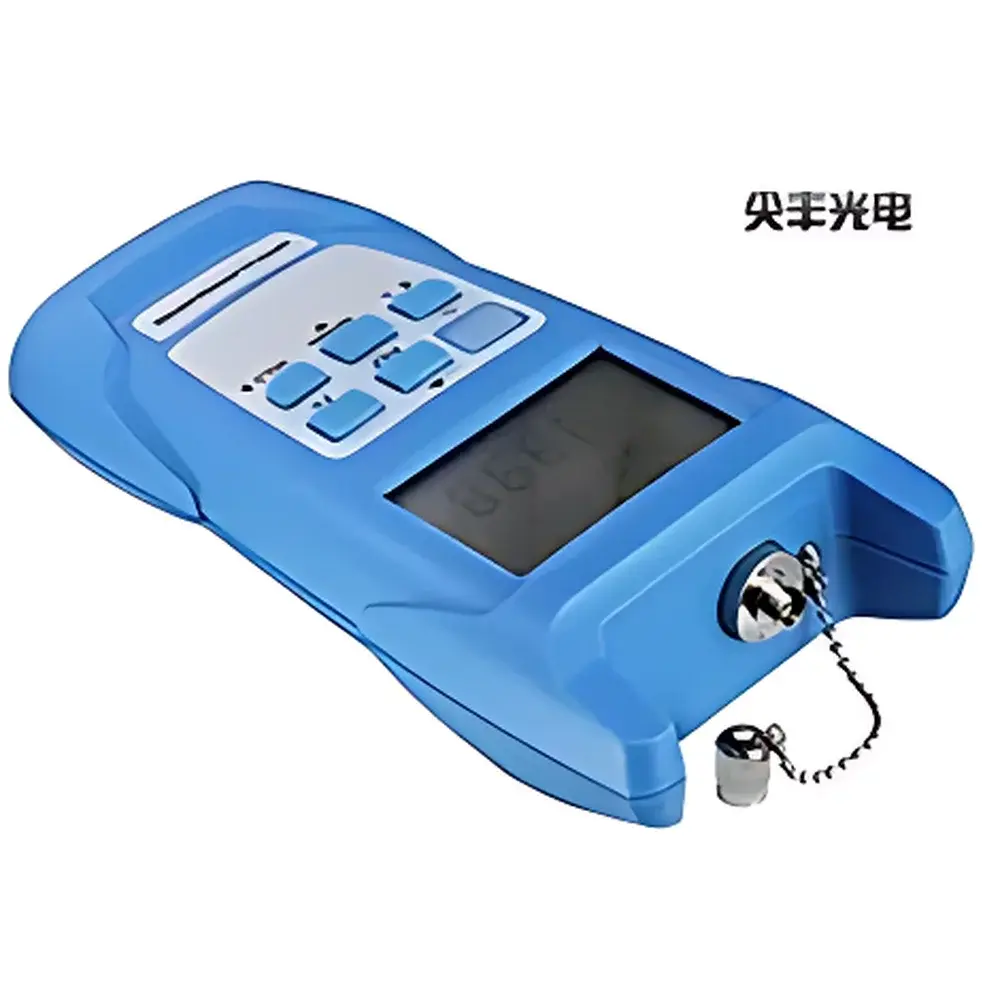
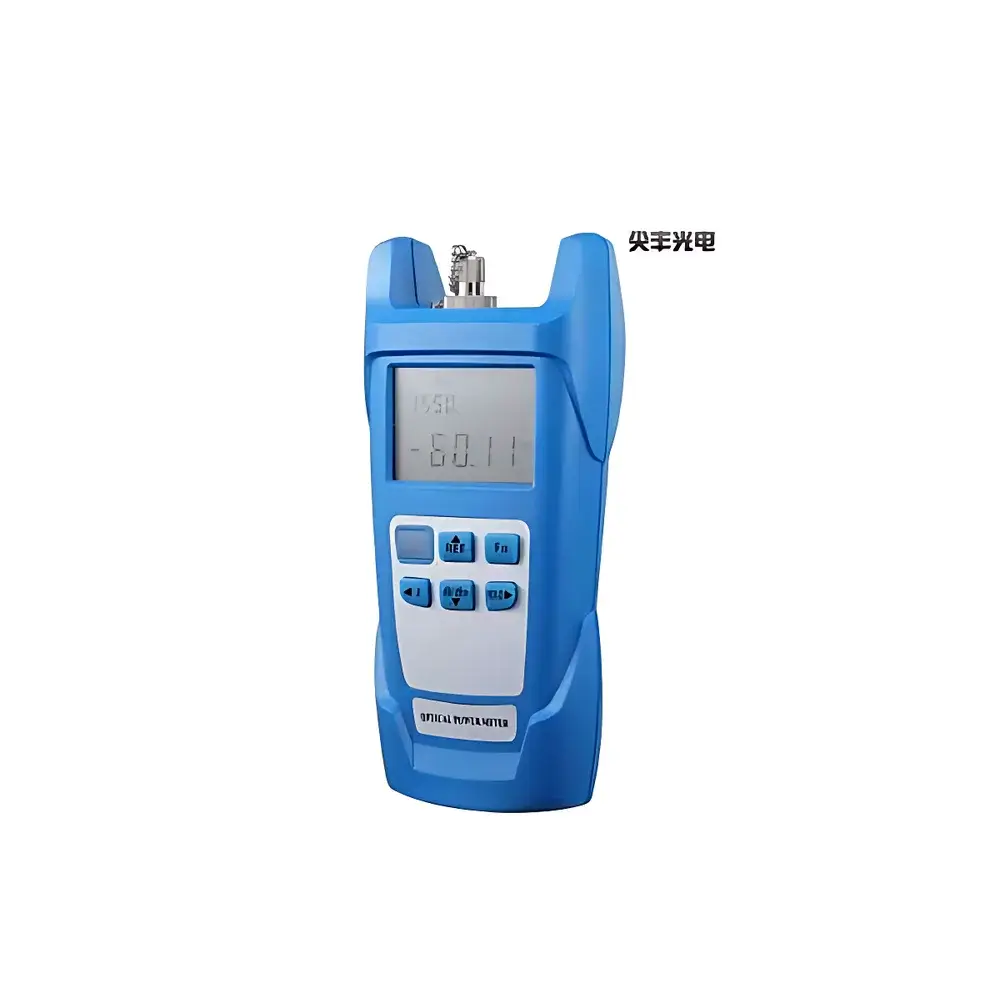
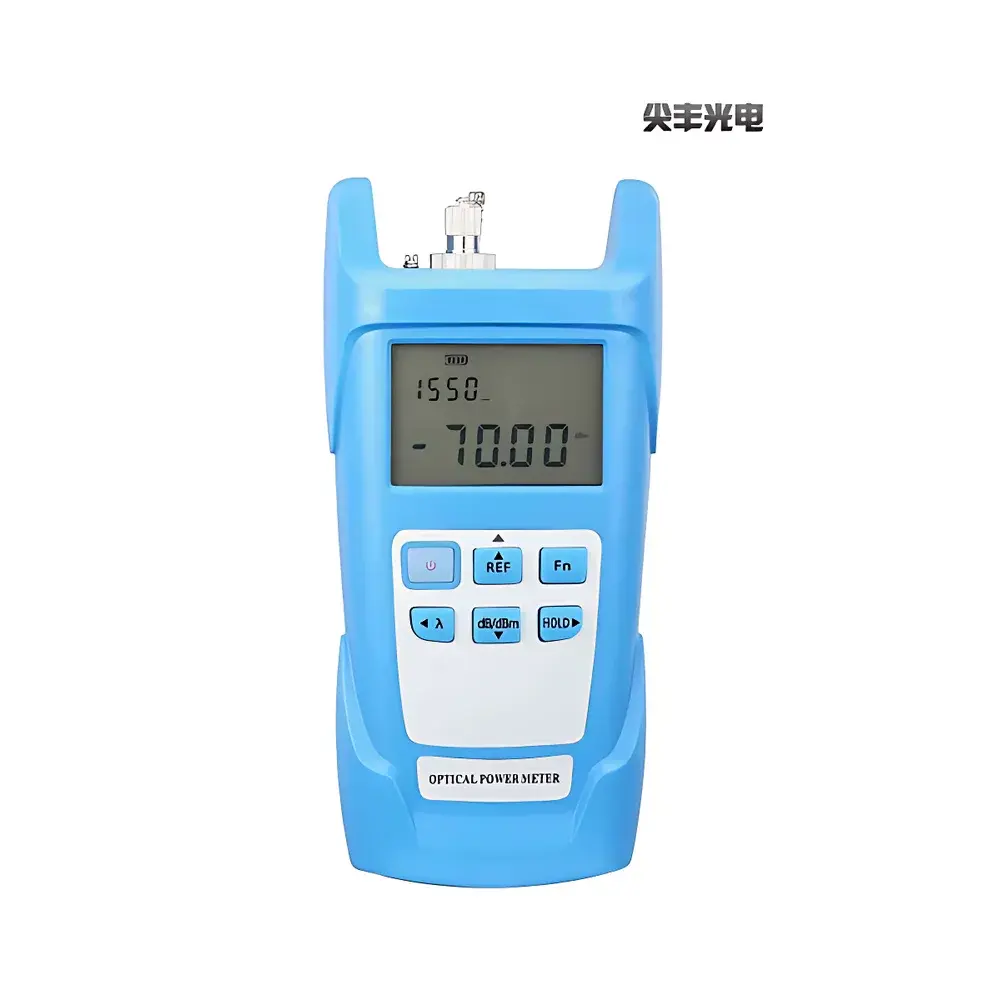
AOE Tech JF-H620 Series Handheld Optical Power Meter
| Brand | AOE Tech |
|---|---|
| Origin | Shanghai, China |
| Manufacturer Type | Authorized Distributor |
| Product Origin | Domestic (China) |
| Model | JF-H620A / JF-H620C |
| Calibration Wavelengths | 850 nm, 980 nm, 1310 nm, 1490 nm, 1550 nm, 1625 nm |
| Wavelength Range | 850–1625 nm |
| Detector Type | InGaAs |
| Power Measurement Range (JF-H620A) | −70 to +6 dBm |
| Power Measurement Range (JF-H620C) | −50 to +26 dBm |
| Uncertainty | ±0.25 dB |
| Display Resolution | 0.1% (linear), 0.01 dBm (logarithmic) |
| Operating Temperature | −10 °C to +60 °C |
| Storage Temperature | −25 °C to +70 °C |
| Auto-Off Interval | 10 min (configurable) |
| Battery Life | ≥130 h |
| Power Supply | Two AA 1.5 V alkaline batteries |
| Weight | 225 g |
| Dimensions | 194.5 × 92.2 × 46.2 mm |
Overview
The AOE Tech JF-H620 Series Handheld Optical Power Meter is a precision field-deployable instrument engineered for reliable optical power measurement in fiber optic communication infrastructure. Based on calibrated photodetector technology using indium gallium arsenide (InGaAs) semiconductor elements, the meter operates across a broad spectral range from 850 nm to 1625 nm—covering all standard telecommunication windows including multimode (850 nm), pump (980 nm), and single-mode bands (1310 nm, 1490 nm, 1550 nm, and 1625 nm). Its core function is the quantitative determination of optical power in dBm or linear units (mW), with traceable calibration enabling compliance with industry-standard test procedures defined in ITU-T G.652, IEC 61280-2-1, and Telcordia GR-1073-CORE. Designed for technicians performing installation, commissioning, troubleshooting, and routine maintenance of passive optical networks (PON), FTTH, CATV, and enterprise LAN environments, the JF-H620 series delivers laboratory-grade repeatability in a ruggedized portable form factor.
Key Features
- Two interchangeable models: JF-H620A (−70 to +6 dBm) optimized for low-power loss testing and receiver sensitivity verification; JF-H620C (−50 to +26 dBm) suited for higher-power applications such as amplifier output monitoring and active device characterization.
- High-accuracy InGaAs photodiode sensor with ±0.25 dB measurement uncertainty across all calibrated wavelengths—meeting requirements for Tier-1 field certification per ANSI/TIA-568.3-D and ISO/IEC 14763-3.
- Large backlit LCD display supporting dual-unit readout (dBm and mW), logarithmic resolution of 0.01 dBm, and linear resolution of 0.1%, facilitating both relative loss analysis and absolute power validation.
- User-accessible self-calibration mode with wavelength-specific correction factors stored in non-volatile memory—enabling field recalibration without return-to-factory service.
- Universal optical interface compatible with FC, SC, LC, ST, and MU connectors via optional adapter sleeves; no physical modification required for multi-connector environments.
- Extended battery endurance (>130 hours) powered by two standard AA alkaline cells; configurable auto-off (10-minute default) and manual disable option for continuous operation during extended test sequences.
Sample Compatibility & Compliance
The JF-H620 series is validated for use with single-mode (SMF-28, G.652.D), multimode (OM1–OM5), and bend-insensitive fibers (G.657.A1/A2). It supports measurement of CW, modulated, and burst-mode optical signals within its specified dynamic range and wavelength coverage. All factory calibrations are performed against NIST-traceable reference standards, and calibration certificates include uncertainty budgets compliant with ISO/IEC 17025 requirements. The instrument meets electromagnetic compatibility (EMC) criteria per EN 61326-1:2013 and safety standards per EN 61010-1:2010. While not inherently 21 CFR Part 11 compliant due to lack of electronic audit trail, its measurement data output supports integration into validated laboratory information management systems (LIMS) when paired with external logging software and procedural controls aligned with GLP/GMP documentation practices.
Software & Data Management
The JF-H620 does not feature embedded Bluetooth or USB connectivity; however, its display output is fully compatible with external digital capture workflows. Technicians may record readings manually into standardized test reports or import values into spreadsheet-based asset tracking templates. For automated data aggregation, third-party optical test management platforms (e.g., VIAVI T-BERD/MTS-2000-compatible loggers or custom Python-based serial parsers) can interface via optional RS-232 or TTL-level UART modules (sold separately). All configuration settings—including selected wavelength, unit mode, and auto-off state—are retained in EEPROM across power cycles, ensuring consistent operational behavior between field deployments.
Applications
- Fiber link insertion loss verification during ODN deployment and acceptance testing
- Optical receiver input power validation at ONT/OLT interfaces in GPON and XGS-PON networks
- EDFA and Raman amplifier gain/flatness assessment in metro and long-haul DWDM systems
- Attenuator and splitter performance characterization under real-world environmental conditions
- Field calibration of optical time-domain reflectometers (OTDRs) and light sources using known reference power levels
- Periodic health monitoring of passive components in outside plant (OSP) cabinets and central offices
FAQ
What wavelengths are supported for calibration, and can additional wavelengths be added post-purchase?
The JF-H620A and JF-H620C are factory-calibrated at six discrete wavelengths: 850 nm, 980 nm, 1310 nm, 1490 nm, 1550 nm, and 1625 nm. These cover all major telecom and datacom bands. Custom wavelength calibration beyond this set is not supported in-field and requires return to an authorized AOE Tech service center.
Is the instrument suitable for measuring pulsed laser sources?
The JF-H620 series is designed for steady-state (CW) optical power measurement. It is not specified for peak power or pulse energy determination; users requiring pulsed-source characterization should consult dedicated peak power meters or integrating sphere-based solutions.
How often should recalibration be performed?
AOE Tech recommends annual recalibration under normal usage conditions. More frequent verification is advised after mechanical shock, exposure to extreme temperatures beyond operating limits, or if measurement drift is observed during routine reference checks using a stable source.
Does the device support zeroing or relative loss mode?
Yes—the instrument includes a “REF” (reference) function that allows users to store a baseline reading and subsequently display subsequent measurements as delta values (ΔdB), simplifying end-to-end loss calculations without manual subtraction.







