
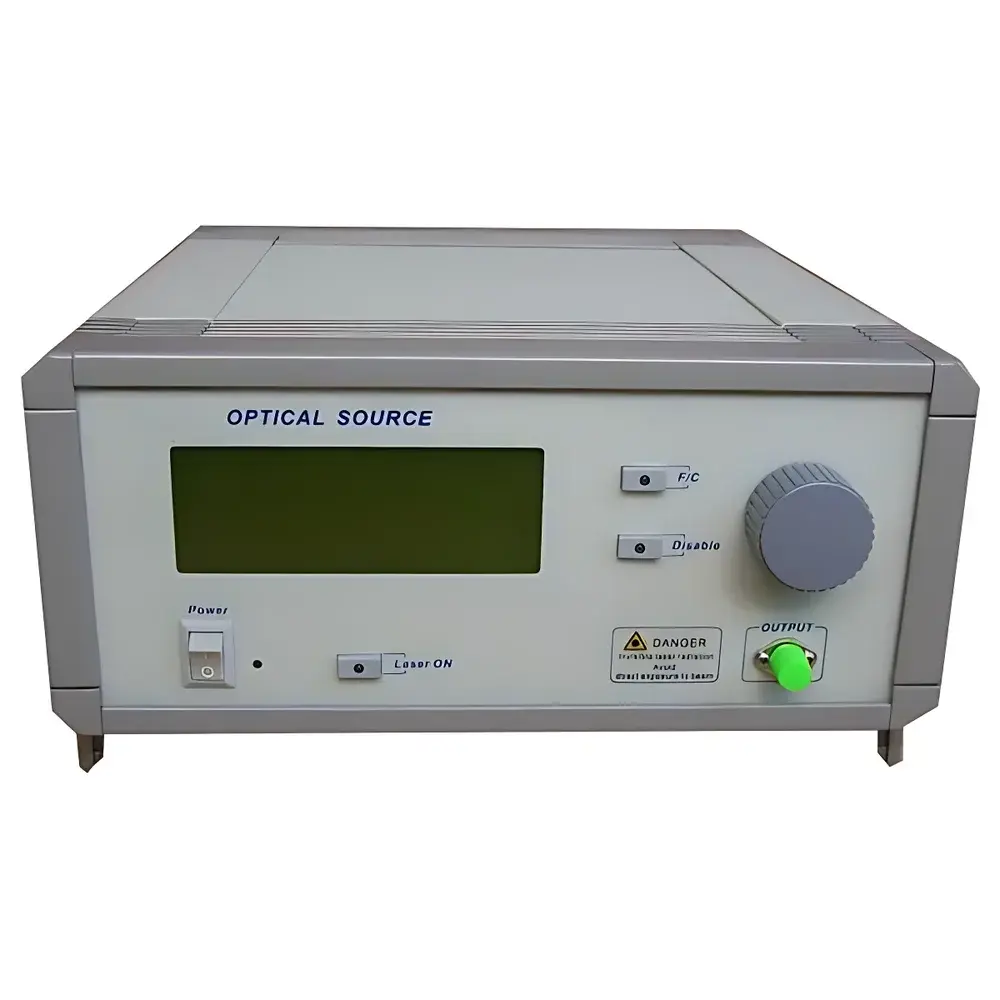
AOE Tech JF8142 High-Speed, High-Power Pulsed Laser Source
| Brand | AOE Tech |
|---|---|
| Origin | Shanghai, China |
| Model | JF8142 |
| Output Configuration | Fiber-Coupled (SM/MM) |
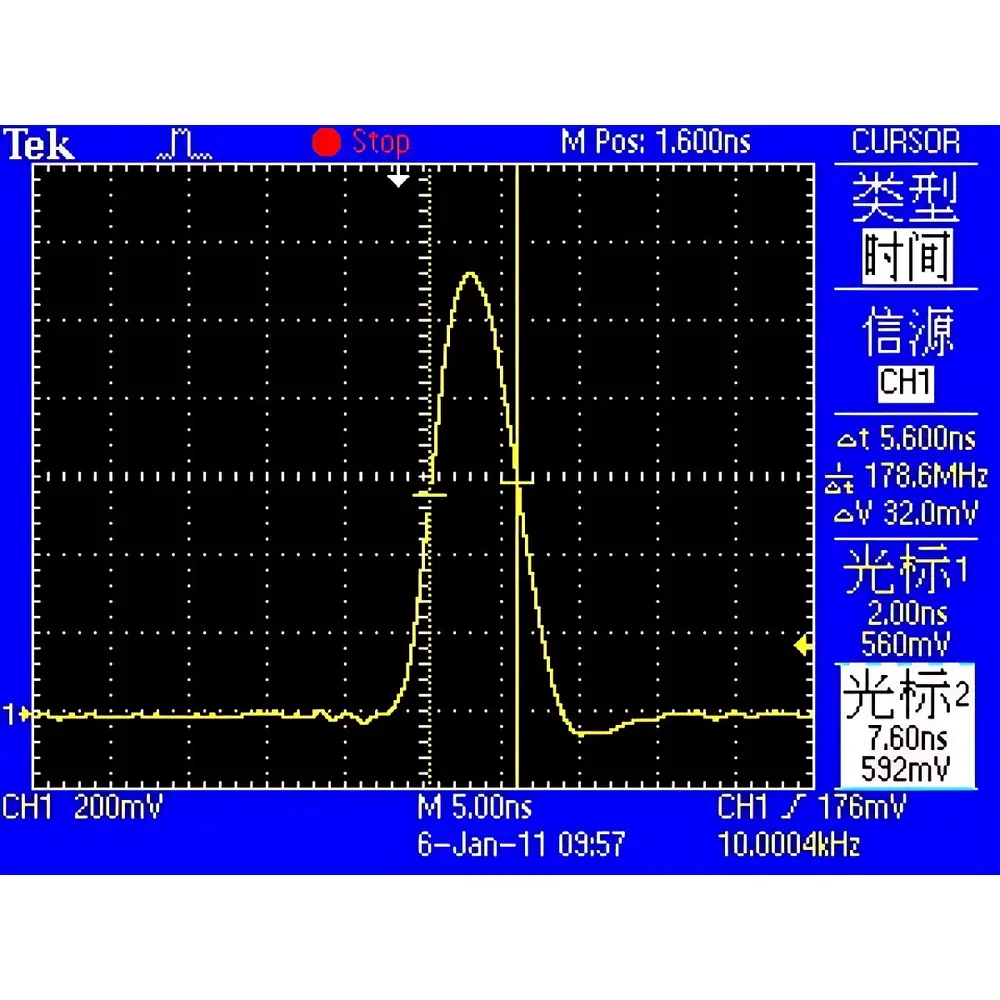
| Pulse Width | 10–300 ns |
| Repetition Rate | Up to 100 kHz |
| Peak Power | 0.7 W (SM single-emitter), 12 W (MM single-emitter), up to 2 kW (MOPA-amplified) |
| Wavelength Options | 808, 915, 940, 975, 980, 1064, 1550 nm |
| Spectral Width (FWHM) | ≤2–4 nm (–3 dB) |
| SMSR | ≥20 dB (MM), ≥35 dB (SM/MOPA) |
| Power Stability | ±5% (rms, over 8 hrs) |
| Operating Temperature | 0–40 °C |
| Storage Temperature | –40–80 °C |
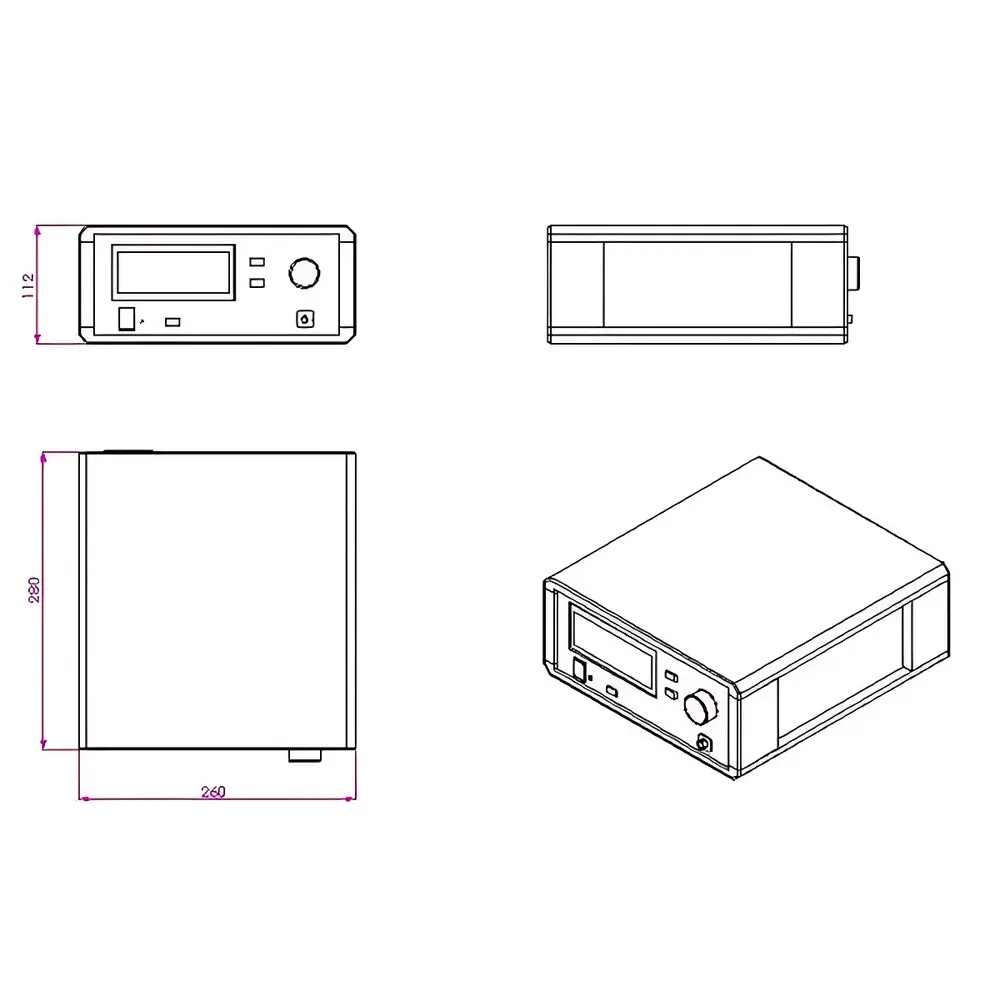
| Dimensions (L×W×H) | 280 × 260 × 112 mm |
| Power Consumption | ≤15 W |
| Synchronization Output | TTL-compatible electrical sync port |
| Modulation Modes | Internal (software/front-panel programmable) and External (triggered by user-supplied TTL/LVDS signal, including single-shot) |
Overview
The AOE Tech JF8142 High-Speed, High-Power Pulsed Laser Source is an engineered optical instrument designed for applications demanding precise temporal control, high peak irradiance, and fiber-delivered beam quality. It operates on the principle of current-driven semiconductor laser diode pulsing, combined with proprietary high-speed driver circuitry that ensures sub-10 ns rise/fall times and nanosecond-level pulse fidelity. Unlike continuous-wave (CW) or quasi-CW sources, the JF8142 delivers true pulsed output with tunable width (10–300 ns), adjustable repetition rate (1 Hz–100 kHz), and scalable peak power—from milliwatt-level seed pulses to kilowatt-class amplified outputs—while maintaining spectral integrity and thermal robustness. Its modular architecture supports integration into OEM systems, laboratory test benches, or field-deployable platforms requiring reliable, repeatable pulsed illumination under controlled environmental conditions.
Key Features
- Fiber-coupled output in three configurations: single-mode single-emitter (e.g., 1064 nm, 0.7 W), multi-mode single-emitter (e.g., 915 nm, 12 W), and single-mode MOPA (Master Oscillator Power Amplifier) architecture (e.g., 1064/1550 nm, up to 2 kW peak power).
- Internally programmable pulse generation with independent adjustment of pulse width, duty cycle, and repetition frequency via front-panel interface or USB-connected software.
- External modulation support with TTL/LVDS-compatible trigger input; enables synchronization with oscilloscopes, gated detectors, or time-of-flight measurement systems—including true single-pulse emission capability.
- Dual-synchronization output: optical pulse train + corresponding electrical sync signal (TTL level), ensuring deterministic timing alignment for data acquisition and system-level triggering.
- Thermally stabilized laser diode mount and closed-loop temperature control maintain wavelength stability (±0.1 nm/°C typical) and power repeatability (±5% RMS over 8-hour operation).
- Compliance with Telcordia GR-468-CORE reliability standards for laser diodes, including accelerated life testing, hermetic packaging, and electrostatic discharge (ESD) protection per IEC 61340-5-1.
Sample Compatibility & Compliance
The JF8142 accommodates diverse optical coupling requirements through standardized fiber interfaces: default delivery via HI1060 (1064 nm), SMF-28 (1550 nm), or 105/125 µm multimode fiber—with optional customization for 50/125 µm or 62.5/125 µm fibers. Its narrow spectral bandwidth (≤4 nm FWHM, –3 dB) and high side-mode suppression ratio (≥35 dB for SM/MOPA variants) ensure compatibility with wavelength-sensitive components such as diffraction gratings, acousto-optic modulators (AOMs), and fiber Bragg grating (FBG) sensors. The device conforms to IEC 61000-6-3 (EMI emissions) and IEC 61000-6-2 (immunity), and its mechanical housing meets IP20 environmental protection rating. While not certified for medical or aerospace use out-of-the-box, it provides traceable calibration documentation and supports GLP/GMP-aligned operational logging when integrated with compliant data acquisition software.
Software & Data Management
The JF8142 is operated via AOE Tech’s cross-platform LaserControl Suite (Windows/macOS/Linux), offering real-time parameter visualization, waveform preview, and non-volatile storage of up to 100 user-defined pulse profiles. All settings—including pulse width, repetition rate, peak current limit, and internal trigger delay—are stored in onboard EEPROM and persist across power cycles. Software logs include timestamped power stability metrics, thermal sensor readings, and error event history (e.g., overtemperature lockout, overcurrent shutdown). For regulated environments, optional firmware upgrade enables audit-trail functionality compliant with FDA 21 CFR Part 11 requirements, including electronic signatures, role-based access control, and immutable record retention.
Applications
- Laser material processing: Nanosecond ablation, thin-film scribing, and micro-machining where minimal heat-affected zones are critical.
- Scientific research: Pump-probe spectroscopy, time-resolved fluorescence lifetime imaging (FLIM), and ultrafast nonlinear optics experiments.
- Defense & sensing: Eye-safe LIDAR transmitters (1550 nm), rangefinder seed sources, and countermeasure simulation systems.
- Fiber laser pumping: Direct diode pumping of Yb-doped or Er/Yb co-doped gain fibers in MOPA or Q-switched architectures.
- Biomedical instrumentation: Optical coherence tomography (OCT) swept-source calibration, photodynamic therapy (PDT) dosimetry validation, and flow cytometry excitation sources.
- Education & training: Hands-on instruction in laser dynamics, pulse shaping, and optoelectronic interfacing within university photonics laboratories.
FAQ
What is the minimum pulse width achievable with the JF8142?
The standard configuration supports pulse widths from 10 ns to 300 ns; custom driver variants can achieve sub-5 ns pulses upon request.
Can the JF8142 operate in continuous wave (CW) mode?
No—it is a dedicated pulsed source; CW operation is not supported due to thermal and reliability constraints inherent in its high-peak-power design.
Is external modulation compatible with arbitrary waveform generators (AWGs)?
Yes, provided the AWG output meets TTL or LVDS voltage levels and impedance matching (50 Ω); rise time < 5 ns is recommended for optimal pulse fidelity.
Does the JF8142 include safety interlocks or laser classification labeling?
It complies with IEC 60825-1:2014 Class 4 laser safety requirements; integrated hardware interlock connector (2-pin LEMO) enables integration with external safety circuits.
How is wavelength selection implemented across different models?
Wavelength is determined at manufacture by laser diode chip selection; discrete models are available per wavelength—no field-swappable optics or tunable elements are included.




