
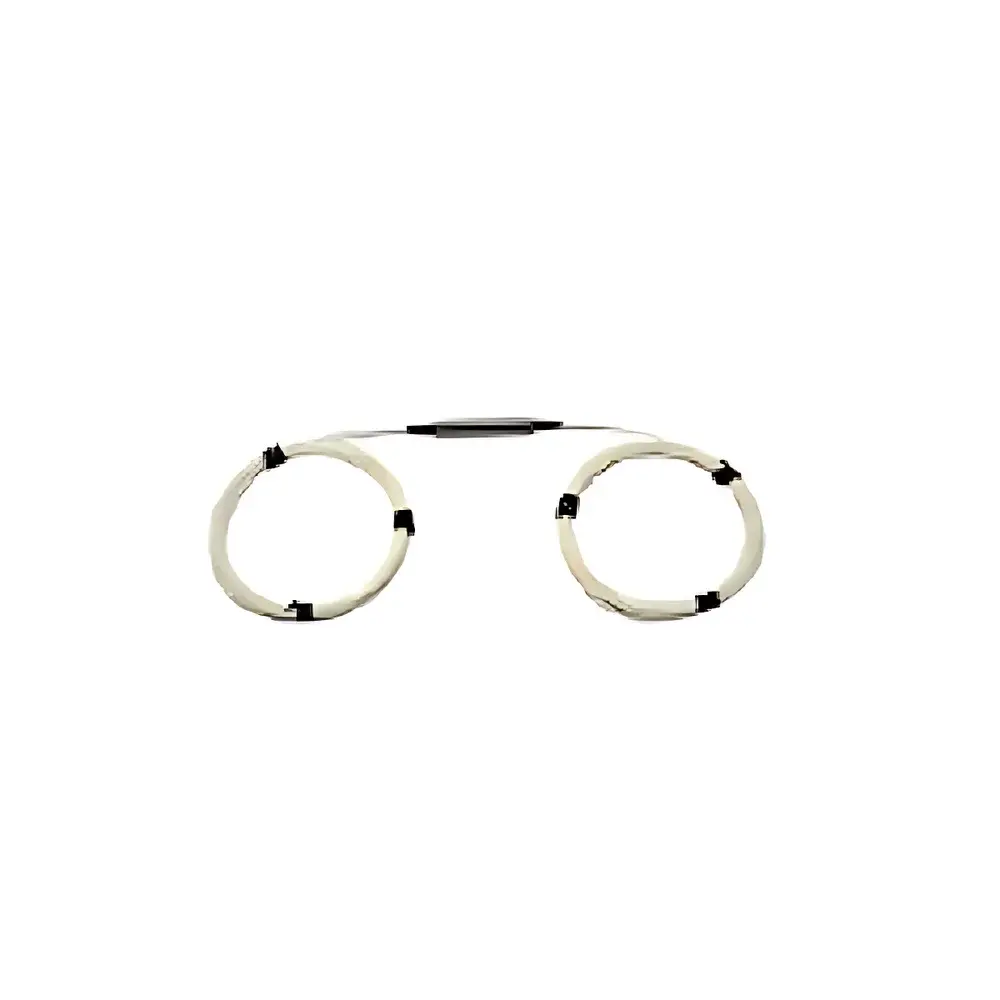
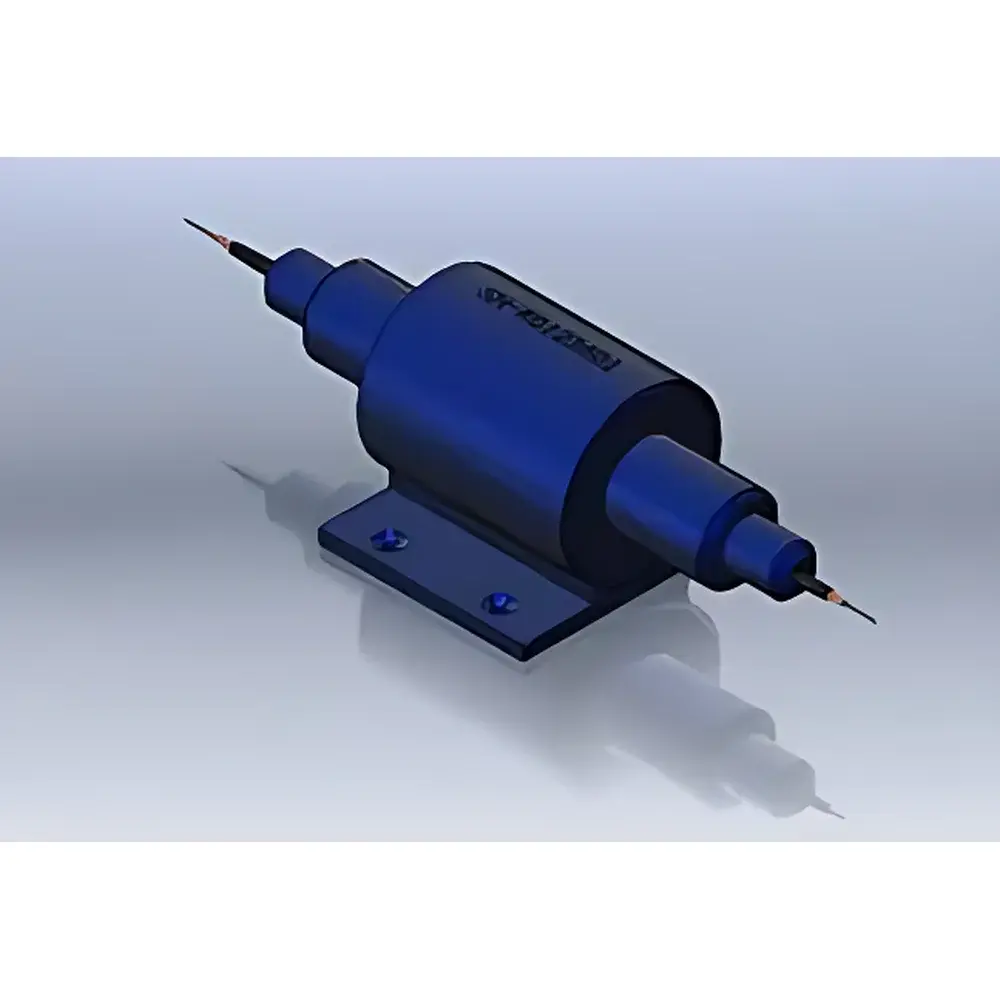
AOE Tech PMIS-1310/1480/1550 Dual-Stage Polarization-Maintaining Optical Isolator
| Brand | AOE Tech |
|---|---|
| Origin | Shanghai, China |
| Model | PMIS-1310nm_1480nm_1550nm |
| Operating Wavelengths | 1310 nm, 1480 nm, 1550 nm |
| Isolation Grade | Dual-Stage (PA) |
| Peak Isolation | ≥55 dB |
| Typical Insertion Loss | ≤0.6 dB (23 °C) |
| Extinction Ratio | ≥22 dB (Fast-Axis Blocked) |
| Return Loss (Input/Output) | ≥55 dB |
| Max. Optical Power Handling | 300 mW |
| Fiber Type | Panda PM Fiber |
| Operating Temperature | –5 °C to +70 °C |
| Package Dimensions | Ø5.5 mm × 35 mm |
| Compliance | Telcordia GR-1221-CORE, IEC 61300-2-4 (Insertion Loss), IEC 61300-2-17 (Return Loss) |
Overview
The AOE Tech PMIS-1310/1480/1550 is a dual-stage polarization-maintaining (PM) optical isolator engineered for high-fidelity signal integrity in coherent and polarization-sensitive photonic systems. Based on the Faraday magneto-optic effect and birefringent crystal alignment, this isolator provides unidirectional transmission while suppressing backward-propagating light—critical for protecting laser sources from destabilizing reflections. Its design preserves the linear polarization state of input light by maintaining alignment between the slow axis of the integrated panda-type PM fiber and the device’s internal optical axis. Optimized for operation across three industry-standard telecom and pump bands—1310 nm (O-band), 1480 nm (pump band for EDFAs), and 1550 nm (C-band)—the isolator delivers stable performance over wide thermal and power envelopes without compromising extinction ratio or isolation depth.
Key Features
- Dual-stage architecture achieving ≥55 dB peak isolation and ≥45 dB isolation at 23 °C across all specified wavelengths
- Low typical insertion loss of ≤0.6 dB at 23 °C, with temperature-stable operation (≤0.80 dB over –5 °C to +70 °C)
- High extinction ratio ≥22 dB (Fast-Axis Blocked configuration), ensuring minimal crosstalk between orthogonal polarization modes
- Input/output return loss ≥55 dB, minimizing residual reflections that could induce mode instability or RIN degradation
- Robust mechanical packaging (Ø5.5 mm × 35 mm) compatible with standard PM fiber pigtails and alignment-keyed connectors
- Rated for continuous-wave optical power up to 300 mW—suitable for low-to-moderate power amplifiers, seed lasers, and instrumentation-grade setups
Sample Compatibility & Compliance
The PMIS-1310/1480/1550 is designed exclusively for use with panda-type polarization-maintaining fibers, with slow-axis alignment referenced to the connector key for deterministic system integration. It meets key reliability and performance benchmarks defined in Telcordia GR-1221-CORE for passive optical components and conforms to IEC 61300-2-4 (insertion loss stability under mechanical stress) and IEC 61300-2-17 (return loss measurement methodology). While not certified for medical or aerospace deployment, its thermal and optical specifications align with laboratory-grade and industrial optical subsystem requirements—including those governed by ISO/IEC 17025-accredited calibration workflows. No proprietary firmware or safety certifications (e.g., UL, CE) apply, as the device operates entirely in the passive optical domain.
Software & Data Management
This isolator is a fully passive, connectorized component requiring no software interface, driver, or configuration utility. Performance validation relies on standardized test instrumentation: calibrated optical power meters (e.g., Thorlabs PM100D with S130C sensor), polarization analyzers (e.g., EXFO PX1000), and tunable laser sources traceable to NIST standards. For traceability in GLP/GMP environments, users are advised to record batch-specific test reports—including measured IL, isolation, ER, and RL values—at time of installation. The device supports audit-ready documentation when integrated into systems compliant with FDA 21 CFR Part 11–aligned data acquisition platforms (e.g., LabVIEW-based optical test benches with electronic signature and change logging).
Applications
- Seed protection in PM fiber laser oscillators operating at 1310 nm or 1550 nm
- Back-reflection suppression in EDFA pump modules utilizing 1480 nm pump diodes
- Stabilization of interferometric sensors (e.g., fiber optic gyroscopes, distributed acoustic sensing) where polarization drift must be minimized
- Integration into PM-based quantum optics setups requiring high-fidelity state preservation
- Test fixture components in automated optical component characterization systems (e.g., wafer-level testing of PM PICs)
- Instrumentation-grade optical bench assemblies for metrology labs validating polarization-dependent loss (PDL) and polarization mode dispersion (PMD)
FAQ
What does “PA” denote in the model designation PMIS-1310nm_1480nm_1550nm?
“PA” stands for Polarization-Maintaining, Dual-Stage Architecture—indicating both polarization preservation and two cascaded isolation stages for enhanced backward-light rejection.
Can this isolator be used with non-panda PM fibers such as bow-tie or elliptical-clad designs?
No. Mechanical and optical alignment is optimized specifically for panda-type PM fiber; substitution may degrade extinction ratio and increase insertion loss.
Is the specified insertion loss inclusive of connector contributions?
No. All listed IL values exclude connector interfaces. When FC/APC or SC/APC connectors are added, total IL increases by ≤0.3 dB and return loss decreases by ≥5 dB per interface.
Does the device support operation beyond 70 °C?
Extended temperature operation is not characterized or guaranteed. Prolonged exposure above +70 °C may cause epoxy degradation in the fiber-to-package interface, risking axial misalignment and ER reduction.
How is slow-axis alignment verified during manufacturing?
Each unit undergoes polarization-resolved near-field imaging and angular scanning to confirm <±0.5° alignment tolerance between the fiber slow axis and the isolator’s principal transmission axis, documented in outgoing test reports.




