
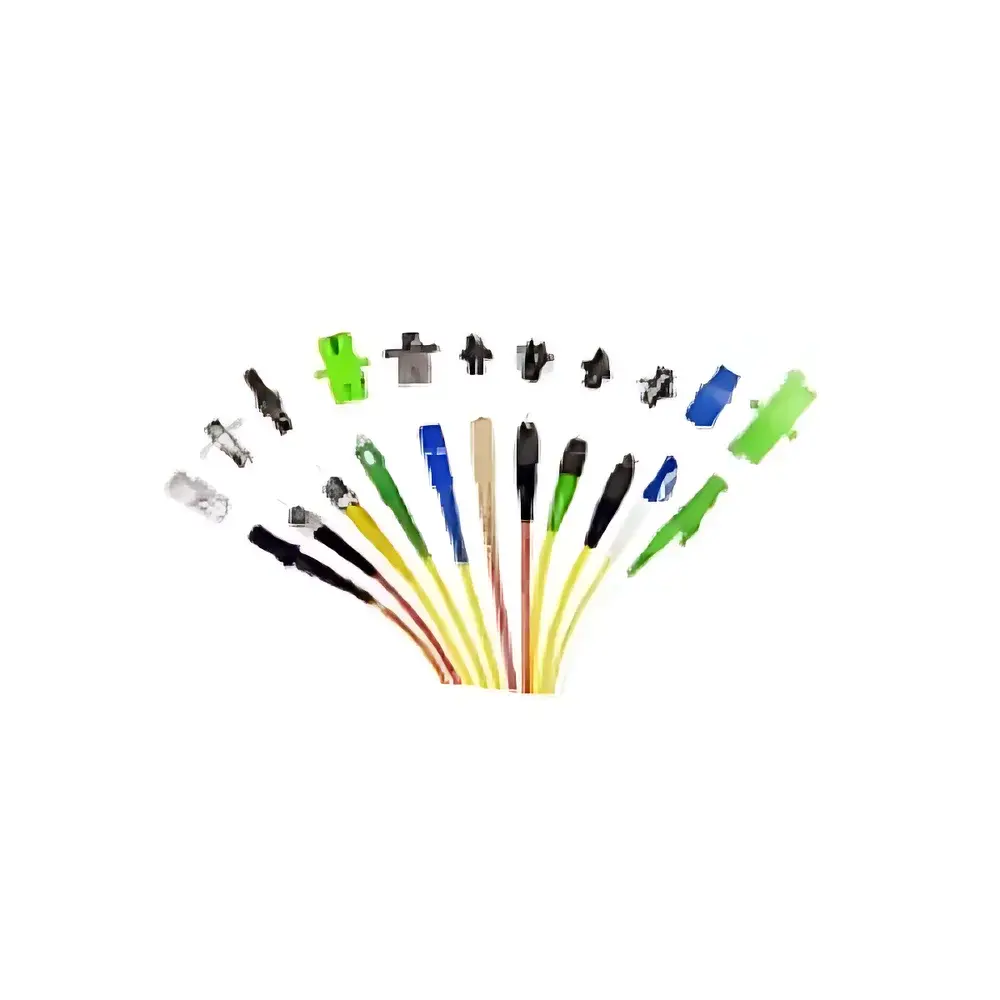
AOE Tech PMJP Polarization-Maintaining Fiber Patch Cord
| Brand | AOE Tech |
|---|---|
| Origin | Shanghai, China |
| Model | PMJP |
| Component Category | Optical Component |
| Connector Types | FC/UPC, SC/UPC, LC/UPC, FC/APC, SC/APC, LC/APC |
| Center Wavelengths | 980 nm, 1064 nm, 1310 nm, 1480 nm, 1550 nm |
| Insertion Loss | ≤0.3 dB (typ.), ≤0.5 dB (max.) |
| Return Loss | ≥50 dB (UPC), ≥60 dB (APC) |
| Extinction Ratio | ≥23 dB |
| Fiber Types | PM850, PM980, PM1310, PM1550 |
| Slow-Axis Alignment Accuracy | ±3° |
| Operating Temperature | –5 °C to +70 °C |
| Storage Temperature | –40 °C to +80 °C |
| Jacket Options | 250 µm bare fiber, 900 µm loose tube, 2 mm / 3 mm tight-buffered cable |
| Length Options | 1 m, 2 m, or custom |
Overview
The AOE Tech PMJP Polarization-Maintaining Fiber Patch Cord is a precision-engineered optical interconnect designed for applications requiring stable polarization state preservation across fiber-optic links. Built upon the principle of stress-induced birefringence in elliptical-core or PANDA-type polarization-maintaining (PM) fibers, the PMJP cord maintains orthogonal linear polarization states with high fidelity—critical for interferometric sensing, coherent detection, quantum optics, and polarization-sensitive laser systems. Unlike standard single-mode patch cords, the PMJP integrates factory-verified slow-axis alignment between connectors, ensuring minimal polarization cross-coupling during mating. Its low insertion loss and high extinction ratio are achieved through monolithic ferrule processing, ultra-precise core centering, and controlled epoxy-free termination techniques—enabling reproducible performance under thermal cycling and mechanical stress.
Key Features
- High extinction ratio ≥23 dB across multiple wavelength bands (980 nm, 1064 nm, 1310 nm, 1550 nm), verified per IEC 61300-3-34 test procedures
- Ultra-low insertion loss: ≤0.3 dB typical, ≤0.5 dB maximum—optimized via physical contact geometry and anti-reflection coatings on APC/UPC end-faces
- Precision slow-axis alignment tolerance of ±3°, maintained across repeated connector matings and thermal excursions (–5 °C to +70 °C)
- Robust mechanical architecture: stainless steel or zirconia ferrules, reinforced strain-relief boots, and UV-cured adhesive bonding compliant with Telcordia GR-326-CORE
- Configurable connector pairing (e.g., FC/APC to LC/UPC) and polarization axis marking (dot or key-aligned orientation) for system-level polarization management
- Available in industry-standard jacket formats: 250 µm bare fiber, 900 µm loose tube, and 2 mm / 3 mm tight-buffered cables—compatible with OEM integration and rack-mount patch panels
Sample Compatibility & Compliance
The PMJP series supports seamless integration with polarization-sensitive photonic subsystems including fiber amplifiers (EDFA, YDFA), interferometric sensors (FOG, FBG interrogators), electro-optic modulators, and quantum light sources. It complies with IEC 61300-2-2 (vibration), IEC 61300-2-1 (impact), and IEC 61300-2-5 (tensile load) standards. All units undergo 100% end-face inspection per IEC 61300-3-35 (automated interferometry), and meet ISO 10110-7 surface quality specifications (scratch-dig 10-5). For regulated environments, documentation packages support GLP/GMP traceability—including lot-specific test reports, RoHS compliance certificates, and MSA-compliant labeling.
Software & Data Management
While the PMJP is a passive component, its performance data is fully traceable within AOE Tech’s optical component database. Each unit carries a serialized QR code linking to a secure portal containing calibration-grade test reports: insertion loss spectrum (15 nm bandwidth), extinction ratio vs. wavelength, return loss verification, and axial rotation scan results. The platform supports CSV export for integration into LabVIEW, MATLAB, or LIMS environments. Audit trails comply with FDA 21 CFR Part 11 requirements for electronic records and signatures where applicable—particularly relevant for medical laser delivery systems and aerospace-grade fiber optic harnesses.
Applications
- Input/output coupling for polarization-maintaining fiber amplifiers (e.g., PM-EDFA at 1550 nm or PM-YDFA at 1064 nm)
- Interferometric sensing interfaces in fiber-optic gyroscopes (FOGs), distributed acoustic sensing (DAS), and strain-monitoring networks
- Coherent receiver front-ends in DP-QPSK and QAM-16 modulation schemes
- Quantum key distribution (QKD) systems requiring deterministic polarization encoding (e.g., BB84 protocol)
- Laser cavity feedback paths for external cavity diode lasers (ECDLs) and narrow-linewidth fiber lasers
- Calibration references in polarization-resolved spectroscopy and Mueller matrix polarimetry setups
FAQ
What defines polarization extinction ratio in a PM fiber patch cord?
Extinction ratio quantifies the ratio of optical power transmitted along the intended slow axis versus the orthogonal fast axis, expressed in decibels (dB). A value ≥23 dB indicates >99.5% polarization purity under ideal launch conditions—essential for minimizing crosstalk in polarization-diverse architectures.
Can the PMJP cord be used in high-power CW laser applications?
Yes—when specified with angle-polished (APC) connectors and high-damage-threshold end-faces, the PMJP supports continuous-wave power levels up to 500 mW at 1064 nm and 300 mW at 1550 nm without measurable thermal lensing or facet degradation. For >1 W operation, consult AOE Tech’s HP-PMJP variant with fused silica ferrules and enhanced thermal anchoring.
How is slow-axis alignment verified and marked?
Alignment is confirmed using a rotating analyzer polarimeter coupled to a stabilized broadband source. The slow axis is physically marked on the boot or connector body using laser etching aligned to the fiber’s stress rods—traceable to NIST-traceable angular metrology equipment calibrated quarterly.
Is custom length or hybrid connector configuration available?
All configurations—including asymmetric connector pairs (e.g., SC/UPC to FC/APC), non-standard lengths (0.5 m to 10 m), and specialty jackets (armored, low-SR, or radiation-hardened)—are offered under AOE Tech’s OEM service program with lead times from 5–12 working days.




