
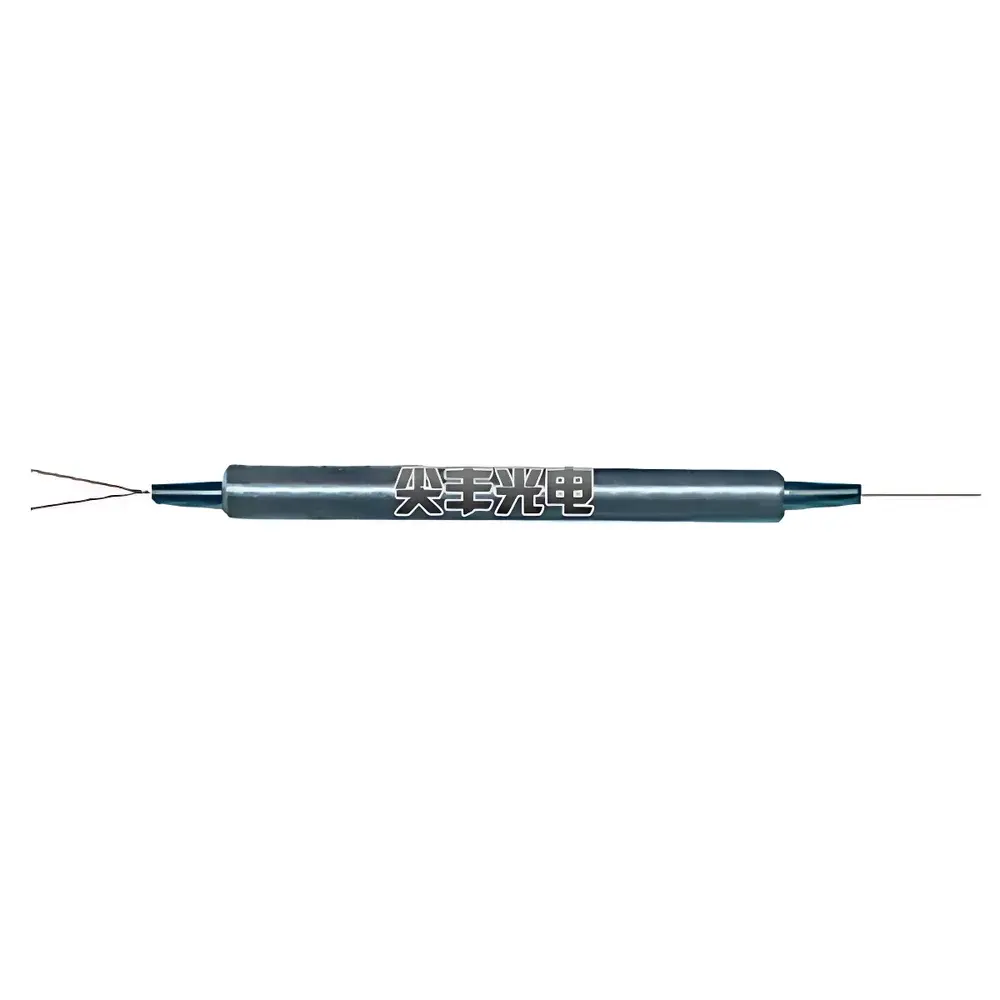
AOE Tech PMOCIR Polarization-Maintaining Optical Circulator
| Brand | AOE Tech |
|---|---|
| Origin | Shanghai, China |
| Manufacturer Type | Authorized Distributor |
| Product Category | Optical Component |
| Model | PMOCIR |
| Wavelength Options | 1310 nm or 1550 nm |
| Insertion Loss (Typ., λc, 23°C) | 0.6–0.7 dB |
| Insertion Loss (Max.) | 0.8–0.9 dB |
| Peak Isolation (Typ.) | 40–52 dB |
| Isolation (λc, 23°C, Typ.) | 30–46 dB |
| Isolation (Min.) | 20–40 dB |
| Extinction Ratio (Min.) | 20 dB |
| Crosstalk (Min.) | 50 dB |
| Return Loss (Min.) | 50 dB |
| Max. CW Optical Power | 300 mW |
| Tensile Load (Max.) | 5 N |
| Operating Temperature | –5 to +70 °C |
| Storage Temperature | –40 to +85 °C |
| Port Count | 3 |
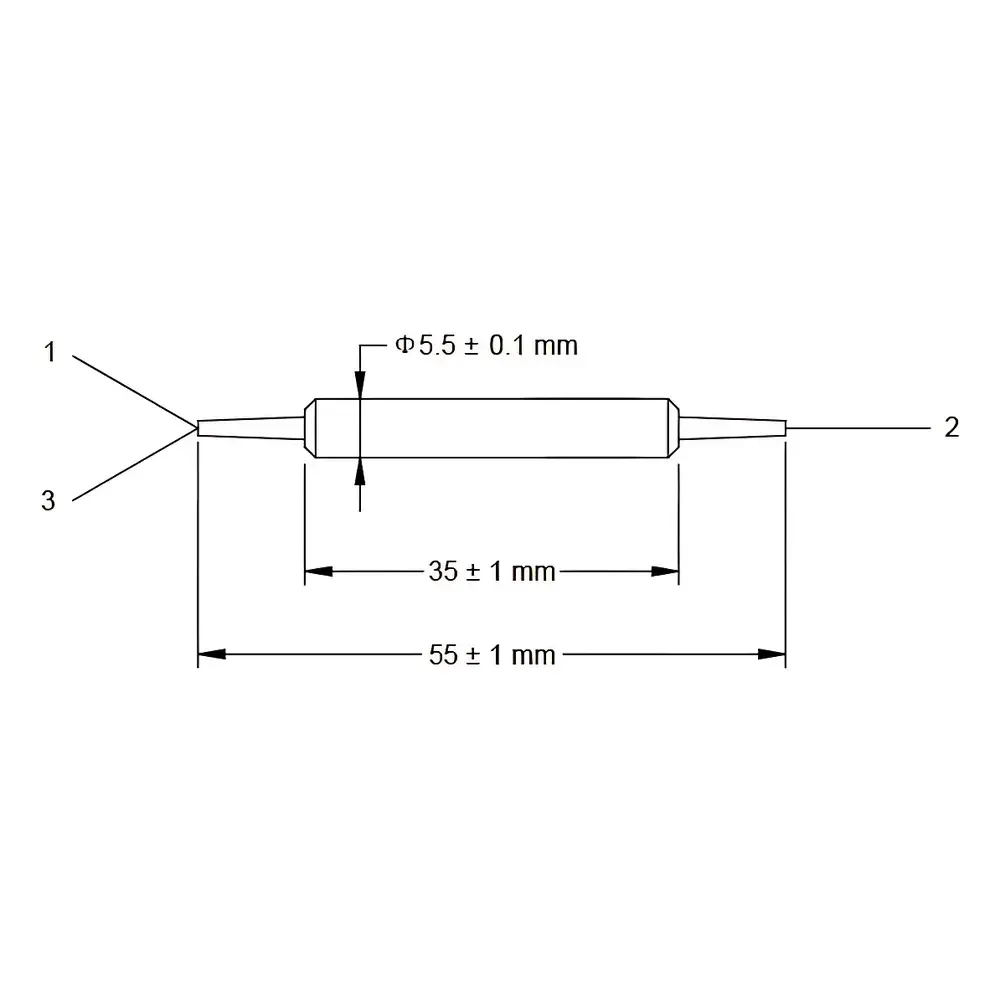
| Package | Φ5.5 × L35 mm cylindrical housing |
| Fiber Options | Panda-type PM fiber (E), 250 µm bare (S), or 900 µm loose tube (M) |
| Connector Options | FC/APC, SC/APC, FC/UPC, SC/UPC |
| Pigtail Length Options | 0.5 m, 0.75 m, 1.0 m |
Overview
The AOE Tech PMOCIR Polarization-Maintaining Optical Circulator is a three-port non-reciprocal photonic device engineered for high-fidelity signal routing in polarization-sensitive fiber-optic systems. Based on magneto-optic Faraday rotation and birefringent crystal interference, the circulator directs light sequentially from Port 1 → Port 2 → Port 3 while suppressing backward propagation with high spectral selectivity and polarization fidelity. Unlike standard single-mode circulators, the PMOCIR preserves the linear polarization state of input light across all ports—critical for applications requiring phase coherence, polarization alignment stability, and minimal modal crosstalk. Its monolithic, epoxy-free optical path design minimizes thermally induced drift and ensures long-term alignment integrity under laboratory and field-deployed conditions.
Key Features
- Polarization-maintaining functionality certified via extinction ratio ≥20 dB (min.) and crosstalk ≥50 dB (min.), ensuring robust suppression of orthogonal polarization modes
- Low insertion loss: 0.6–0.7 dB typical at λc (1310/1550 nm), ≤0.9 dB maximum—optimized for low-noise interferometric and sensing architectures
- High isolation: ≥40 dB minimum at central wavelength; up to 52 dB peak—enabling effective suppression of reflected signals in bidirectional amplifiers and coherent receivers
- Hermetically sealed, compact Φ5.5 × L35 mm stainless-steel package with industry-standard mechanical tolerances for OEM integration into rack-mounted or benchtop optical assemblies
- Qualified for continuous-wave operation up to 300 mW and mechanical tensile load up to 5 N—compatible with splicing, coiling, and vibration-prone environments
- Thermal stability validated over –5 to +70 °C operating range; storage rating extends to –40 to +85 °C without performance degradation
Sample Compatibility & Compliance
The PMOCIR supports industry-standard polarization-maintaining fibers—including Panda-type (PANDA) fiber (ITU-T G.657.A1 compliant) with 125 µm cladding and 80 µm stress-applying parts—and is compatible with both 250 µm bare fiber and 900 µm loose-tube buffered configurations. All devices undergo 100% end-face inspection per IEC 61300-3-35 (fiber connector geometry) and pass IL/isolation sweep testing across ±20–30 nm bandwidths (per ITU-T G.694.2). While not certified to FDA or ISO 13485, the device conforms to RoHS 2011/65/EU and REACH (EC 1907/2006) material restrictions. Documentation includes full traceability of fiber lot numbers, test reports with wavelength-swept IL/isolation curves, and GLP-aligned calibration records upon request.
Software & Data Management
As a passive optical component, the PMOCIR requires no embedded firmware, drivers, or host software. However, its performance parameters are fully integrable into automated test platforms via SCPI-compatible optical switch controllers (e.g., Thorlabs Kinesis, VIAVI T-BERD/MTS platforms) and LabVIEW-based characterization suites. Users may import measured IL/isolation datasets (CSV or .tdms format) into MATLAB or Python (SciPy) for statistical process control (SPC) analysis—including Cpk calculation for batch consistency—and correlation with environmental stress profiles (temperature cycling, humidity soak). Audit trails for calibration and qualification testing comply with GLP principles when maintained in controlled electronic lab notebooks (ELN).
Applications
- Fiber optic gyroscopes (FOGs) and interferometric current sensors requiring stable polarization routing between Sagnac loop arms
- Coherent detection systems—especially dual-polarization QPSK/QAM receivers—where polarization crosstalk must remain below –30 dB
- PM-fiber-based distributed acoustic sensing (DAS) and Brillouin optical time-domain analysis (BOTDA) interrogators
- Optical time-domain reflectometry (OTDR) modules with integrated circulators for enhanced backscatter rejection
- R&D-grade tunable laser characterization setups, where port-to-port isolation prevents feedback-induced linewidth broadening
- OEM subsystems for quantum key distribution (QKD) transceivers requiring deterministic polarization routing without active control
FAQ
What polarization-maintaining fiber types are supported?
Panda-type (E), bow-tie, and elliptical-clad PM fibers with 125 µm outer diameter are supported. Custom stress-applying part geometries require prior optical alignment verification.
Can the PMOCIR be used bidirectionally between Port 2 and Port 3?
No—the device is strictly unidirectional (1→2→3). Reverse operation violates Faraday rotator symmetry and degrades isolation by >25 dB.
Is thermal tuning required during installation?
No. The device exhibits <±0.02 dB/°C insertion loss drift and <±0.15 dB/°C isolation drift within its specified operating range—no active thermal stabilization is needed.
Are custom wavelength bands available beyond 1310/1550 nm?
Yes. AOE Tech offers engineering samples for 1064 nm and 1625 nm upon NDA and minimum order quantity agreement.
Does the device meet Telcordia GR-1209-CORE reliability requirements?
While not formally Telcordia-certified, accelerated life testing (500 hrs @ 85 °C/85% RH, 1000-cycle thermal shock –40/+85 °C) demonstrates compliance with GR-1209 section 4.4 (mechanical and environmental robustness).



