
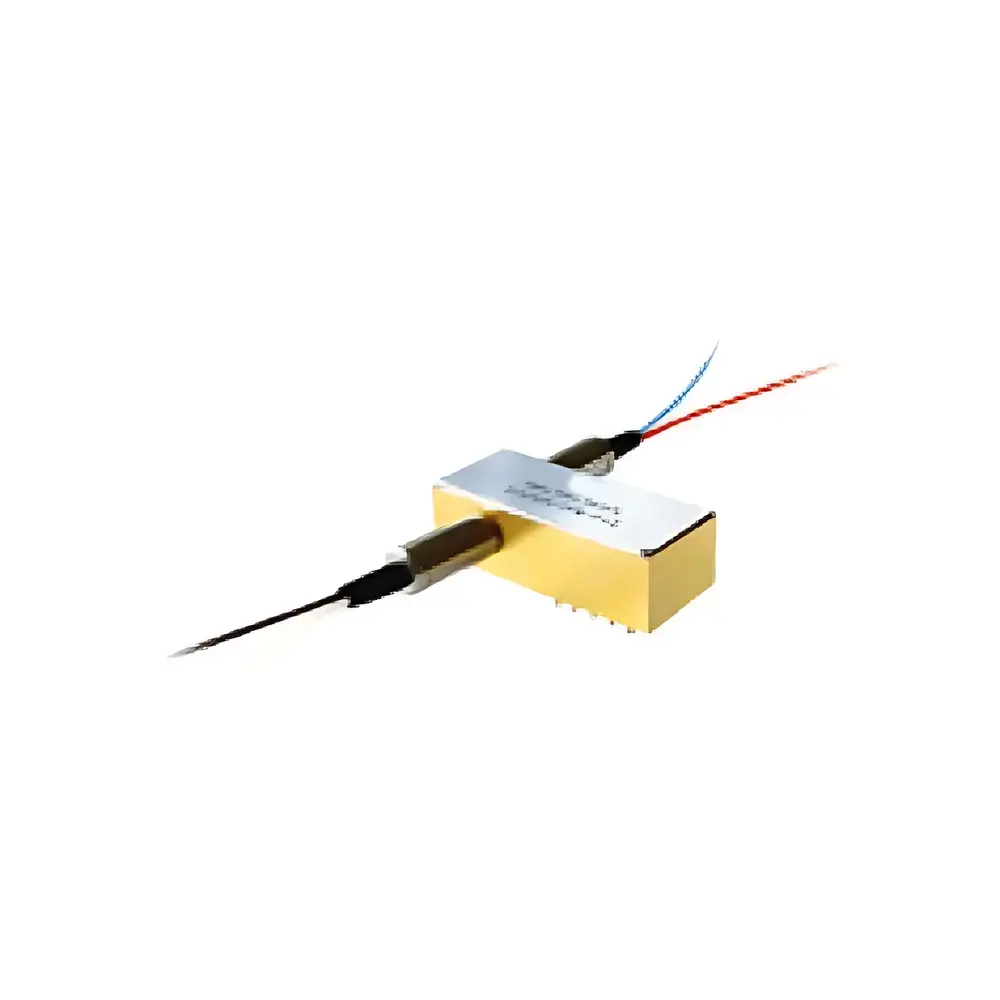
AOE Tech PMOSW Series Polarization-Maintaining Mechanical Optical Switch (1×1, 1×2)
| Key | Brand: AOE Tech |
|---|---|
| Origin | Shanghai, China |
| Model | PMOSW |
| Component Category | Optical Component |
| Wavelength Options | 1064 nm / 1310 nm / 1550 nm |
| Insertion Loss | ≤0.5 dB (Typ. 0.4 dB) |
| Extinction Ratio | ≥20 dB |
| Channel Crosstalk | ≥55 dB |
| Return Loss | ≥55 dB |
| Repeatability | ≤±0.05 dB |
| Switching Time | 10 ms |
| Lifetime | >1,000,000 cycles |
| Operating Voltage | 5 ±0.5 V DC or 5 V pulse |
| Operating Current | <50 mA |
| Fiber Type | PM Panda fiber |
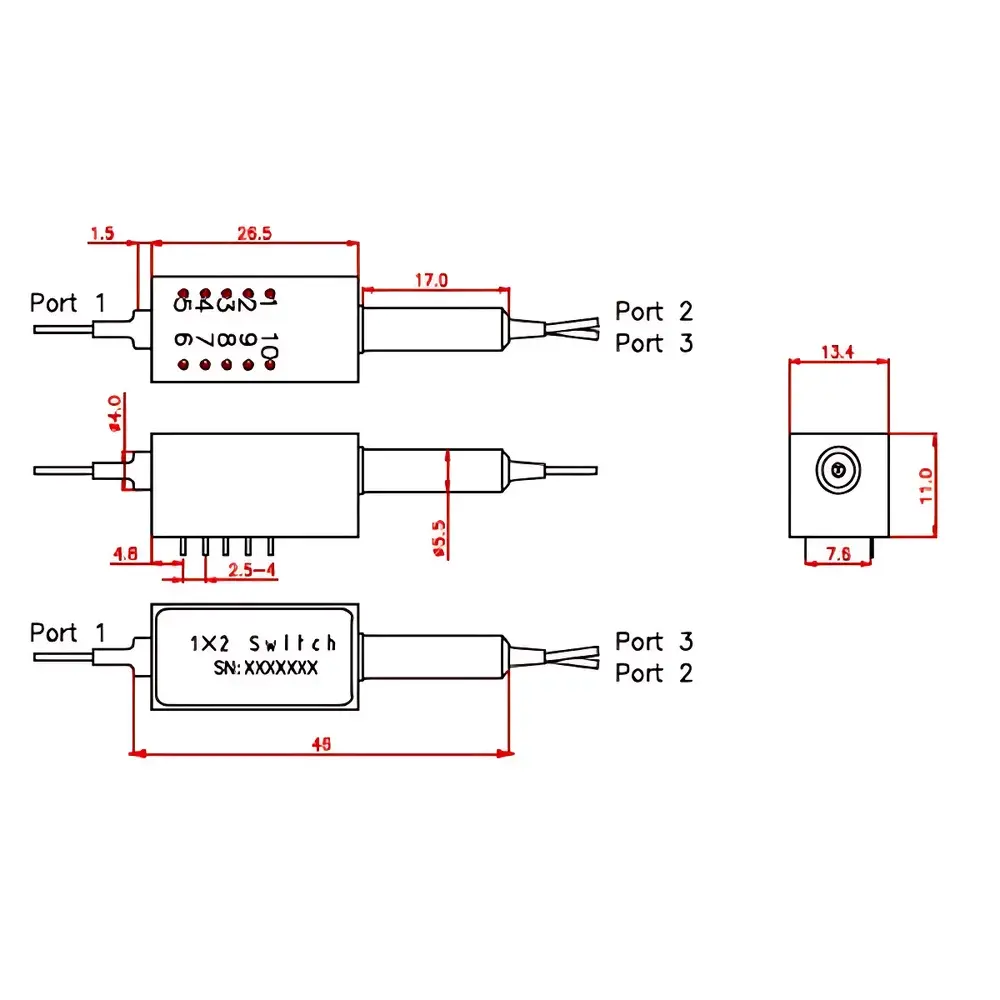
| Package Dimensions | 26.5 × 13.4 × 11 mm (L×W×H) |
| Operating Temperature | −15 °C to +70 °C |
| Storage Temperature | −40 °C to +85 °C |
| Switching Mode | Latching or Non-latching |
Overview
The AOE Tech PMOSW Series Polarization-Maintaining Mechanical Optical Switch is a precision electro-optic component engineered for stable, repeatable routing of polarized light in high-fidelity photonic systems. Based on robust micro-mechanical actuation, this switch maintains the linear polarization state of input light across all operational configurations—critical for interferometric sensing, quantum optics, coherent communications, and polarization-sensitive metrology. Unlike thermo-optic or MEMS-based alternatives, the mechanical architecture ensures zero polarization-dependent loss (PDL), minimal thermal drift, and immunity to electromagnetic interference. The device operates via TTL-compatible electrical pulses applied to designated control pins, enabling deterministic optical path selection between single-input–single-output (1×1) or single-input–dual-output (1×2) configurations. Its all-fiber, epoxy-free optical path eliminates birefringent stress at junctions, preserving extinction ratio and long-term polarization fidelity.
Key Features
- Ultra-low insertion loss (≤0.5 dB typ.) with exceptional repeatability (±0.05 dB) over >1 million switching cycles
- Polarization-maintaining performance validated using PM Panda fiber—extinction ratio ≥20 dB, crosstalk ≥55 dB, return loss ≥55 dB
- Sub-10 ms switching time with latching or non-latching mode options, supporting both continuous DC hold and transient pulse drive
- Compact hermetic package (26.5 × 13.4 × 11 mm) optimized for PCB-level integration in dense optical line cards and test instrumentation
- Wide wavelength compatibility: factory-aligned and qualified at 1064 nm, 1310 nm, and 1550 nm—suitable for telecom, fiber laser, and sensing bands
- Industrial-grade thermal stability: fully specified from −15 °C to +70 °C operating range; storage tolerance up to +85 °C
- Modular pinout architecture with integrated status sensing—enables real-time feedback for closed-loop system control and fault logging
Sample Compatibility & Compliance
The PMOSW switch is designed exclusively for use with polarization-maintaining fibers—primarily 900 µm loose-tube buffered PM Panda fiber (as standard), with customization available for 0.8 m or 1 m pigtails and FC/APC, SC/UPC, LC/UPC, or custom connectors. All optical interfaces are fusion-spliced or angle-cleaved and index-matched to minimize back-reflection and preserve extinction ratio. While not certified to IEC 61300 or Telcordia GR-1209-CORE by default, the device conforms to core mechanical and optical test methods defined therein—including vibration, shock, and temperature cycling per IEC 60068-2 series. It supports GLP-compliant lab environments when integrated into systems with audit-trail-capable controllers (e.g., via RS232 command logging). No hazardous substances are used in manufacturing; RoHS 3 (2015/863/EU) and REACH SVHC compliance documentation is available upon request.
Software & Data Management
The PMOSW operates as a standalone hardware component with no embedded firmware. Control is implemented externally via TTL-level digital signals routed through a standardized 10-pin DIP header (pin assignments documented in the OEM datasheet). For automated test systems, it integrates seamlessly with LabVIEW, Python (PySerial), MATLAB, or C++-based instrument control frameworks using ASCII command sets over RS232 (standard interface included). Optional USB-to-RS232 adapters enable direct PC connection without additional drivers. While the switch itself does not generate telemetry, its status-sensing pins (open-collector outputs) allow host software to verify actuator position in real time—supporting fail-safe sequencing, power-loss recovery protocols, and traceable switching logs required under ISO/IEC 17025-accredited calibration workflows.
Applications
- Dynamic reconfiguration of polarization-encoded quantum key distribution (QKD) channels
- Multi-point interrogation in distributed fiber optic sensing arrays (e.g., Φ-OTDR, Sagnac loop sensors)
- Automatic test equipment (ATE) for PM fiber component characterization—insertion loss, PDL, and extinction ratio mapping
- Redundant path selection in high-reliability free-space optical interconnects and satellite lasercom terminals
- Lab-scale optical circuit prototyping requiring polarization-preserving signal routing between sources, modulators, and detectors
- Protection switching in EDFA-based amplification stages where polarization state must remain invariant across backup paths
FAQ
Is this switch compatible with non-PM fiber?
No. The PMOSW is mechanically and optically aligned specifically for PM Panda fiber. Use with standard SMF will result in significant polarization scrambling and degraded extinction ratio.
Can multiple PMOSW units be synchronized for matrix switching?
Yes. Units support parallel control via shared address lines and individual enable pins. AOE Tech provides reference schematics for cascading up to 128 ports using modular stacking architecture—no proprietary controller required.
What is the maximum optical power handling capability?
The device is rated for continuous-wave (CW) power up to +300 mW at 1550 nm. For pulsed operation (e.g., ns lasers), peak power must remain below 5 W to avoid nonlinear effects or thermal lensing in the collimation path.
Does the latching version retain state during power loss?
Yes. Latching-mode operation uses bistable mechanical memory—zero hold current required after switching. This is essential for fail-safe network protection applications.
Are calibration certificates provided with shipment?
Standard units ship with factory test reports including measured IL, ER, and crosstalk at specified wavelength. NIST-traceable calibration with uncertainty budgets is available as an optional service (lead time +5 business days).




