
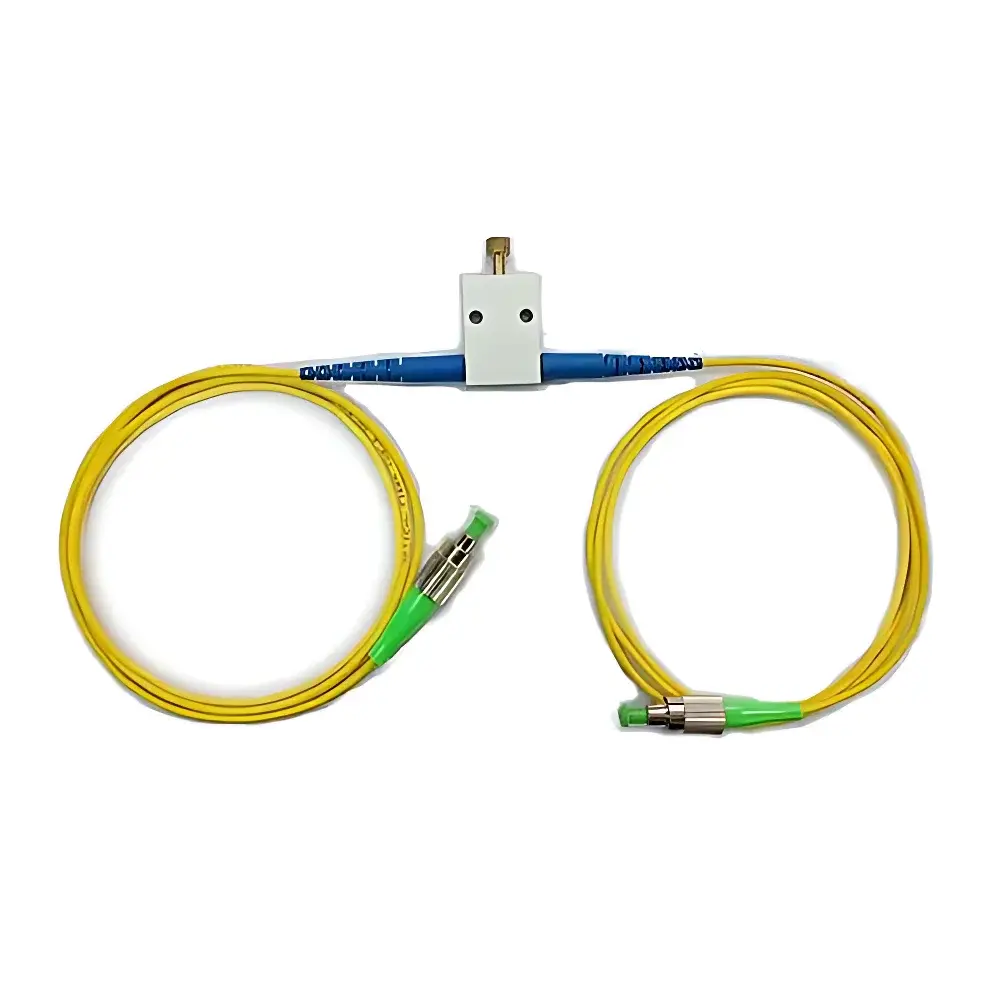
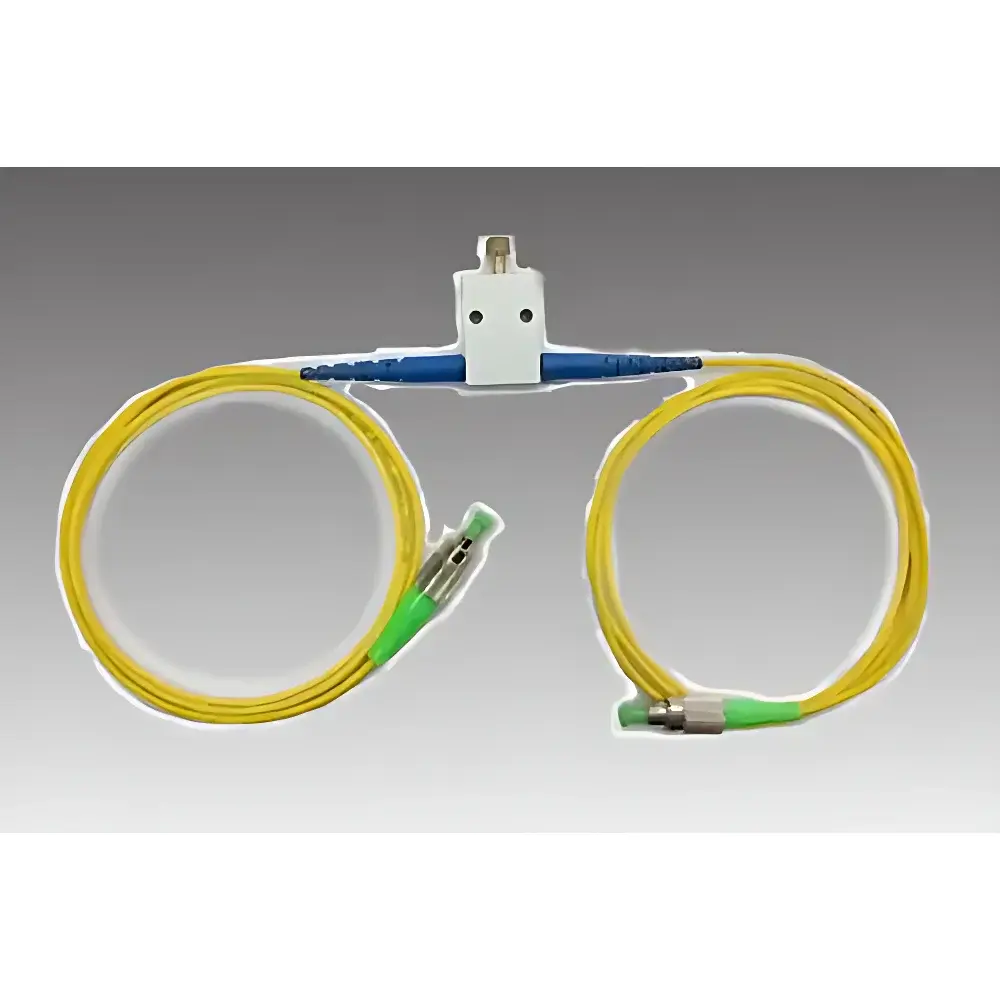
AOE Tech PMVOA Series Polarization-Maintaining Variable Optical Attenuator
| [Brand | AOE Tech |
|---|---|
| Origin | Shanghai, China |
| Model | PMVOA |
| Component Category | Passive Optical Component |
| Wavelength Options | 1310 nm, 1550 nm, 1310/1550 nm, 1064 nm |
| Operating Wavelength Bandwidth | ±20 nm (for dual-band) or ±40 nm (for single-band) |
| Attenuation Range | 0.6–40 dB (1310 nm), 0.8–40 dB (1550 nm) |
| Insertion Loss (Original) | ≤0.6 dB (1310 nm), ≤0.8 dB (1550 nm) |
| Extinction Ratio | ≥20 dB |
| Return Loss | ≥50 dB |
| Fiber Type | Panda-type PM fiber |
| Adjustment Resolution | 0.02 dB |
| Operating Temperature | –5 °C to +70 °C |
| Storage Temperature | –40 °C to +85 °C |
| Package Dimensions (L×W×H) | 26 × 18 × 8 mm |
| Connector Options | FC/PC, FC/APC, SC/PC, SC/APC, or bare fiber (900 µm, 2 mm, 3 mm loose tube) |
| Fiber Length Options | 0.8 m standard, custom lengths available] |
Overview
The AOE Tech PMVOA Series Polarization-Maintaining Variable Optical Attenuator is a precision passive optical component engineered for stable, repeatable attenuation of linearly polarized light in polarization-sensitive photonic systems. Unlike standard VOAs, the PMVOA preserves the input polarization state through its integrated panda-type polarization-maintaining fiber and alignment-optimized internal mechanism—ensuring minimal polarization-dependent loss (PDL) and high extinction ratio across its operational range. It operates on a mechanical variable-gap principle: controlled axial displacement of a precision-aligned fiber pair modulates coupling efficiency while maintaining physical contact integrity and polarization axis alignment. This design eliminates thermal drift-induced polarization crosstalk and supports both manual and electronic control variants (with optional analog voltage or digital interface modules). The device is optimized for use in coherent detection systems, fiber-optic gyroscopes, quantum optics setups, and polarization-encoded communication links where maintaining state fidelity during power scaling is non-negotiable.
Key Features
- High extinction ratio ≥20 dB ensures robust suppression of orthogonal polarization mode coupling
- Low intrinsic insertion loss (≤0.6 dB at 1310 nm; ≤0.8 dB at 1550 nm) minimizes signal degradation in cascaded PM networks
- Exceptional return loss ≥50 dB reduces back-reflection-induced interference in laser cavity and interferometric applications
- Sub-0.02 dB mechanical adjustment resolution enables fine-grained power leveling for calibration-grade measurements
- Hermetically sealed compact housing (26 × 18 × 8 mm) with thermal stability over –5 °C to +70 °C supports integration into space-constrained OEM modules
- Interchangeable termination options—including FC/PC, FC/APC, SC/PC, SC/APC, or bare 900 µm/2 mm/3 mm loose-tube fiber—facilitate system-level compatibility without adapter-induced PDL penalties
Sample Compatibility & Compliance
The PMVOA is qualified for use with industry-standard panda-type PM fibers (e.g., Thorlabs PANDA-1550, OFS PM1550) and maintains full polarization maintenance performance when spliced or connectorized per IEC 61300-3-33 (fiber alignment repeatability) and Telcordia GR-1209-CORE (mechanical reliability). Its optical surfaces meet IEC 61300-2-4 (end-face geometry) and IEC 61300-2-1 (scratch-dig) specifications. While not certified to ISO 17025 or FDA 21 CFR Part 11 as a standalone measurement instrument, the PMVOA’s traceable attenuation linearity and thermal hysteresis behavior (<±0.1 dB over full temperature range) support GLP-compliant optical power management in validated test benches. All units undergo 100% factory verification of extinction ratio, insertion loss, and attenuation repeatability using NIST-traceable optical power meters and polarization analyzers.
Software & Data Management
The manual PMVOA variant requires no software interaction and delivers deterministic attenuation via calibrated micrometer or rotary knob actuation. For electronically controlled versions (PMVOA-E), AOE Tech provides a USB- or RS-232–enabled driver library compatible with LabVIEW, Python (PySerial), MATLAB, and C/C++. Firmware supports IEEE-488.2 SCPI command sets for remote attenuation setting, real-time status query (current attenuation, temperature, fault flags), and programmable ramp profiles. Audit trails—including timestamped setpoint changes, firmware version logs, and calibration expiration dates—are stored internally and exportable in CSV format to satisfy internal QA documentation requirements. Optional integration with enterprise asset management platforms is supported via Modbus TCP gateway modules.
Applications
- Polarization-resolved optical coherence tomography (OCT) source power balancing
- Stabilization of pump-probe ratios in ultrafast fiber amplifiers and parametric oscillators
- Dynamic gain flattening in Er/Yb-doped PM fiber amplifiers
- Power conditioning in fiber-optic current/voltage sensors compliant with IEC 60044-8
- Calibration reference in metrology-grade PM fiber loss measurement systems (per IEC 61280-4-1)
- Signal level optimization in quantum key distribution (QKD) transceivers operating at 1550 nm
- Lab-based polarization mode dispersion (PMD) emulation and compensation validation
FAQ
What is the maximum optical power handling capability of the PMVOA?
The standard PMVOA is rated for continuous-wave (CW) power up to 300 mW at 1550 nm and 500 mW at 1310 nm. High-power variants (PMVOA-HP) supporting up to 2 W are available upon request.
Can the PMVOA be used with 1064 nm lasers in free-space-to-fiber coupling setups?
Yes—the 1064 nm–optimized variant uses AR-coated collimating optics and low-PDL PM fiber pigtails compatible with Nd:YAG and fiber laser sources. Alignment tolerance is ±0.5° for optimal extinction ratio retention.
Is the attenuation value wavelength-dependent within the specified band?
Attenuation is spectrally flat to within ±0.15 dB across the ±20 nm or ±40 nm bandwidths listed in the datasheet, verified by tunable-laser sweep testing.
How does temperature cycling affect long-term attenuation stability?
After 500 thermal cycles between –40 °C and +85 °C, measured hysteresis remains below ±0.05 dB at mid-range settings (10–30 dB), meeting Telcordia GR-1221-CORE accelerated aging criteria.
Are custom connector configurations or fiber lengths available for OEM integration?
Yes—custom pigtails (lengths from 0.3 m to 5 m), specialty connectors (e.g., angled physical contact with 8° polish), and hybrid terminations (e.g., FC/APC input + bare fiber output) are offered under NRE-supported engineering agreements.




