
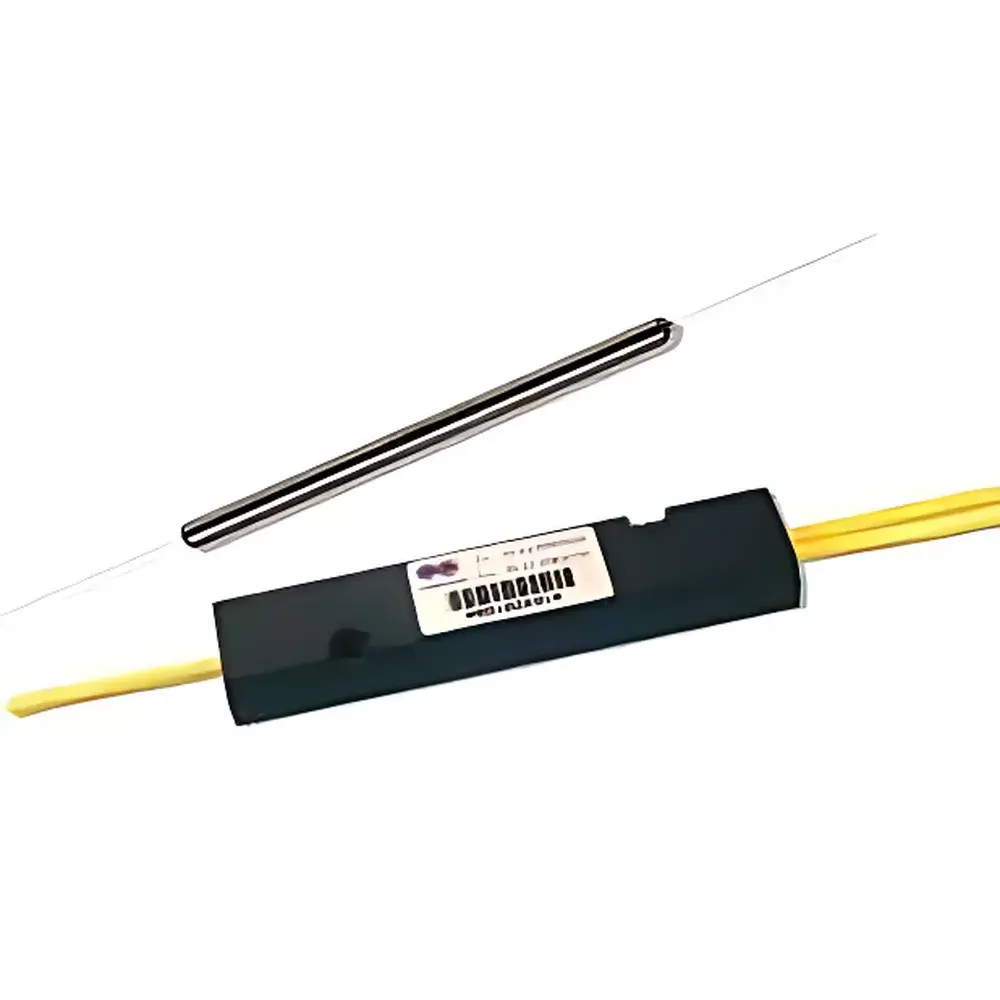
AOE Tech WDM-1550/1625 Single-Mode Fiber Wavelength Division Multiplexer
| Brand | AOE Tech |
|---|---|
| Model | WDM-1550/1625 |
| Operating Wavelength | 1550 ± 5 nm / 1625 ± 5 nm |
| Insertion Loss (Max.) | 0.4 dB |
| Polarization-Dependent Loss (Max.) | 0.15 dB |
| Channel Isolation (Min.) | 13 dB |
| Return Loss (Typ.) | >55 dB |
| Operating Power (Max.) | 5 W |
| Operating Temperature | –40 °C to +85 °C |
| Storage Temperature | –50 °C to +85 °C |
| Package Options | S9 (Ø3×76 mm, bare fiber), S10 (Ø3×92 mm, 0.9 mm loose tube), M3 (7.5×18×100 mm, supports 0.9 mm tube / 2 mm or 3 mm cable) |
| Fiber Type | SMF-28e or custom single-mode pigtail |
| Connector Options | FC/PC, FC/APC, SC/PC, SC/APC, ST, LC, MU, FC/UPC, SC/UPC |
Overview
The AOE Tech WDM-1550/1625 is a passive, fused-fiber-based wavelength division multiplexer engineered for high-performance dense wavelength routing in C-band and extended L-band optical systems. Operating on the principle of evanescent field coupling within thermally fused single-mode fibers, this device enables bidirectional separation and combination of two discrete wavelength channels—1550 nm (C-band edge) and 1625 nm (L-band monitor channel)—with minimal crosstalk and exceptional thermal stability. Unlike active or planar lightwave circuit (PLC)-based alternatives, the fused biconical taper architecture delivers intrinsic polarization insensitivity, low thermal drift (<0.002 nm/°C), and long-term reliability under continuous operation. It is designed for integration into unamplified and amplified fiber-optic links where spectral integrity, power budget margin, and environmental robustness are critical—particularly in legacy infrastructure upgrades, remote fiber monitoring, and hybrid analog/digital CATV networks.
Key Features
- Ultra-low insertion loss: ≤0.4 dB per channel (typical <0.3 dB), preserving system optical signal-to-noise ratio (OSNR)
- Polarization-dependent loss (PDL) <0.15 dB ensures consistent performance across arbitrary input SOPs without external polarization control
- High inter-channel isolation ≥13 dB at both 1550 nm and 1625 nm bands, suppressing adjacent-channel interference in bidirectional architectures
- Return loss >55 dB minimizes back-reflections that could destabilize DFB lasers or EDFAs
- Hermetically sealed metal or stainless-steel housing options (S9, S10, M3 packages) rated for industrial-grade deployment
- Wide operating temperature range (–40 °C to +85 °C) validated per Telcordia GR-1209-CORE and IEC 61300-2-22 thermal cycling standards
- Compatible with ITU-T G.652.D compliant SMF-28e fiber; customizable pigtails and connectorization per application requirements
Sample Compatibility & Compliance
The WDM-1550/1625 is fully compatible with standard single-mode telecommunications fiber (ITU-T G.652.D, G.657.A1), including bend-insensitive variants used in FTTx and data center interconnects. Its mechanical design conforms to IEC 61300-2-1 (tensile load), IEC 61300-2-4 (vibration), and IEC 61300-2-17 (humidity aging) test protocols. While not a medical or safety-critical device, its materials comply with RoHS 2011/65/EU and REACH SVHC regulations. The component meets Telcordia GR-1221-CORE reliability benchmarks for passive optical components, supporting >25-year service life when operated within specified power (≤5 W) and temperature envelopes. No regulatory certification (e.g., FDA, CE marking for EMC) is required for standalone use in Class 1 laser systems per IEC 60825-1:2014.
Software & Data Management
As a passive optical component, the WDM-1550/1625 requires no firmware, driver software, or real-time data acquisition. However, it is routinely characterized during manufacturing using automated optical test stations compliant with IEC 61280-2-9 (WDM device spectral characterization). Spectral response data—including IL, PDL, isolation, and return loss vs. wavelength—is delivered in industry-standard .s4p or .csv format upon request for inclusion in link budget simulations (e.g., OptiSystem, VPItransmissionMaker). Traceable calibration reports (NIST-traceable reference sources) and full spectral scans are available as optional deliverables for GLP-compliant lab environments or vendor qualification programs.
Applications
- Bi-directional CWDM overlay in existing 1550 nm DWDM infrastructure for in-service fiber health monitoring via 1625 nm OTDR probing
- Separation of upstream analog video (1550 nm) and downstream digital data (1625 nm) in hybrid HFC networks
- EDFA gain-flattening and pump-signal combining in L-band amplifiers
- Optical time-domain reflectometry (OTDR) test port injection in passive optical networks (PONs)
- Multi-wavelength sensor interrogation in distributed fiber sensing systems (e.g., Φ-OTDR, Brillouin scattering)
- Lab-scale wavelength routing for tunable laser characterization and interferometric setups
FAQ
What is the typical spectral bandwidth for each channel?
The 3-dB passband width is approximately ±7 nm per channel, optimized for ITU grid alignment and legacy system compatibility.
Can this WDM be used with polarization-maintaining (PM) fiber?
No—this device is designed exclusively for standard single-mode fiber (G.652.D). PM fiber introduces mode-field mismatch and increased splice loss; dedicated PM-WDM variants require custom fabrication.
Is connectorization included by default?
No—connector type, fiber length, and jacketing must be specified at order time using the standardized part-numbering scheme (e.g., WDM00-6-1-P-S9-1-0.75m-FC/APC).
Are spectral specifications guaranteed after connector installation?
All published parameters are measured on bare-fiber or factory-pigtailed units prior to connector attachment. Final system-level performance depends on splice quality and connector return loss.
Does AOE Tech provide custom center wavelengths?
Yes—central wavelengths can be adjusted in 1 nm increments between 1530 nm and 1650 nm, subject to minimum order quantity and additional lead time.




