
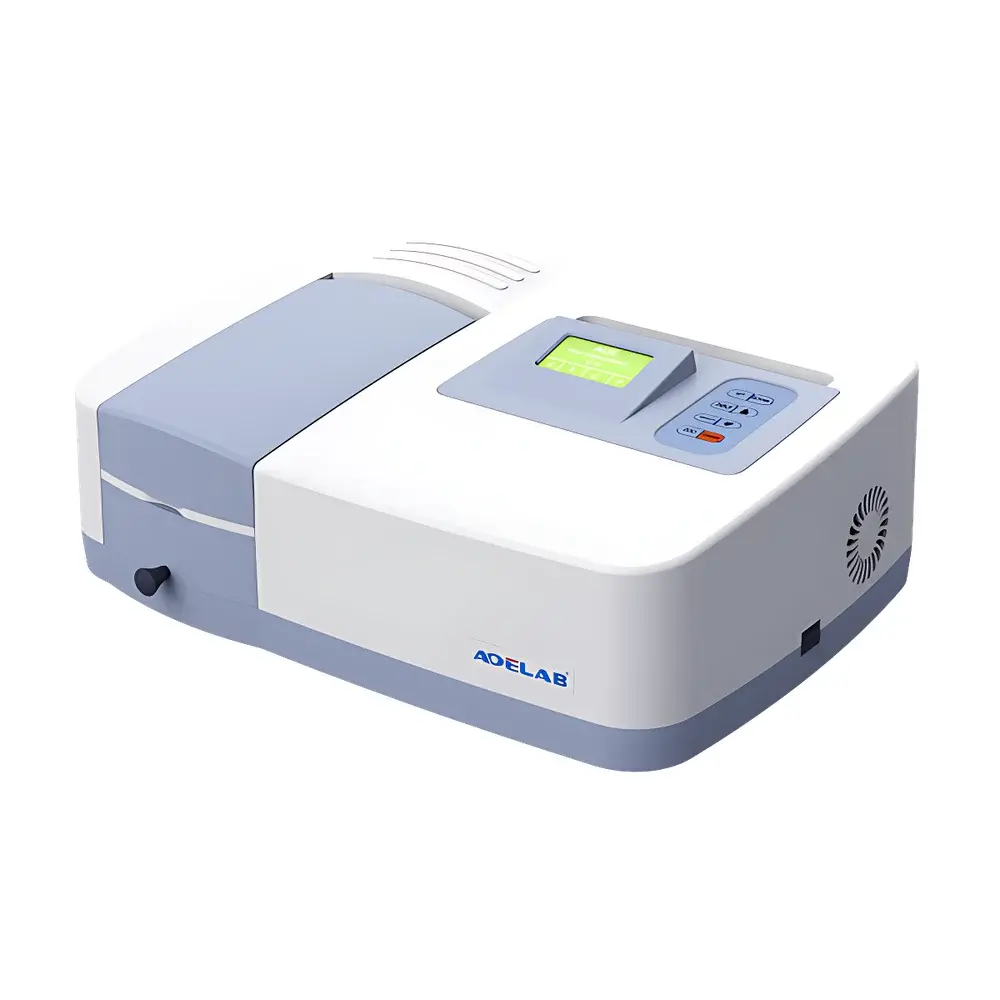
AOE UV-1000 Ultraviolet-Visible Spectrophotometer
| Brand | AOE |
|---|---|
| Origin | Shanghai, China |
| Model | UV-1000 |
| Optical System | Single-beam with dual-beam ratio monitoring |
| Detector Type | Photocell |
| Wavelength Range | 200–1020 nm |
| Wavelength Accuracy | ±1.5 nm |
| Wavelength Repeatability | ≤0.2 nm |
| Spectral Bandwidth | 4.0 nm |
| Stray Light | ≤0.1% T @ 360 nm |
| Display | 128 × 64 dot-matrix LCD |
| Data Output | USB port (U-disk export), RS-232 serial printer interface |
| Software | AOE Basic Spectroscopy Software (certified under PRC Copyright Registration No. 2021SRXXXXXX) |
| Compliance | ISO 9001, CE, CMC, RoHS |
Overview
The AOE UV-1000 Ultraviolet-Visible Spectrophotometer is a precision single-beam optical instrument engineered for quantitative and qualitative analysis of absorbance, transmittance, concentration, and energy across the ultraviolet and visible spectral regions (200–1020 nm). It employs a high-efficiency holographic grating (1200 lines/mm) coupled with real-time dual-beam ratio monitoring to compensate for source intensity drift and detector sensitivity variation—effectively delivering stability and reproducibility comparable to true double-beam architectures without mechanical beam-switching complexity. Designed for routine laboratory environments—including QC labs, academic teaching facilities, and R&D centers—the UV-1000 delivers robust performance in compliance with fundamental spectroscopic measurement principles defined in ISO 6425, ASTM E275, and USP . Its fixed 4.0 nm spectral bandwidth ensures adequate resolution for standard pharmaceutical assays, dye concentration profiling, and water quality parameter validation (e.g., nitrate, phosphate, COD), while maintaining high photometric throughput.
Key Features
- 128 × 64 dot-matrix LCD display with intuitive menu navigation and real-time spectral preview
- Integrated USB host interface enabling direct data export to FAT32-formatted USB flash drives—no PC dependency for basic reporting
- RS-232 serial port supporting connection to standard ESC/POS or thermal label printers for GLP-compliant hardcopy record generation
- Firmware upgradability via U-disk: users download verified firmware packages from the official AOE support portal using the instrument’s unique serial number, ensuring traceable version control and regulatory alignment
- AOE Basic Spectroscopy Software—officially registered with the China National Copyright Administration (Certificate No. 2021SRXXXXXX)—provides validated methods for A/T/C/E mode operation, kinetic scanning, and multi-point calibration curves
- Compliance-certified architecture: certified to ISO 9001:2015 (quality management), CE (EMC & LVD directives), CMC (China Metrology Accreditation), and RoHS 2011/65/EU (hazardous substance restriction)
Sample Compatibility & Compliance
The UV-1000 accommodates standard 10 mm pathlength quartz or glass cuvettes (including matched pairs for reference compensation) and supports optional 5 mm, 20 mm, and flow-cell configurations via accessory kits. It meets essential requirements for method validation under ICH Q2(R2) guidelines when used in conjunction with documented SOPs and periodic verification per ASTM E1655. The ≤0.1% T stray light specification at 360 nm satisfies minimum performance thresholds for UV-based quantitation of aromatic compounds and nucleic acids. All optical components are sealed against ambient dust and humidity, and the instrument housing conforms to IP20 environmental protection standards. Full audit trail functionality—including user login, method selection, measurement timestamp, and result export logs—is implemented in the Basic software to support 21 CFR Part 11 readiness when deployed in regulated GxP environments.
Software & Data Management
AOE Basic Software operates as a standalone Windows application (Windows 7–11, 64-bit) with native support for CSV, TXT, and PDF export formats. It enforces role-based access control (administrator/operator modes), automatic file naming with date/time stamps, and embedded calibration certificate templates compliant with ISO/IEC 17025 documentation expectations. Raw absorbance spectra can be exported for third-party chemometric analysis (e.g., PCA, PLS regression in MATLAB or Unscrambler). Firmware updates preserve all user-defined methods and calibration tables; version rollback is supported via backup archive restoration. Data integrity is reinforced through SHA-256 checksum verification during U-disk firmware loading and internal EEPROM write-cycle redundancy.
Applications
- Pharmaceutical QC: Assay of active pharmaceutical ingredients (APIs) per USP monographs requiring UV quantitation (e.g., paracetamol, aspirin, riboflavin)
- Environmental testing: Determination of nitrate (220/275 nm), phosphate (880 nm via molybdenum blue), and total organic carbon surrogates
- Food & beverage: Color index (L*a*b* derived from spectral reflectance), preservative (sorbate/benzoate) quantification, and enzyme activity (NADH/NADPH kinetics at 340 nm)
- Academic instruction: Beer-Lambert law validation, equilibrium constant determination (e.g., FeSCN²⁺), and spectral deconvolution exercises
- Material science: Thin-film transmittance profiling and bandgap estimation of semiconductor oxides (e.g., TiO₂, ZnO)
FAQ
Is the UV-1000 compliant with 21 CFR Part 11 for electronic records in FDA-regulated labs?
The instrument itself is not inherently Part 11-compliant; however, when operated with AOE Basic Software v3.2+ under controlled IT infrastructure (validated OS, password policies, audit trail review procedures), it supports key elements including electronic signatures, secure login, and immutable audit logs—enabling qualification per internal SOPs aligned with Part 11 Annex A guidance.
What is the recommended calibration frequency for routine use?
Per ASTM E275 and manufacturer recommendations, wavelength calibration should be verified daily using holmium oxide or didymium filters; photometric accuracy should be checked weekly using neutral density filters traceable to NIST SRM 930e. Annual full performance verification is advised.
Can the UV-1000 perform kinetic measurements?
Yes—AOE Basic Software supports time-scan mode with user-defined interval (0.1–60 s) and duration (up to 9999 points), enabling enzyme kinetics, reaction rate studies, and dissolution profile monitoring.
Does the instrument support external PC control via USB virtual COM port?
No—USB is designated exclusively for mass storage (U-disk export); RS-232 remains the sole interface for external device communication, including PC-based SCADA or LIMS integration.
Is the 4.0 nm spectral bandwidth adjustable?
No—bandwidth is fixed by the optical design to ensure consistent stray light suppression and signal-to-noise ratio across the operational range; variable bandwidth systems require slit motorization and are not implemented in this model.



