
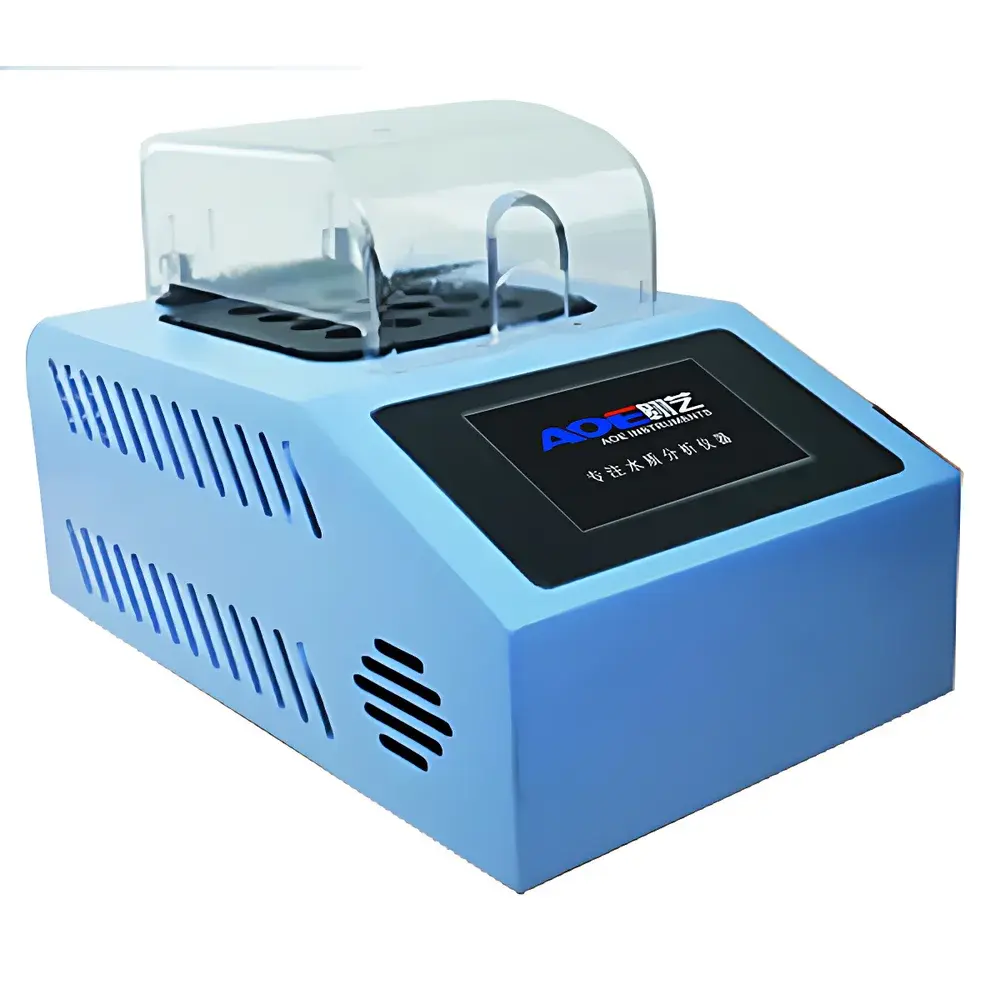
AOE WA653 Multi-Parameter Water Quality Analyzer
| Brand | AOE |
|---|---|
| Origin | Shanghai, China |
| Model | WA653 |
| Instrument Type | Benchtop Laboratory Analyzer |
| Measurement Principle | UV-Vis Spectrophotometry (with Integrated Digestion) |
| Wavelength Range | 190–1100 nm |
| Wavelength Accuracy | ±0.5 nm |
| Photometric Accuracy (Transmittance) | < ±0.5% T |
| Photometric Repeatability | < ±0.2% T |
| Stray Light | < 0.05% T |
| Optical Stability | ±0.002 A/h |
| Detection Limit | 0.01 mg/L (for TN, TP, NH₃-N, COD) |
| Resolution | 0.001 mg/L |
| Measurement Range | Total Nitrogen (TN): 2–15,000 mg/L |
| Total Phosphorus (TP) | 1–10 mg/L |
| Ammonia Nitrogen (NH₃-N) | 0.01–30 mg/L |
| Chemical Oxygen Demand (COD) | 0.02–100 mg/L |
| Measurement Error | TN < ±8%, TP < ±5%, NH₃-N < ±5%, COD < ±5% |
| Digestion Temperature Control | TN: 122 °C ±0.5 °C |
| TP | 120 °C ±0.5 °C |
| COD | 165 °C ±0.5 °C |
| Digestion Time | TN: 40 min |
| TP | 30 min |
| NH₃-N | 10 min |
| COD | 10 min |
| Sample Throughput | Up to 16 samples (TN/TP/COD), up to 20 samples (NH₃-N), with optional expansion |
| Display | 65K-color TFT LCD |
| Data Storage | 40,000 measurement records + 200 preloaded calibration curves |
| Interface | USB |
Overview
The AOE WA653 Multi-Parameter Water Quality Analyzer is a benchtop spectrophotometric system engineered for precise, standardized determination of key water quality parameters—including total nitrogen (TN), total phosphorus (TP), ammonia nitrogen (NH3-N), and chemical oxygen demand (COD)—in compliance with national and international environmental monitoring protocols. It integrates dual-function capability: high-resolution UV-Vis absorbance measurement (190–1100 nm) and thermally controlled digestion for oxidation of refractory nitrogen and phosphorus species prior to colorimetric quantification. The instrument operates on established methods aligned with ISO 11905-1 (TN), ISO 6878 (TP), ISO 7150-1 (NH3-N), and ISO 8467 (COD), supporting method validation under GLP and routine QC workflows in municipal, industrial, and research laboratories.
Key Features
- Integrated 16-position intelligent digester with independent temperature control (±0.5 °C) and programmable ramp-hold profiles for TN (122 °C), TP (120 °C), and COD (165 °C)
- High-fidelity optical architecture featuring double-beam compensation, low-stray-light monochromator (<0.05% T), and photometric stability of ±0.002 A/h over 1 hour
- Pre-validated calibration curves for 200+ common matrixes—stored internally with versioned metadata and user-editable coefficients
- Automated workflow sequencing: digestion → cooling → reagent addition → incubation → measurement → result calculation → report generation
- 65K-color TFT display with intuitive touch-enabled interface supporting multilingual UI (English, Spanish, French, German)
- USB-host interface enabling direct export of raw absorbance data, calibration logs, and audit-ready CSV reports compliant with ISO/IEC 17025 documentation requirements
Sample Compatibility & Compliance
The WA653 accommodates standard 10 mm and 20 mm square cuvettes and supports sample matrices ranging from low-conductivity groundwater (EC 20 mS/cm), provided turbidity is reduced to < 5 NTU via centrifugation or filtration prior to analysis. All digestion and measurement protocols adhere to EPA Method 351.2 (TN), EPA Method 365.4 (TP), EPA Method 350.1 (NH3-N), and Standard Methods 5220 D (COD). Instrument performance verification follows ASTM D5173 for spectrophotometric accuracy and ISO 8466-1 for calibration linearity assessment. Full traceability is maintained via embedded electronic logbooks recording operator ID, timestamp, method ID, digestion batch number, and raw Aλ values per measurement cycle.
Software & Data Management
Data integrity is ensured through built-in audit trail functionality compliant with FDA 21 CFR Part 11 requirements—supporting role-based access control (admin/operator/viewer), electronic signatures, and immutable record retention. The internal database stores up to 40,000 test records with full contextual metadata: sample ID, location code, analyst initials, digestion lot number, reagent expiry date, and uncertainty estimates derived from calibration curve residuals. Export formats include ISO/IEC 17025-compliant PDF certificates, Excel-compatible CSV files, and XML schemas compatible with LIMS integration (e.g., LabWare, STARLIMS). Firmware updates are delivered via signed USB packages with SHA-256 hash verification.
Applications
- Regulatory compliance testing for municipal wastewater treatment plants (WWTPs) under EU Urban Wastewater Treatment Directive (91/271/EEC) and US Clean Water Act discharge permits
- Source water characterization in drinking water utilities assessing eutrophication risk via TN:TP ratio analysis
- Industrial pretreatment monitoring for food processing, pharmaceutical, and textile facilities subject to local effluent limits
- Research-grade nutrient budgeting in limnological and hydrological field studies requiring trace-level NH3-N detection (LOD = 0.01 mg/L)
- Method transfer and validation support for ISO 17025-accredited environmental testing laboratories
FAQ
Does the WA653 meet EPA or ISO method equivalency requirements?
Yes—the instrument’s optical specifications, digestion temperature profiles, and reagent protocols align with EPA Methods 351.2, 365.4, and 350.1, as well as ISO standards 11905-1, 6878, and 7150-1. Full method equivalence documentation is available upon request.
Can the system be integrated into an existing LIMS environment?
Yes—via USB-host data export in standardized CSV/XML formats, with optional middleware support for HL7 and ASTM E1384 message mapping.
What is the recommended maintenance interval for optical calibration verification?
We recommend quarterly verification using NIST-traceable neutral density filters and certified reference materials (CRMs) for absorbance at 254 nm, 400 nm, and 600 nm.
Is the digester module validated for precision across all four target analytes?
Yes—inter-laboratory validation data (n=12 labs) demonstrate RSD < 2.8% for TN, < 1.9% for TP, < 1.5% for NH3-N, and < 2.1% for COD at mid-range concentrations.
How is data security enforced during remote firmware updates?
All firmware packages are digitally signed and verified using X.509 certificates; update execution requires dual-operator authentication and generates an immutable audit entry documenting hash, timestamp, and initiating user ID.
Related Products







